
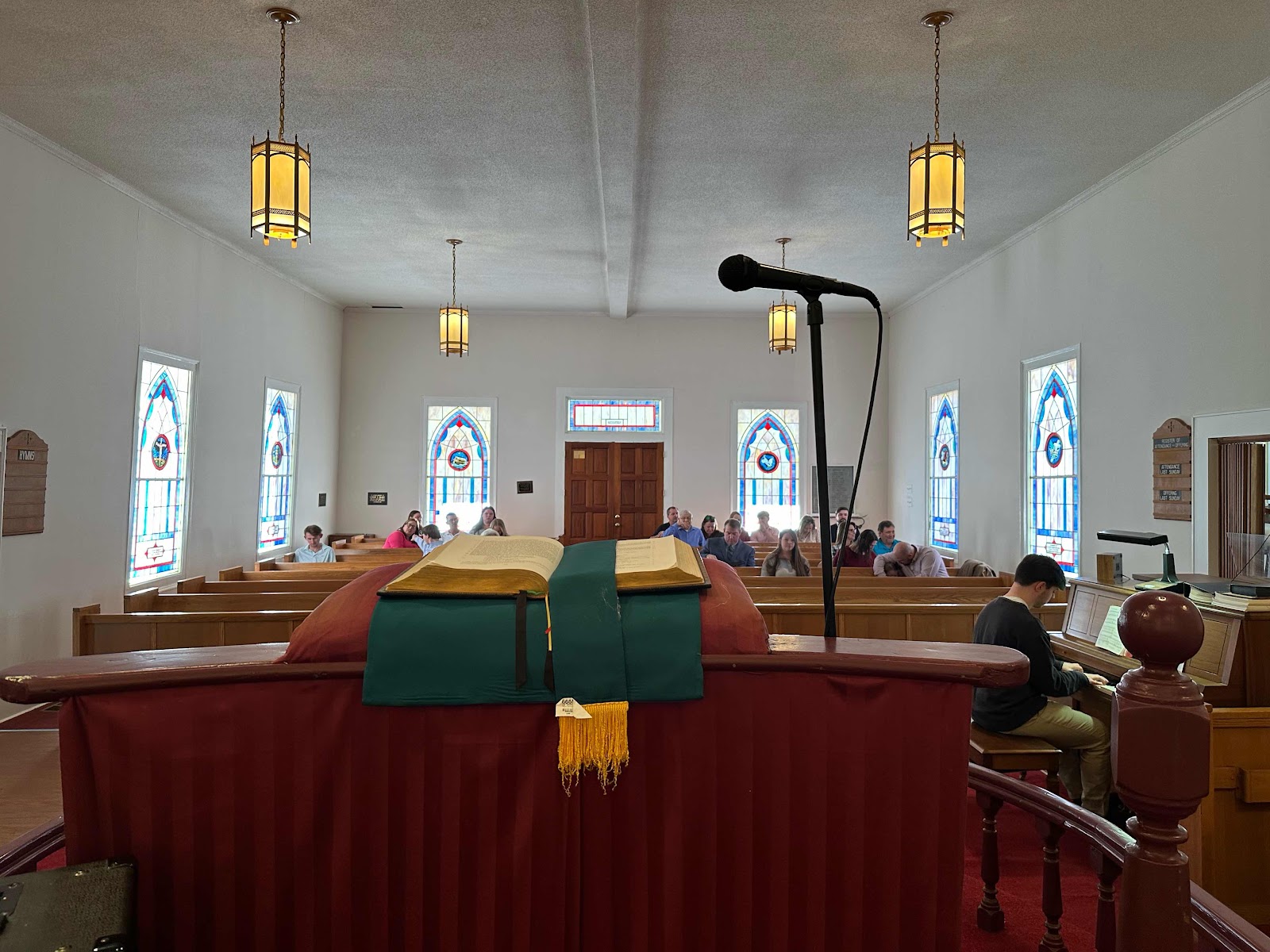
Last Sunday, we began a 7-week sermon series that we are calling, “Dear Timothy.” Our appointed New Testament readings during these weeks take us through the two letters that the Apostle Paul wrote to Timothy.
These two letters are known as “The Pastoral Letters” because in these letters Paul is offering pastoral instructions to young Timothy who is pastoring the church in Ephesus.
Actually, I don’t know why Paul wrote these letters to Timothy. He could have saved a lot of time by simply sending Timothy this website link that says at the top of the homepage:
“Online ordination is fast, easy, and completely free. To become a minister, start by clicking the button below!”
And underneath that link it says that this website will also provide free training information for officiating at a wedding, a baptism, a funeral, starting your own church, and delivering a sermon.
You might have noticed that my sermons have been a little better lately because I clicked on that link.
I like the part from that sermon training link that says, “When speaking on controversial subjects, it is best to tread lightly.” I mean, there is some really good information in there. And a lot of it is free! No 3-year Master of Divinity degree needed! Just click whatever link you need. How easy is that??
Well, it really isn’t that simple which is why Paul is taking the time to write these letters to Timothy. The big advantage that Paul has in instructing Timothy is that unlike these online instant clergy websites, Paul actually knows Timothy pretty well because they have already been in ministry together.
This personal connection between Paul and Timothy goes back to Paul’s 1st of 3 missionary journeys that we can read about in the Book of Acts. During his 1st missionary journey, Paul had founded new churches in Asia Minor which included the cities of Iconium, Lystra, and Derbe.
During Paul’s 2nd missionary journey, he revisits these new churches and meets Timothy for the first time. The other connection is that Paul knew Timothy’s grandmother and mother, Lois and Eunice because they were two of Paul’s first converts from the Jewish community in Lystra. Most likely, Timothy became a follower of Jesus in between Paul’s 1st two missionary journeys.
Paul could see in Timothy a person who would be good to assist him in his missionary journey.
The other reason I think that Paul saw Timothy as a future pastoral leader is because Timothy’s father was a Gentile and his mother was Jewish. Paul knew that God would be able to use him since the good news of Jesus is meant to be shared with both Jews and Gentiles.
As Paul’s trusted missionary companion, he was able to send Timothy to check on the various churches he had founded. We know that Paul and Timothy had a close relationship in these early years of ministry together because in other letters, Paul refers to Timothy as his “co-worker,” as his “son,” as “his child,” and as “his brother.”
Unlike getting trained to be a pastor by reading a couple of articles on the internet, Timothy already knew Paul and served in ministry with him. Timothy has already seen first-hand what is needed to help a church to grow and he also experienced the challenges and the obstacles that can keep a church from living out its faith and mission.
And now years later, Timothy is pastoring a church in Ephesus and Paul is providing him with these two letters of instructions to continue to help him lead his churches.
For Paul’s first instruction to Timothy which we looked at last week, the focus was on setting a culture in the church where all are welcomed and included. And Paul does this by opening his letter to Timothy by emphasizing the overflowing grace and mercy of Jesus Christ.
Setting a culture in which God’s grace is emphasized and where everyone is loved and included is so important because there are many people who feel more judged by the church than they do accepted by the church.
For this week here in chapter two of his letter, Paul reminds Timothy to emphasize prayer in his church. He writes, “I urge you that supplications, prayers, intercessions, and thanksgivings be made for everyone.”
Paul concludes that sentence by adding “for kings and all who are in high positions.” I’ll come back to that specific prayer instruction a little later. For now, I want to focus on the first part of Paul’s instructions to Timothy.
Paul urges Timothy to have a church that offers up prayers of supplication, intercession, and thanksgivings for everyone.
Let’s focus on prayers of supplication. These are prayers in which we are asking God for something. These are probably the most popular type of prayers where we have a need; maybe it’s a need for guidance and direction, maybe we are in need of some type of healing, maybe we are in need of forgiveness for something we have done or left undone.
There all kinds of examples of prayers of supplication.
One of the things I have been working in my own spiritual life is to not minimize my own personal prayer needs. For example, I’m pretty good at praying for others but sometimes, I neglect to include myself in my own prayers.
And when we neglect our own personal prayer needs, we can become spiritually empty. So, to all of you who sometimes forget your own personal prayer needs, Paul is urging us to take time for ourselves as well.
Paul also urges Timothy to have his church offer prayers of intercessions which refer to those prayers that we lift up on behalf of others. Our weekly pastoral prayer during the worship service is an opportunity for us to lift up prayer needs both locally as well as around the world.
We also keep updating our church’s prayer list which reminds us to pray for these persons who are in need of God’s comfort and strength in whatever they may be facing.
Just like it’s important for a church to set a culture of being welcoming to everyone, Paul encourages Timothy to set a culture of prayer in the church as well. And when that culture of prayer is set, people will know the importance of praying for each other.
I was having a conversation one day with a church member who attends another church when her phone started ringing. She said to me, “Sorry, I need to take this call.”
It was an automated call from her church that asked people to pray for someone who was about to have surgery that morning. After she hung up the phone, she bowed her head for about 30 seconds praying for that person who was about to have surgery. After she prayed, we resumed our conversation. This was a great example of a prayer of intercession not just in the middle of the day, but in the middle of a conversation.
And then Paul urges Timothy to have his church offer prayers of thanksgiving. It’s wonderful that we can pray for our own needs as well as the needs of others, but it’s also important that we offer prayers of thanksgiving for our many blessings.
Paul excelled at this in the letters he wrote. He often begins his letters with prayers of thanksgiving. In one of his letters, he abruptly pauses and offers a short prayer of praise and thanksgiving to God and then continues on with his letter. I love how Paul was able to have prayer interrupt his daily work. What’s that hymn writer tell us to do? “Every time I feel the Spirit moving in my heart, I will pray.”
Prayers of thanksgiving aren’t just meant for around the Thanksgiving table in November. They are meant to be prayed throughout the year! God has blessed us in so many ways and prayers of thanksgiving remind us of those blessings.
Paul is urging Timothy to encourage his church to be a church that offers prayers of supplication, prayers of intercession, and prayers of thanksgiving.
Paul adds specific instructions about praying for everyone including kings and all who are in high positions. You read that and you wonder why Paul mentions that specific group of people.
Paul’s big goal was to share the good news of Jesus Christ with the entire world which was governed by the Roman Empire. Even when he was establishing several churches in Asia Minor, he also wanted to eventually share the gospel in Rome and even in Spain.
Paul always had this big picture in mind, this global picture in mind where the good news of Jesus would be shared throughout the world.
In addition to being globally minded, Paul who believed that Jesus was the true king and ruler over all creation also knew that God uses earthly rulers to help hold the world together through their leadership.
The famous 20th century theologian Karl Barth was known to say, “Keep the bible in one hand and your newspaper in the other.”
Barth said this because he believed that in order for God to speak to us through his Word, our faith should always be informed by the events that are taking place in our community, in our country, and throughout the world. If God so loved the world that he gave his only Son, it’s important for us to be aware of the needs of the world that God loves so much.
Paul encourages Timothy to have a praying church, prayers of supplication, prayers of intercession, and prayers of thanksgiving.
In a church I was serving, I was walking down one of the hallways on a weekday afternoon and noticed out of the corner of my eye two of our youth praying together just outside the chapel door.
As I continued walking by, a smile came to my face and I remember thinking, “We must be doing something right.”
No comments:
Post a Comment