A United Methodist Pastor's Theological Reflections

"But thanks be to God, who gives us the victory (nikos) through our Lord Jesus Christ." - I Corinthians 15:57


Monday, August 31, 2020

Sermon (August 30) by Rev. Robert McDowell


     Don’t tell anyone, but I’m sneaking Psalm 23 into our Psummer of Psalms series. This is actually not the designated Psalm reading for this Sunday of the year, but today seemed like the best day to include it.

     Psalm 23 is the appointed Psalm reading during the spring on what is called “Good Shepherd” Sunday. On that Sunday, Psalm 23 is paired with the Gospel reading for that day which is where Jesus says that he is the good shepherd who cares for his sheep. 

     I just had to include this psalm during this series because it is a favorite psalm for many of us. We have often seen this psalm as a peaceful psalm with it’s image of still waters and green pastures, but it’s actually more of a psalm about protection and security. The psalmist is writing this psalm with danger close at hand.

     We can divide the psalm into two main sections. And by the way, this is a very short psalm, just six verses long. 

     The first section, verses one through three, give us the beautiful image of the Lord as our shepherd. The psalmist tells us that this shepherd is able to lead us, restore us and provide for us even in the darkest situations we face in life because he is never far away.

     Notice how the psalmist shifts from facing the threat of the valley of the shadow of death, also translated as “darkest valleys” to a more positive image of a banquet! That shift happens in verse five. “You prepare a table before me.” 

     And by the way, it’s so hard for me to not say this phrase the way the King James Version beautifully states. “Thou preparest a table before me.”

     This psalm which begins with the image of a shepherd and a pasture moves into a different image of being in a house that includes a banquet. It’s like the psalmist is saying, “Yes, God is present with us when we are out in the open space of green pastures, but our truest security is when we are in God’s house for worship.” This is the place of ultimate security for this psalmist. 

     I’ve been thinking about this a lot in preparing for this Sunday since we have been away from our physical house of worship for the past several months. So many of you have shared with me how our online worship services have helped you to sense that security during this time of physical separation from one another. Whether we are here in our sanctuary or watching on a computer while still wearing our pajamas, weekly worship has a way of offering a sense of peace and security.

     Another aspect of this psalm that I find interesting is that this image of the Lord as our shepherd is actually a frequent image throughout the psalms. I counted seven other psalms that describe God as our shepherd.

     Psalm 28 says, “O save your people, and bless your heritage; be their shepherd, and carry them forever.”

     Psalm 77 says, “You led your people like a flock by the hand of Moses and Aaron.”

     Psalm 78 says, “Then he led out his people like sheep, and guided them in the wilderness like a flock.”

     Psalm 79 says, “Then we your people, the flock of your pasture, will give thanks to you forever.”

     Psalm 80 says, “Give ear, O Shepherd of Israel, you who lead Joseph like a flock!”

     Psalm 95 says, “For he is our God, and we are the people of his pasture and the sheep of his hand.”

     Psalm 100 says, “Know that the Lord is God. It is he that made us, and we are his; we are his people, and the sheep of his pasture.”

     Psalm 23 reminds us that the Lord, our shepherd will provide for all our needs, will give us rest when we get tired, and will guide and protect us along our journey in life. I love how the psalmist also emphasizes that the Lord, our shepherd is also our gracious host by preparing a feast for us that includes an overflowing cup. 

     This is an image that reminds us of God’s amazing grace. God’s grace is overflowing and abundant, like a great banquet spread of plenty of food and drink. We have more than we can possibly need because the Lord is our shepherd.

     The other powerful part of this psalm is in how it concludes. “Surely goodness and mercy shall follow me all the days of my life, and I shall dwell in the house of the Lord my whole life long.”

     The thought here is that the enemies and the threat of danger that are pursuing the psalmist, are no longer a cause for fear because of God’s protection and overflowing blessings. And I love the very creative way the psalm concludes by saying that instead of enemies following him, the psalmist can look back and instead see “goodness and mercy” chasing after him. 

     I had an Old Testament professor tell us in seminary that a better phrase than our translation that says, “goodness and mercy shall follow” would be the phrase, “goodness and mercy shall CHASE me.” 

     What a powerful theological thought from this Psalmist. God’s goodness and mercy is chasing us down. This idea of God’s loving chasing after us is at the center of John Wesley’s understanding of grace in how in any given moment, God’s grace is being extended to every single person. 

     Even when we have no thought of God, God is still reaching out to us and pursuing us with goodness and mercy. And all we need to do is to be open to receive God’s grace. And this grace never runs out. Our cup is always overflowing.

     One of the ways the coronavirus has been described is that it is an invisible enemy. As I think about that way of describing this virus, I also think about other invisible enemies we face from time to time, invisible enemies like fear of the future and things from our past that still haunt us.     

     Our invisible enemy might be our own self-doubts and unnecessary worry that keeps us awake at night. Like the psalmist, we too can have our share of visible as well as invisible enemies. The good news that the psalmist wants us to know is that as we face these enemies, take heart. The Lord is our shepherd, we shall not want.

     About ten years ago at a church I was serving, I officiated for the funeral of an elderly church member. She didn’t have a lot of surviving family members, but her brother who drove up from South Carolina met me at the church to help me prepare for the funeral service.

     He was really nice and told me a lot about his sister. And then I asked him if there was any particular scripture that he wanted me to read during the service. And he said to me, “Yes, my favorite scripture is Psalm 23. I’d like you to read that during the service. It has special meaning for me.” And so I asked him what he liked about this psalm, and he told me the most amazing story.

     He said that he was in his hotel room in Philadelphia many, many years ago. He said that he couldn’t get to sleep because he was feeling very nervous and anxious that night. He said that he opened the nightstand drawer in his hotel room and found a bible. He opened it to Psalm 23 and after he read it, it really helped him to feel at peace and he was able to get to get a full night of sleep so he was ready to go in the morning. 

     But he wasn’t done with his story. He said that the reason he was nervous was because he was the starting pitcher for a baseball game the next day. And he said that he ended up pitching one of his best games he ever pitched. He said that they beat the Philadelphia Phillies and he was able to strike out Richie Ashburn to help win the game.

     And it was at that point when I said, “Excuse me? What did you say? You were a major league pitcher?”

    To make a long story short, I discovered that I was talking to Jim Waugh who was a starting pitcher for the Pittsburgh Pirates in the 1950’s. He grew up in Lancaster, Ohio. And he told me that he had the record for being the youngest pitcher to win a game for the Pittsburgh Pirates when he was just 18 years old.  Joe Garagiola was the catcher for that game. And he said that’s why Psalm 23 has so much meaning for him. It helped him to know that the Lord was his shepherd and he didn’t have anything to fear. 

     Just one month after that funeral for his sister, I read the sad news that Jim also passed away down at his home in South Carolina. The Lancaster newspaper had a nice article about his life and career. While the article focused on his life as a Major League Baseball player, I will remember him more as someone who learned to trust in the Lord as his shepherd, and who came across this psalm one night in his hotel room many years ago.

     This psalm reminds us that enemies, both visible and invisible may chase after us, but they are no match for God’s goodness and mercy that pursue us all the days of our lives. We can always find our security in the Lord who is our shepherd. He is the one who leads us to green pastures, still waters, and a banquet table filled with all that we need. 

     When you are feeling the anxiety of beginning a new year of school, remember that the Lord is your shepherd. When you are anxious about what the future may hold, remember that the Lord is your shepherd. When you find yourself all alone in a hotel room and you just can’t get to sleep, remember that the Lord is your shepherd. When a virus continues to cause fear and uncertainty, remember that the Lord is your shepherd.

     When one of my uncles died several years ago, my family asked me to read this Psalm during the funeral service which was held in northern Maryland near where he lived. My uncle was a farmer all his life and that small country church was packed with other farmers and their families. I began reading this Psalm like I usually do, using the King James Version which is the common way this psalm is read and the way most of us have learned it.

     And so I started reading it, “The Lord is my shepherd; I shall not want. He maketh me to lie down in green pastures.” 

     And I just stopped reading it after that first line because I realized in that moment that Uncle Bill’s whole life was about spending time in green pastures on his farm. I think people were wondering if I was OK because I just stood there for a few moments thinking about that line from Uncle Bill’s perspective

     I say this because maybe we need to take our time whenever we read this short psalm. Even if we know it by heart, read it like you are reading, or I should say, praying it for the very first time.

     And as you pray this psalm and savor each verse, may God’s goodness and mercy chase after you all the days of your life and may you dwell in he house of the Lord for ever.

A Psummer of Psalms: Psalm 23
Sermon Discussion Questions
Psalm 23
August 30, 2020 

Psalm 23 is considered by many to be their favorite psalm. It’s only six verses but it offers very rich imagery in describing how the Lord is our shepherd.

What do you appreciate most about this psalm? How has it helped you to have a deeper prayer life?

Psalm 23 can be divided in two sections. The 1st section, verses 1-3 describe the Lord who as our shepherd, leads, guides and protects us even through the “darkest valleys.” The 2nd section, verses 4-6 uses the image of a banquet and how God’s abundant goodness and mercy are always following after us. The psalm is categorized as a psalm of protection because it mentions the threat of “enemies.”

What are some “enemies” that we face from time to time? (Enemies do not necessarily need to refer to human enemies.) How has God protected you from enemies?

Pastor Robert shared a story of someone who said how Psalm 23 helped him in facing the invisible enemy of his own self-doubts and anxiety. He stumbled upon Psalm 23 one night before bed, read it, and he was able to get a good night’s sleep, knowing that the Lord would lead and guide him through a challenge he was facing the next day.

What are some ways that you keep the Bible and psalms like this close by when you are facing an anxious and challenging time in your life? 

Sometimes, it can be helpful when reading a psalm, to pause at phrase or verse that is speaking to you in that moment, and reflect on how God is reaching out to you as a loving shepherd.

Go ahead and read Psalm 23, pausing wherever you sense God is speaking to you the most.

Sunday, August 30, 2020

Online Worship (August 30) Athens First UMC


Welcome to our (August 30) online worship!
Athens First UMC!
2 S. College St., Athens, OH 45701

Wednesday, August 26, 2020

Monday, August 24, 2020

Sermon (August 23) by Rev. Robert McDowell


   Today’s featured psalm, Psalm 124 is the third “psalm of ascent” that we have looked at during our summer series on the Psalms. This psalm, along with thirteen other “psalms of ascent” were the hymns that would have been sung by the Jewish people during their long festival pilgrimages to the city of Jerusalem three times each year.

     These psalms not only helped to make the time go faster, the lyrics of these songs also reminded them of God’s faithfulness and would have helped them to remember the reason why they were making this long pilgrimage which was to gather from all parts of the world and worship together. 

     Notice that Psalm 124 is a very communal psalm. It calls upon Israel to recount God’s faithfulness and the psalm ends with that powerful verse that proclaims, “Our help is in the name of the Lord, who made heaven and earth.” “Our help,” not just “my help.”

     In addition to this being one of Israel’s traveling psalms, it has also been known as a psalm of thanksgiving. It is known as a psalm of thanksgiving because it begins by talking about an event in the past in which Israel had been threatened by an enemy. It then goes on to celebrate how God saved them from their time of trouble, helping them to escape.

     This is why this psalm is paired with our Exodus scripture reading for this morning. Our Exodus reading is the story of how the new king of Egypt started to oppress the Jewish people because they were becoming too numerous. We are told that Pharaoh became increasingly ruthless in how he treated them and forced them to do hard labor.

     The Pharaoh went so far as to instruct the Egyptian midwives who helped the Hebrew women who were giving birth to kill all the newborn male children at birth. But as we are told in our Exodus scripture reading, the midwives feared God and did not do as they were commanded. They spared the Hebrew newborns.

     And this leads to the story of how Moses was spared when the daughter of Pharaoh noticed a basket in the river containing a baby and she saved the child. This is how our Exodus scripture reading ends, but we know that Moses would be the one God would use to deliver the Israelites from slavery in Egypt to the Promised Land.

     As I said, this story about Moses is paired with our Psalm reading for today because the Psalm begins by saying if it had not been the Lord who was on our side, we wouldn’t have been saved. But this Psalm isn’t only about that big event when the Lord called upon Moses to deliver his people from Egypt into the Promised Land. This psalm could refer to many other events as well. And it can also speak to us on a more personal level in how God has rescued us from times of adversity.

     Which brings me to this thought about the Psalms and any scripture reading for that matter. When we approach any scripture passage, I think its helpful for us to remember two things. The first thing is to think about what that scripture reading meant in its original context to the people who first heard it. And the second thing that I think is important is to think about how God might be using this text to speak to us.

     So when we read Psalm 124, it’s good to keep in mind that this psalm is probably thinking about Moses and the Exodus story or maybe even another story in which Israel was threatened by a surrounding enemy, maybe a situation that happened to them well after they made it into the Promised Land. That’s why bible study is so important. We need to think of what was in the mind of the Psalmist when he or she was writing these words.

     But it’s also important for us to realize that the scriptures are a living word and is an important way in how God communicates with us today. And in the case of Psalm 124, it’s good to ask ourselves, what challenges and adversities have I faced in my life that have led me to say like the Psalmist, “If it had not been the Lord who was on my side…” And you fill in the blank from there.

     This is how the Psalms, ancient as they are can still speak to us today, where we first think what they most likely meant in their original context and how they might speak to our own day and age. That approach to the Bible helps us to not take the scriptures out of context and it also reminds us that God has a word for us today as well.

         How would you fill in that first line of this psalm? “If it had not been the Lord who was on my side…I don’t know how I would have made it through college.” 

     “If it had not been the Lord who was on my side…I don’t know how our church would have remained strong during a global pandemic.” 

     “If it had not been the Lord who was on my side…I don’t know how I would have cared for my elderly mother.”

     “If it had not been the Lord who was on my side…I don’t know how I would have made it through the divorce.”

     “If it had not been the Lord who was on my side…I don’t know how I would have survived my job loss.”

     What comes to mind when you think about completing that sentence which is really a statement of faith?

     This is how we make the psalms our prayers. We respect what it might have meant to the original author and then we allow that psalm to become our prayer as well.


     Several years ago, I was standing with my associate pastor in a hallway of one of the top floors of Dayton Children’s Hospital. We were there to visit a family in our church whose young child was there as a patient.

     As we were waiting to go into the hospital room to make our pastoral visit, my associate pastor was standing over by the large window that was overlooking the city of Dayton. And he was staring out that window. I said, “Mark, everything OK?”

     He said, “This was the same window I was looking out about 18 years ago when our daughter was a month old.”

     He went on to tell me that when she was a month old, she developed a really high fever and couldn’t keep any formula down, so they took her to Children’s Hospital. They took tests and discovered that when she was born, her organs were not in the right places. She was now experiencing a bad infection from all of this. They needed to do a risky surgery because she was just a month old. 

     And my friend said that when they took his baby into surgery, he went by that window where he was now standing to call his parents to  give them an update. And as he was on the phone with his parents, that’s when he experienced a God moment, or what we call, a “thin place” moment.

     As he was looking out that window on that cold February day, he noticed the beautiful Ukrainian Church there in the city of Dayton. And just then in that moment, the sun came out and hit the gold cross of that steeple in such a way that it was breathtaking. He felt God’s presence in such a powerful way. He said, it was in that moment that he knew that Allie would be OK.

     And then he said that during the surgery, his wife stayed in the room while he went down to the cafeteria to get something to eat. And while his wife was in the room, a little girl who was a patient came into the room with a balloon on a stick. She handed it to her and said, “You’re baby will be OK.”

      Their baby made it through the surgery and recovered completely. When my friend and his wife went to look for that little girl who had brought them the balloon, they couldn’t find her. His wife to this day believes that that little girl was sent from God just for her.

     It was this incredible challenge that led my friend and his wife to begin attending church again. They joined the United Methodist Church in their neighborhood and it was through that church that my friend ended up receiving a calling to go into the pastoral ministry. 

     To add one more detail to the story, I had the honor of officiating at his daughter’s wedding several years later and our families stay in touch.

     If it had not been for the Lord who opened up the skies to shine upon that Ukrainian church steeple and who sent that little girl with a balloon into the room, and who used the skills of that surgeon…they would probably not have been led to a deeper faith and trust in God.

     No wonder my friend was looking out that window that day there at Children’s Hospital. He was remembering how the Lord was by their side during a very challenging time in their lives. I don’t know what was going through his mind in that moment. But my guess is that it had some kind of connection with how Psalm 124 concludes. 

     “Our help is in the name of the Lord, who made heaven and earth.”

     I love how the Psalmists invite us to look back on our lives so we can remember how God got us through some troubling times. That’s what helps us to face new challenges. We look back and see how God has guided us through the storms and the floods that we have experienced.

     Whether it would be starting a new semester. Learning new ways of adapting to the coronavirus. Beginning a new job. Facing a medical challenge. Experiencing stress in a relationship. Being fearful of the future. These are all challenges we face from time to time. 

     Psalm 124 might be a prayer for you. Remember the story of Moses and how God rescued his people from slavery and led them into the Promised Land. Look out that window and remember how the sun lit up that church steeple at just the right time. Remember the little girl who gave you the balloon and said, “everything’s going to be alright.”

     And remember, whatever you may be facing, our help is in the name of the Lord. 
     
     A Psummer of Psalms: Psalm 124
Sermon Discussion Questions
Exodus 1:8-2:10 & Psalm 124
August 23, 2020 

Psalm 124 is known as a “psalm of ascent.” These psalms were used by the Israelites when they made the long journey from their homes three times a year to celebrate religious festivals in Jerusalem. Notice that Psalm 124 is a communal psalm. The psalmist says, “Our help is in the name of the Lord.”

What helps you to remember that our faith isn’t just about our personal relationship with God? How do other Christians remind you that “our” help is in the name of the Lord?

The psalm is paired with our Genesis scripture reading which describes the time when Pharaoh sought to have all the male Hebrew children killed. Thanks to the daughter of Pharaoh, one of those Hebrew children who would eventually lead the Hebrews out of slavery was spared. Psalm 124 invites us to reflect on times when God has rescued us and helped us overcome a difficult challenge we were facing.

Share a time when the Lord helped you through a difficult challenge you were facing. 

Pastor Robert shared the story of his friend who’s one month baby needed surgery several years ago. He and his wife weren’t church goers at the time, but they still prayed for their little girl. They ended up experiencing God’s presence during that very difficult time through several “thin place” moments at the hospital. Their baby ended up having successful surgery. That experience led them to start attending a United Methodist Church in their neighborhood and they continue to grow in their faith.

Share a “thin place” moment where you experienced God’s presence.

How would you complete this first part of the psalmist’s prayer? “If it had not been the Lord who was on our side...”

Close by offering this prayer of thanksgiving: 

Maker of heaven and earth, we come today from different places along our faith journey. Some of us are feeling settled and secure while others are facing fear and uncertainty. Thank you for this place of haven and peace where all are welcome here. Forgive us for those times when we have not turned to you in times of need and for when we have forgotten to give you thanks and praise for guiding us through the storms of life. Today, we join the Psalmist in exclaiming, “Our help is in the name of the Lord, who made heaven and earth.” Amen.

Sunday, August 23, 2020

Online Worship (August 23) Athens First UMC


Welcome to our (August 23) online worship!
Athens First UMC!
2 S. College St., Athens, OH 45701


Wednesday, August 19, 2020

Monday, August 17, 2020

Sermon (August 16) by Rev. Robert McDowell


    Last Sunday, we focused on Psalm 105 which feels like it goes on forever because it summarizes Israel’s early history with story after story. That psalm needs to feel long because it is reminding us of how God has been faithful in the past. 

     But just like sermons, not every psalm needs to feel long or go on and on, like for example, today’s psalm, Psalm 133. Psalm 133 only has three verses compared to last Sunday’s psalm that had 45 verses.

     Of the 150 psalms, Psalm 133 is one of only three psalms that has three verses. Trivia question time: Which psalm has the shortest number of verses? Psalm 117 which only has two verses. 

     So why is Psalm 133 so short? I think it has something to do with it being one of the psalms of ascent. Three  weeks ago, we were introduced to a psalm of ascent, Psalm 128. Psalms of ascent were known as psalms you would sing as you were making the long journey from wherever you live up the long slope toward the city of Jerusalem where the Jewish Temple was located to attend one of the 3 big religious festivals. Those pilgrims would literally ascend for many miles during their long journey before finally arriving into the city. 

     People would have traveled together during those long journeys and the singing of these psalms of ascent was a way for people to not just fill the time, but to remind them where they were headed, Zion, the beautiful city of God. One of our hymns in the hymnal, in fact the very last hymn is a modern day hymn of ascent called, “We’re marching to Zion.” That’s an example of a hymn where the lyrics help you to feel like you are on a journey.

     Psalm 133 is one of fourteen of these psalms of ascent that we find in the Book of Psalms. And by the way, all fourteen of these psalms of ascent are grouped together from psalm 120 to psalm 134.

      The reason the people would sing this psalm during a pilgrimage to Jerusalem is because of two reasons. First of all, it refers to Jerusalem which was the location of the Temple where all of Israel was called to worship during three annual festivals.

     And secondly, this psalm focuses on the goodness and blessings of people living together in unity. This would have been an important focus for those singing pilgrims because the people of Israel were divided into several different tribes scattered throughout the Middle East region. 

     Even though they shared the same religious faith, the Jewish faith, they also represented many different cultures and customs, so there would have been a lot of differences between them. This psalm of ascent as it would have been sung over and over again served as a great reminder of what they had in common in spite of their differences which was their faith and trust in the Lord. So this Psalm in particular was a way to remind the people that together, they were God’s people.

     In the back of our hymnal, you will find a big section called, The Psalter. These are several psalms that appear in our weekly scripture readings that are accompanied by a short refrain that is sung in between the responsive readings. Some of those refrains are taken from familiar hymns while others were composed by church musicians. 

     The lyrics of those sung refrains reflect the theme of each psalm. For our Psalm today, Psalm 133, the words of the refrain are, “Unite us, Lord, unite us us by your everlasting love.” When the Israelites sung this psalm on their long journey to Jerusalem, they were celebrating their unity as God’s people. 

     Whenever I ask church musicians what they appreciate most about church music, they will often say to me that it is what brings people together. I think that’s what I love the most about church music as well. Whenever I hear an anthem, it’s such a beautiful thing to hear several people singing as one.

     That’s why choirs meet every week to rehearse an upcoming anthem. They are perfecting the art of blending their voices and instruments together as an offering to God. And those who listen to the anthem are drawn into that sense of unity and togetherness.

     So let’s look at the three verses of this Psalm to see how the Psalmist helps us to celebrate our unity as God’s people. The first verse might sound familiar because it is so beautifully stated. There are several colleges that use this as their school motto by the way. Just listen to this beautiful phrasing:

     “How very good and pleasant it is when kindred live together in unity.”

     And the last two verses of the Psalm offer us an image to help us celebrate that unity which need a little unpacking. The psalmist prays, “It is like the precious oil on the head running down the beard, on the beard of Aaron, running down over the collar of his robes.”

     I must admit that at first glance, this image does nothing for me. In fact, the thought of oil dripping down someone’s beard makes me not want to be anywhere near that person, quite frankly.

     But this image is referring specifically to the time when Aaron was anointed by his brother Moses to be a High Priest during the time when Israel was being formed as God’s people. Perhaps this psalmist is thinking about the unity of these brothers, Moses and Aaron as they in turn, helped to unify the people. And just as the anointing oil was poured on Aaron’s head and flowed down over his robe, so too, God’s blessings flow down over us forming us into a community of God’s people.

     And in the last verse, the Psalmist compares the oil that flows down upon us to the morning dew of Hermon, which was located many miles north of Jerusalem. The overflowing dew of Hermon is even able to reach Zion, the city of Jerusalem, the Psalmist tells us.

       Hermon was known for its plentiful rain, hence the dew image, and Jerusalem was known to be more arid and located in a dry area of Israel. And so, the image is that the dew of God’s blessings reach as far south as Zion, the city of Jerusalem. The oil and the dew are  powerful ways of describing how God’s blessings extend far and wide covering God’s people and making us one.

     When explained this way, I’m not as grossed out at the thought of oil dripping from a man’s beard, although I think I like the dew image of God’s blessings much better. But that might just be me.

     Whichever image you go with, the important thing about this psalm is that we are called to celebrate God’s overflowing blessings that extend beyond what we think is possible to include all people. We are all within reach of God’s goodness and blessings, even if we feel that we are too far south for God to find us. You can never be beyond God’s reach, even when a congregation is unable to worship together in person.

     God’s blessings and sense of unity continue to be present with us during this challenging time. During the first few weeks in not being able to worship in person together, many of you reminded me that God was still with us as a church.

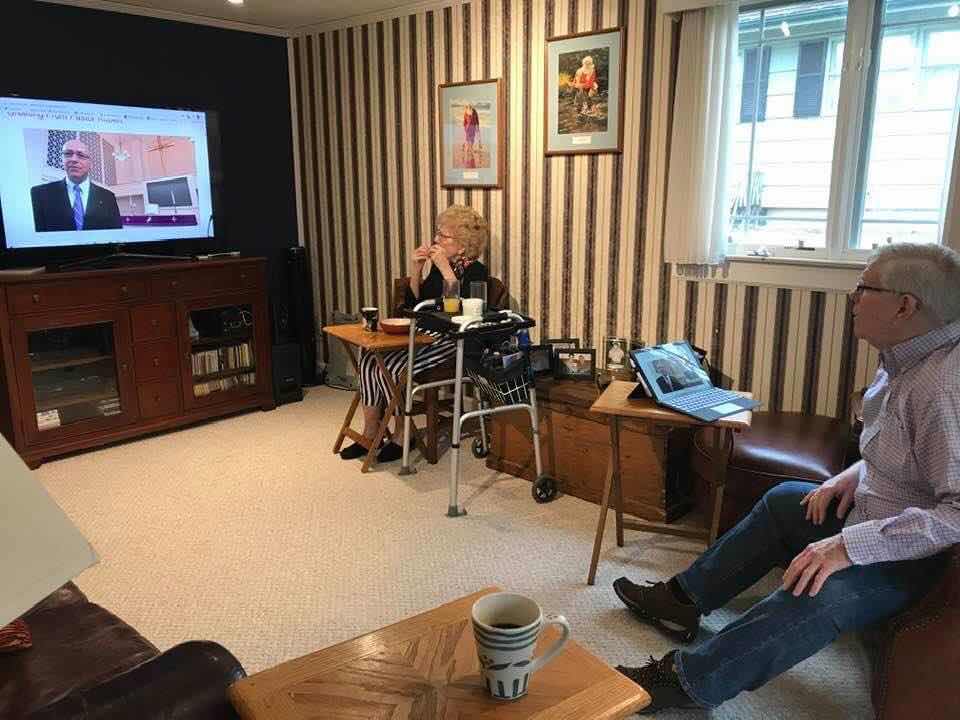
     I love these pictures from this past spring that some of you shared. Here’s one where the Boger family worshiped together in their living room.


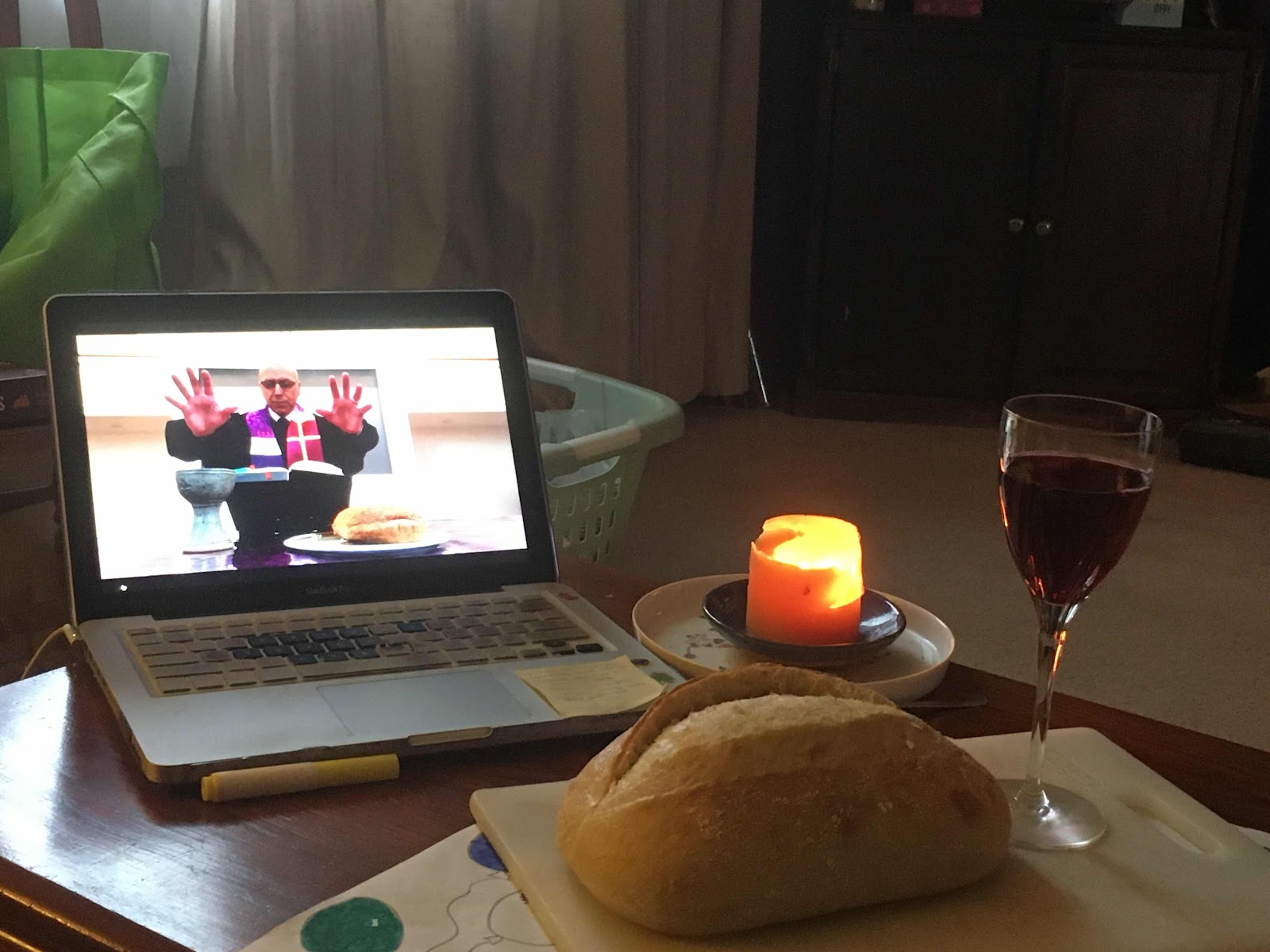
     Here’s one where the Lee family celebrated Holy Communion at their kitchen table during one of our online worship services.


     Here’s one where one of the Eckelberry children used their dog as a pillow as they watched our online children’s moments.


     Kay Taylor took gift bags and encouragement cards to the residents of assisted living facilities.


     For Palm Sunday, Wendy Merb-Brown led a Palm Sunday processional parade in her neighborhood which included several other of our church members. The families who participated kept to the six feet social distancing guideline. They couldn’t find any palm branches at the store so they improvised by using forsythia branches.


         Our Stephen Ministers made phone calls to the people listed in our church directory just to see how they were doing and to offer prayers over the phone.

     People are volunteering to give additional offerings to the church to help us stay financially strong since we are unable to gather in person for worship..

     Our staff is finding creative ways to work remotely and tackle some projects that normally don’t get done when the church is so busy with weekly events. Our Growing Tree preschool teachers offered online teaching moments with the Growing Tree families when they weren’t able to be together here at the church. 

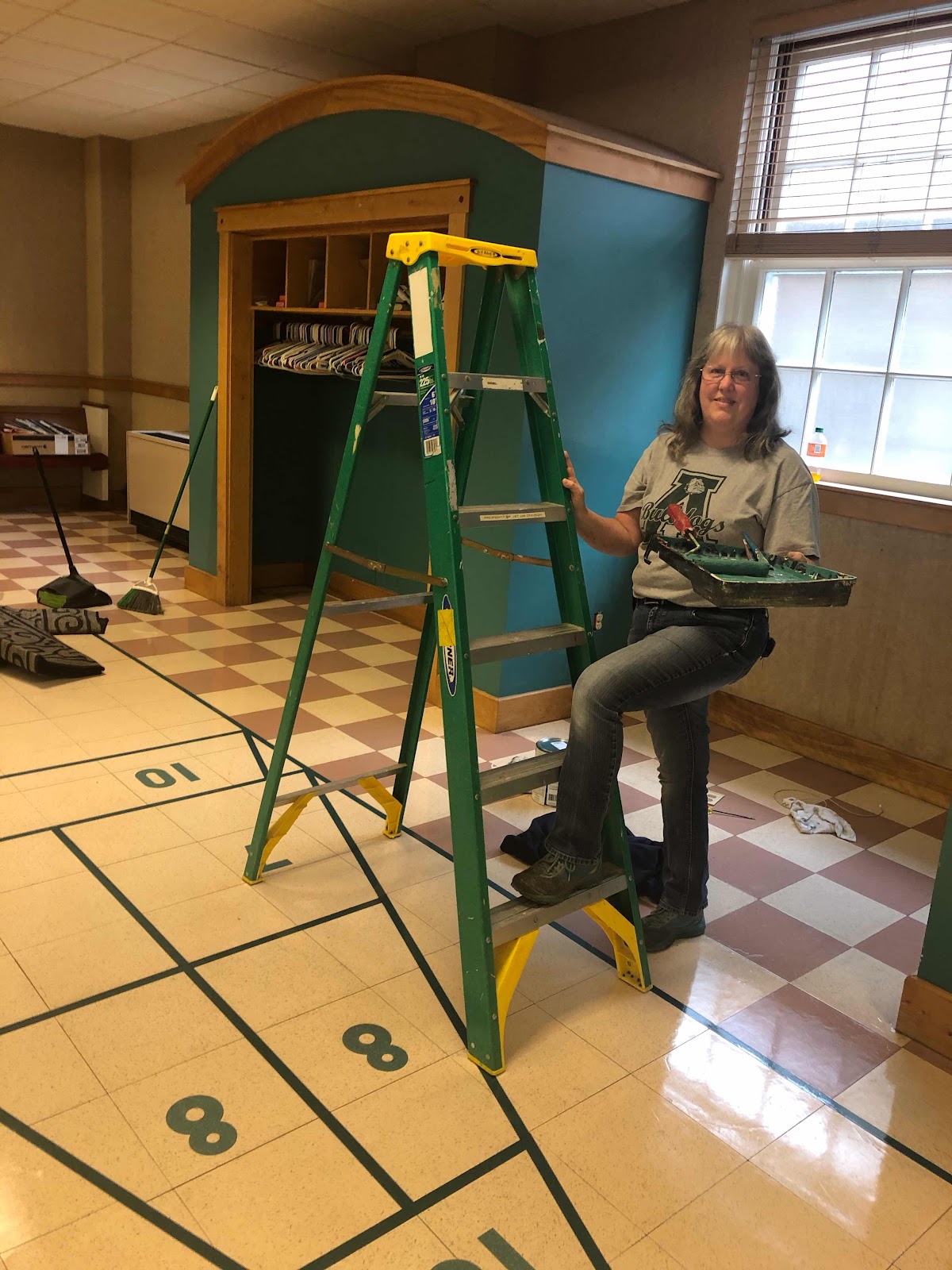
     Mindy, our custodian has been waxing our church floors, and doing some much needed painting.


      Our maintenance director, Dan Inman is getting a lot of projects done in and around the building.

     Our Leadership Board has been holding online Zoom meetings to help us stay in communication of any needs in the church. 


      Our Trustees team has been really busy by adding new thermostat controls in the rooms of our church, adding new security doors for our Growing Tree preschool hallway, repairing our church steeple, and adding a camera to record worship services in our sanctuary.


           Vicki and Jed Butcher continued to receive and send out prayer requests from the congregation. And by the way, every time I receive an email prayer notice from them, it makes my heart glad to know that we are still connected as a congregation through the power of prayer.

     And the good news is that these creative ways of staying connected and unified as a church continue to be a blessing. 

     I could go on with more examples of how we are staying connected and unified as a church but these are some of the stories that come to my mind when I reflect on Psalm 133, our psalm for today.

     The dew of Mount Herman didn’t stop when it reached several miles south to the city of Jerusalem. It has been making its way into each of our homes during this time of physical separation. God’s blessings have been running down Aaron’s beard and they keep flowing, covering each one of us. I believe we are becoming an even more unified church because of this very challenging time.

     These blessings go beyond our shinier floors and fancy new thermostat controls. We are receiving so much more. We are discovering how very good and pleasant it is when kindred live together in unity, even during a global pandemic.

     And for however long it takes, we will continue to sing this psalm, this song of ascent that reminds us that we are still God’s people.


A Psummer of Psalms: Psalm 133
Sermon Discussion Questions
Genesis 45:1-15Psalm 133
August 16, 2020 

Psalm 133 is known as a “psalm of ascent” because it is one of fourteen psalms that were used by Jewish pilgrims who attended three large holy festivals in the city of Jerusalem (Zion) each year.

Do you ever find yourself singing a hymn while out traveling? How does this “singing/humming while traveling” strengthen your faith?

Psalm 133 has two focuses which include 1) a focus on Jerusalem (Zion) where the Temple was located. 2) the goodness and beauty when God’s people are unified.This would have been important since Jewish families from the surrounding Middle East region representing different cultures would need to be reminded of their unity.

What helps you to feel united with people in our church even though we also represent different backgrounds and opinions?

With our church building closed for these several months due to the coronavirus, we have had to find creative ways to feel unified as a church family. Our online presence through our church’s social media, church emails, online worship services, and telephone calls are helping us to stay connected.

What helps you to feel connected to others during this time of physical separation?

Psalm 133 uses two images to emphasize how God helps us to stay connected. The first image is of oil dripping from Aaron’s beard down upon his robe. The other image is of the dew of Herman in the north able to flow all the way south to the city of Jerusalem. Both images convey that God is more than able to unite us even though we may be separated in other ways.

What are some practical ways that you can help others feel connected and an important part of our church family?