
Today, we begin a 6-week sermon series focusing on two letters that the Apostle Paul wrote to Timothy who was one of the young pastors of the early church. In addition to these two letters to Timothy, Paul also wrote a similar letter to Titus, also a pastor at that time. These three letters that the Apostle Paul wrote to Timothy and Titus have become known as “The Pastoral Letters;” I Timothy, II Timothy, and Titus.
The reason we will be spending six weeks focusing on I & II Timothy, is because these are the appointed New Testament readings for these 6 Sundays and I think these letters have a lot to teach us about what it means to be the church.
In preparing for this series, one of the bible scholars I was reading mentioned that the reason the Apostle Paul wrote these letters was to instruct Timothy on providing the pastoral leadership needed to help people in the church commit their lives to Christ, serve his kingdom, and to worship God.
This is why it’s important to have pastors and church leaders who provide the necessary leadership to help churches to be clear about their mission and purpose. Without strong leadership, the church can easily drift away from why it exists in the first place.
Sometimes, even with strong leadership, it can be challenging to help the church to move in a direction of hope and vitality.
In addition to this 6-week sermon series being a way to justify job security for pastors, it’s really meant to help us see the church from a larger perspective that we do not often take time to see. Sometimes this larger perspective of the church can help us to see how everything is meant to fit together and support the larger mission and direction of the church.
Before we get started, I think it’s important to know who Timothy was. Besides these two letters that Paul wrote to Timothy, his name is mentioned in nine other New Testament letters. He’s either included in Paul’s opening greeting or he is simply named as one of Paul’s messengers and co-workers in sharing the gospel.
Pastors like Timothy and Titus were people who were entrusted to provide pastoral leadership for a church in a particular geographical area. For example, Timothy was pastor of the church in the region of Ephesus and Titus was the pastor of the church in the region of Crete.
So, who are pastors, anyway? Does anybody really know what pastors do? I sure would like to know!
Actually, the title gives it a way. Pastors are shepherds who are entrusted with the care of their flock. And as we mentioned just a little bit ago, pastors are to provide leadership in helping the people of their church to commit to Christ, serve Christ’s kingdom, and worship God.
The first thing that Paul wants Timothy to focus on from our scripture reading today as the pastor of a church is in setting a culture in the church where all are welcome and included.” Setting a culture in the church where all are welcome and included.
Here in the opening of Paul’s letter to Timothy, the Apostle Paul writes how God’s mercy reached out to him, the chief of all sinners and led him to faith in Christ. Paul calls himself the chief of all sinners because of how he had persecuted Christians prior to his conversion.
Twice in this part of the letter, Paul writes how he received mercy from God. And he also writes how the grace of the Lord Jesus Christ overflowed for him.
I don’t know what it is about religion, but a lot of times people use their religion as a platform to exclude people. I’m sure you’ve experienced this as well. There must be something about human nature where we feel the need to be judgy toward others. Humans in general love to be judgy and throw religion in the mix, and we can become even extra judgy.
When we put ourselves in a position to judge others and use our religion as a justification to exclude people or make ourselves look better than others, than we have missed the whole point of being a people of faith. Yes, God wants to shape and mold us into the people God is calling us to be, but our primary calling is to love people into the church, not judge people out of the church.
This theme of God’s grace is also prominent in our Gospel reading for today from Luke. I love how the first verse of that reading begins, “Now all the tax collectors and sinners were coming near to listen to him, (meaning Jesus.”)
And then we read how the religious leaders, the Pharisees and scribes were grumbling when they saw Jesus spending time with these people and they said, “This fellow welcomes sinners and eats with them.”
And as Jesus so often does, instead of lecturing those religious leaders about loving and not judging others, he then tells them a parable about the joy you experience when something is lost is finally found. Jesus was focusing on God’s welcoming grace, not on worrying about who is included or not included.
Look at how the Apostle Paul begins his letter to Timothy. He writes, “Paul, an apostle of Christ Jesus by the command of God our Savior and of Christ Jesus our hope, to Timothy, my loyal child in the faith: Grace, mercy and peace from God the Father and Christ Jesus our Lord.” In just the first couple of lines in Paul’s letter to Timothy, he mentions God’s grace and mercy.
Just a few verses down from that opening greeting in his letter to Timothy, Paul writes about the importance of teaching doctrine that is true to the faith and then he writes, “The aim of such instruction is love that comes from a pure heart, a good conscience, and a sincere faith.”
In the verses that follow, Paul does offer examples of people who live in a way that is not loving and where they are causing harm toward others. This is all the more reason why Paul wants Timothy to help the church set a culture in which the church celebrates and lives out God’s overflowing love that welcomes all and will not leave us the same.
When I came here to be your pastor a little of two years ago, I could tell that you are a very welcome bunch. You enjoy being together.
There was already a culture here of being open and welcoming. As Paul wrote to Timothy in our scripture reading for today, it’s important for each one of us to allow God’s overflowing love to be part of everything we do. An overflowing love that welcomes all.
I once heard a pastor say that he wants his church to always be a haven of blessing and peace not only for ourselves but for others as well. To be a haven of blessing and peace is to be a place where people know that this is a safe space for them.
When people feel welcomed and loved in the church, that’s when you know that you have a church culture where God’s mercy and love are overflowing. But here’s the thing to keep in mind about setting a church culture. A church culture has a shelf life. It’s something that can quickly expire. It’s something we always need to work on and offer our time and energy.
Being welcoming and loving can be challenging which is another reason why it’s something that requires our prayerful attention and focus.
And if I can be really honest with you, a lot of my personal struggle with being welcoming is to not allow my personal political or theological opinions to become more important than just loving people.
Hey, I am really, really good at accepting people who look like me, act like me, vote like me and think like me! But not so good at accepting anyone else. I guess you can say that I am not very tolerant of intolerance which makes me intolerant.
No wonder why the Apostle Paul feels the need to write these letters to Timothy. He knows it’s not easy to set a culture in the church where people truly know that this is a haven of blessing and peace. Paul knows that it’s always a process in not only leading a church to be more loving and welcoming, but also where we are also striving to be more welcoming and loving.
In this first chapter of his letter, Paul is encouraging not only Timothy, but all of us here in this church to always be intentional in celebrating God’s overflowing mercy and love made known to us through Jesus Christ.
If anyone should know what it means to be included and welcomed unconditionally in the church family, it’s Paul because in his own words, he was the chief of all sinners.
There are many, many stories about the life of Queen Elizabeth. Here’s one that speaks of how she was welcoming of others.
Rev. Robert Cunningham, a Presbyterian Pastor in Lexington, Kentucky took a tour of the UK Parliament several years ago. He says that one of the tour guides shared a personal story with him about Queen Elizabeth. He told him this story which was his favorite about the Queen.
Every legislative session begins with a visit from the Queen, and it's a very regal tradition. She wears her crown and robe and processes down a hallway lined with the Queen’s Guards who literally strike the stone walls with their swords to make sparks fly as she walks by.
The hallway ends at the House of Lords, where the Queen enters to take her seat on the throne and essentially commissions the legislators to enact the will of the people. Several years ago, they were forced to break tradition a bit to accommodate the Queen in her older age.
There is a grand staircase leading to the hallway, and it became too much for her to climb. So, they decided to start using the elevator to get her up. Well, the first year they did this, a mistake was made. The lift operator accidentally pushed the button for the wrong floor.
Rather than the entrance to parliament, he presses the button for the maintenance floor. The lift goes up, the doors open, and Alice from the cleaning crew with her head down pushes her cleaning cart into the elevator as she has done countless times.
Only this time, she has pinned the Queen of England against the wall of the small lift. The doors close behind her, Alice is stuck in the lift with the Queen and her Guard, and she lets out an expletive not fitting the presence of royalty. Then an awkward silence, no one knowing what to do.
The silence was broken by the Queen's uncontrollable laughter, and then the most remarkable invitation. Rather than opening the doors to let Alice off, the Queen asks the lift operator to take them down to the proper floor.
The doors open and to everyone's shock, out walks her Majesty the Queen and Alice the maintenance worker. Then the Queen in her regalia along with Alice in her maintenance uniform process side by side down the royal hallway. But it gets even better.
Once a year for the rest of Alice's life, she was invited to Buckingham Palace for high tea with her newfound friend, Queen Elizabeth.
Queen Elizabeth had set a culture in allowing these unexpected moments to become an opportunity to connect with people in a very gracious and loving way. She made room for people she normally would not have met.
J.R.R. Tolkien, the great 20th century English writer once wrote, “Not all those who wander are lost.”
In Christ’s love, even when we wander, we are never truly lost. We are found by the grace of God. And since we all wander from time to time, we all need to depend on God’s grace.
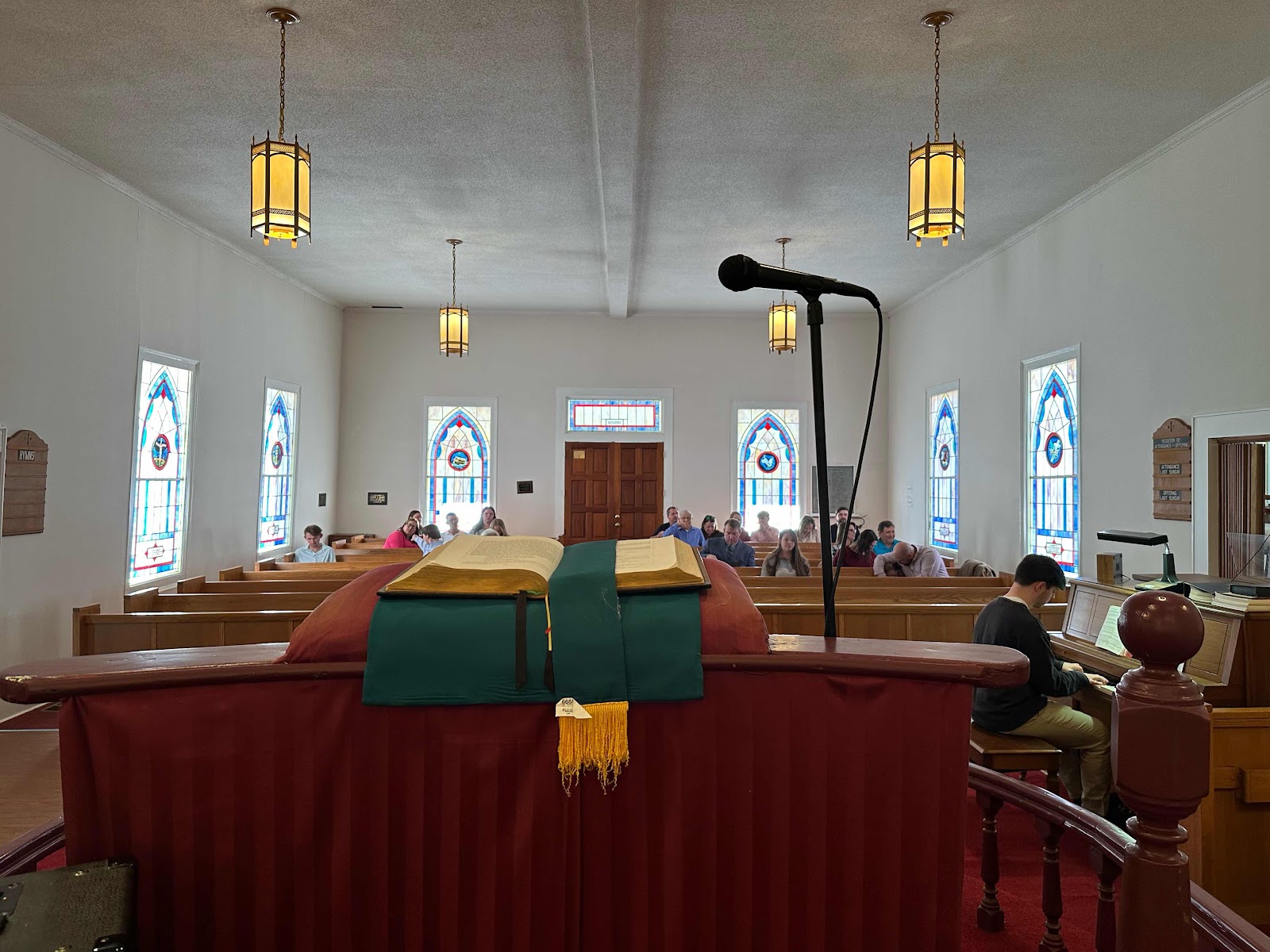
I love that the architectural name for this space where all of the pews are located is known as the “nave.” Nave is the Latin word for “ship.” It’s to remind us that each one of us, every single one of us, saints and sinners alike, are on this boat together.
So, let’s row together in setting a culture where all are welcomed in this place.


No comments:
Post a Comment