Welcome to our
March 7
online worship service!
Athens First UMC
2 S. College St., Athens, OH 45701
[Live-Stream Begins @ 10:20 am]

(Nee'-kos) Biblical Greek Word for "Victory"

Last week, we began our Season of Lent series on the first wilderness challenge and that was the challenge of our identity. The wilderness is that desolate area where Jesus spent forty days and forty nights facing various challenges to who he was and what he was sent by God to do.
This wilderness story is why the Season of Lent is a forty day season. The purpose of these weeks leading up to Easter is to help us face these challenges which involve dying to self and offering ourselves to God.
Last week, we looked at the wilderness challenge of our identity. Just before Jesus was sent into the wilderness to begin facing the challenges that would come his way, he was baptized by John the Baptist in the Jordan River. When Jesus was baptized, we are told that the Spirit descended upon him in the form of a dove and a voice from heaven said, “This is my Son, the Beloved, and with him I am well pleased.”
The Sacrament of Holy Baptism is what reminds us of our identity. We belong to God. We are claimed by God. The Holy Spirit is with us. And because God loves us unconditionally, we too are called his beloved. This is why our weekly benediction has that fist line that says, “You are a blessed, beloved, and beautiful child of God. There are no exceptions, asterisks, or loopholes.”
We say this benediction every week at the conclusion of our worship service so that we can all be reminded of our true identity. When we leave from worship and face a new week, it’s so important that we remember who we are and who we were created to be.
So when Jesus went into the wilderness and faced all of those temptations, he was able to do so because he already knew who he was. He was God’s Son. He was God’s beloved.
Knowing who we are is so important when we face challenges in life. Baptism is an important way for us to remember our identity. We only need to be baptized once, but it’s important that we renew our baptism as often as possible. We can do that by simply repeating the words, “I am baptized” which is something the famous 16th century Protestant Reformer, Martin Luther would do whenever he was feeling discouraged.
Remember your baptism. Remember that you belong to God. Remember that you are claimed by God. And so the first wilderness challenge during this Season of Lent is remembering our true identity.
For this week’s wilderness challenge, our appointed Old Testament reading from Genesis helps us to focus on the challenge of trust. It’s the story of God wanting to make a covenant with Abraham and Sarah for them to have offspring that would lead to the formation of God’s people. It’s an incredible covenant because God specifically says that their offspring will continue throughout generations where even kings will come from them.
This sounds like an incredible promise that God makes to Sarah and Abraham but there’s just one major problem. A really big problem. Sarah is way past child-bearing years. They are around a hundred years old when God made this covenant with them. Their challenge would be one of trusting that God would be able to make this happen. When Jesus went into the wilderness and faced all of those challenges from Satan, he also needed to trust that God had a different mission in mind for him.
For the past several years, I have served on the district committee on ministry. It’s where we interview candidates for ministry. And one of the basic questions we always ask someone who is pursing the pastoral ministry is, “Tell us about your calling.” How has God called you to be a pastor?
And almost every single time these candidates share their story of how God called them, it includes how they were reluctant to respond to that calling at first. One candidate in telling me his call story said how he and his wife attended a small country church one Sunday for worship. It was only their second time visiting that little church and there was a guest preacher that Sunday.
And after the worship service, one of the church leaders came up and asked him, “I know this is only your second time here, but we are in need of a pastor. Would you be interested?
You know, I’ve heard of church people asking a worship guest to join the choir but I think this was the first time I ever heard of someone new being asked to become their pastor! I asked him how he responded and he said that he would need time to think about it.
Long story, short. He did take time to think and pray about it which led him to have a conversation with the district superintendent who explained to him the process of how a lay person can serve as a pastor of a church. Of course this includes a process of training and credentialing, but even more importantly, it includes trust. He ended up saying that he would give it a try as long as the people in that little church would be patient with him since he didn’t have any experience in being a pastor.
And the wonderful thing is that because this person had an open mind and was willing to learn, that little church he is serving is responding to his leadership in a very positive way. His initial challenge was to trust that God really did want him to pray about if he should become their pastor which led him to saying yes.
Another pastor told me his call story that involved trust. He was a truck driver and while fixing a car one day, he was invited to come inside a church to get warm. As he was getting warm, he saw a picture of Jesus on the wall which left an impression with him.
He decided to get involved in church again and received training to become a Lay Speaker and that led to him to responding to a calling to start the process of becoming a pastor of a small congregation.
His story was one of trust because he had to work through the challenge of not feeling equipped to become a pastor, even though he could sense that God was calling him.
When God calls us to try something new or alter our way of life and thinking, that requires us to be willing to trust as we step out in faith. Abraham and Sarah probably couldn’t believe that having children would be possible through them in their advanced years, but they trusted and God blessed them.
As I’ve been thinking about the importance of learning to trust God while we’re in the wilderness during this season of Lent, the thought occurred to me that we are all wired to trust to varying degrees.
A couple of months ago when I was in the grocery check-out line, I noticed a national enquirer newspaper. I had almost forgotten that this publication still existed. The headlines on that issue were hilarious. The one about Kenny Roger’s body was missing made me laugh. And I remember thinking to myself, “How do people believe this stuff and why do these newspapers of fake stories sell so many copies?”
But then I started thinking about the many people who believe in conspiracy theories especially those of a political nature. These are grown adults who otherwise seem to be fairly normal and reasonable people, but they actually believe the information that come out of these conspiracy groups.
So, in a weird kind of way, there is something inside of us that wants us to trust that these bizarre stories just might be true.
The challenge we often face is in prayerfully discerning if God is truly calling us in a particular way. And this requires trust on our part. I say “prayerfully discerning” because based on these tabloids and conspiracy theories, we don’t want to just believe everything that we read or hear.
When Jesus was in the wilderness, Satan was trying to get Jesus to believe that he should turn stones into bread, and jump off the pinnacle of the Temple and angels would save him, and worship him and all the kingdoms of the world would become his. Satan was trying to get Jesus to believe in these conspiracies of what he should do rather than what God sent him to do.
The wilderness is where we do a lot of soul searching in discerning what is true and what is not true. This is why spending these weeks of Lent in the wilderness with Jesus are so important. It helps us to face the challenge of where we are called to place our trust and the things where we should not place our trust.
Jesus was able to keep his trust in what God wanted him to do rather than what Satan was wanting him to do. Just like God did for Abraham and Sarah, we are called to trust in God’s incredible vision and hope for the world.
This vision is one where we are invited to participate in making this world a better place, a place where all people are loved and valued, a place where there is harmony, justice, peace, and equality. This is why our church’s mission statement is to make disciples of Jesus Christ for the transformation of our community and world. What an incredible mission we have! To participate with God in bringing transformation to our world.
If all of this sounds too good to be true, remember that this is what Abraham and Sarah were probably thinking when God made a covenant with them. It sounds like something that you might see on a tabloid while waiting in the check-out line…
“Hundred year old couple to become pregnant.” But this headline ended up being true and it was through the covenant that God made with them that God would send Jesus, the savior of the world.
During this season of Lent, God is calling us to place our trust in something far more interesting than who stole Kenny Roger’s body. God is calling us to change the world.
Wilderness Challenges - Our Trust
We are beginning a new season of Lent worship series called, “Wilderness Challenges” based on the forty days when Jesus began his ministry in the wilderness. While Jesus was in the wilderness, he faced several challenges related to his identity and his mission.
The forty day season of Lent is meant to remind us of those forty days that Jesus spent in the wilderness. If we want to grow in our faith and be faithful in following Jesus to the cross and the empty tomb of Easter, we need to be willing to face these challenges as well. By facing them, we will learn more about the areas of our spiritual lives that are in need of growth and renewal.
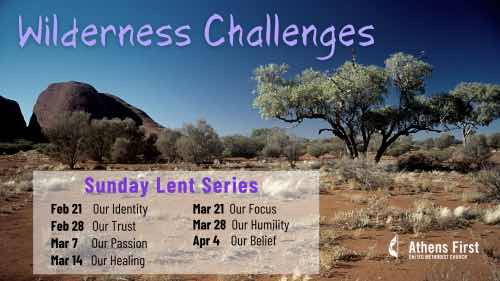
Over these next several weeks of Lent, we will be looking at several different wilderness challenges. These include our identity, our trust, our passion, our healing, our focus, our humility and our belief. We will be using the appointed scripture readings for each of these Sundays in Lent to explore these themes.
As we begin this season of Lent series, let’s think about why Jesus spent forty days in the wilderness. What is the significance of the wilderness and why is it important for us to spend time there with Jesus as well?
When we see that Jesus began his ministry by living in the wilderness for forty days, we immediately make the connection with the people of Israel, who centuries before were in the wilderness for forty years.
The people of Israel had been slaves in Egypt for four hundred years and God called Moses to lead them from slavery and into the promised land. To do this, they needed to travel through the wilderness. It was while they were in the wilderness that God was forming and shaping them to be his people.
By first going to the wilderness to begin his ministry, Jesus is mimicking what happened to the Israelites centuries before him. Here is the parallel with the wilderness story of the Israelites and the wilderness story of Jesus.
Both of these wilderness stories begin with water. For the Israelites, it was the Red Sea when Moses parted it allowing them to escape from Pharaoh. For Jesus, it was the Jordan River where he was baptized.
These wilderness stories also were a passage way to their ultimate destination. For the Israelites, the destination was the Promised Land where they would be able to live as free people under God’s gracious rule. For Jesus, the destination was the city of Jerusalem where he would die on a cross and rise again which would lead to the freedom of God’s people from sin and death.
But to go from slavery to the Promised Land, the Israelites and Jesus first needed to face the challenges of living in the wilderness. The church has designated this season of Lent as a time to live out this wilderness journey. It’s not an easy journey. It will test us along the way, but it can be a time of tremendous spiritual growth.
For this first Sunday in the wilderness, the appointed scriptures for today offer us our very first challenge and it’s related to our identity.
Knowing who we are is critical in living out our faith.
Our Gospel reading this morning begins with Jesus in the wilderness but just before he was driven into the wilderness, we have the story of Jesus being baptized in the River Jordan. And I think this connection is a very important one because Jesus’ baptism centers around his identity.
So even before Jesus entered the challenge of the wilderness, he knew his identity. What do we learn about Jesus’ identity from his baptism?
Well, the first thing we learn is that as Jesus was coming out of the water from his baptism, the Spirit descended upon him like a dove. And then we get this voice from heaven saying, “You are my Son, the Beloved; with you I am well pleased.”
These two aspects of Jesus’ baptism, the Spirit descending upon him and the voice from heaven calling him “beloved” are also important dimensions whenever we celebrate a baptism. Baptism reminds us that we have been claimed by God and that we are given the name, “beloved.” And so, when Jesus went into the wilderness, he already knew who he was and that the Spirit was with him.
Every week when we worship together, we collectively say our benediction which reminds us of our identity. We begin that benediction with these words, “You are a blessed, beloved, and beautiful child of God.”
We started using this benediction almost two years ago. The motivation for creating our own special benediction came out of the anguish I was feeling after the disappointing decision by our denomination to retain the restrictive language found in the Book of Discipline regarding LGBTQ issues.
The decision from that special General Conference had made national news and the spotlight was on our denomination. Since Athens First has always sought to be an inclusive and welcoming church, I was trying to think of what our congregation could do to emphasize God’s acceptance of all people, especially people in the LGBTQ community.
And that’s when God reminded me of something that often goes unnoticed in a worship service. The benediction. The thought occurred to me that I put so much time into developing a sermon, that I don’t give nearly enough attention to what is spoken during the benediction. And so I prayed about it, and came up with that opening line, “You are a blessed, beloved, and beautiful child of God.”
For the first few Sundays, I was the only one speaking this benediction because that is what typically happens. The pastor offers the benediction and the congregation listens. And then I went on vacation for a few Sundays and the person who was leading the service for those Sundays invited the entire congregation to say it with him.
When I got back from vacation, somebody told me about it and they said how powerful it was that everybody was saying it together. So, I continued this new tradition where I invite all of you to speak those words with me.
What I love about this benediction is that on any given Sunday when we worship together, every single person is invited to say these words and know that they truly are a blessed, beloved, and beautiful child of God.
The other interesting thing about this is that my plan was to use this benediction for a month or two and now it’s been almost two years that we have been using it!
One of the leading worship scholars of our denomination has been Laurence Hull Stookey who passed away in 2016. Stookey wrote a book about baptism in which he says,
“Each of us stuffers from spiritual amnesia. We forget what God has done for us and promised to us. We also conveniently forget what God wants from us as disciples. In short, we are oblivious to the identity we have been given by our creator. God, aware of our malady and of our inability to effect a cure, acts to reveal our true identity to us. One means by which God counteracts this amnesia is baptism.”
Our first wilderness challenge is related to having spiritual amnesia and this is all rooted in our identity. To overcome this challenge, we need to find ways to remember who we are.
Martin Luther, who started the Protestant Reformation back in the 1500’s would remember his baptism and who he was by placing his hand on his head and repeating the words, “I am baptized. I am baptized.”
He would do this especially whenever he was feeling anxiety or distress. “I am baptized.”
What a great way to remember our baptism, to cure our spiritual amnesia and to remember our true identity, that we are loved by God.
In one of the churches I served, a member of the congregation told me that she doesn’t know what she would have done without our church. I asked her what she meant.
And she said how throughout her life, she had always struggled with self-worth and feeling accepted. She then told me that sometimes when she is really struggling and feeling down, she’ll simply pull her car into our church parking lot and sit there in her car looking at our church building. She said that it has a way of reminding her that she is somebody, that God loves her, and that this is a safe space for her.
One of my favorite things to do is to look up at our church steeple especially when it’s a beautiful day and seeing that cross high above, 130 feet above our sidewalk. That steeple is here to remind us that God loves us.
Friends, let’s remember to never underestimate how God can use a hymn, a benediction, a kind word or gesture, a steeple, or even a church parking lot as a way of reminding us of our true identity.
So on this first Sunday in the wilderness, never forget who you are. You are a blessed, beloved, and beautiful child of God! That is who you are!
Wilderness Challenges - Our Identity