A United Methodist Pastor's Theological Reflections

"But thanks be to God, who gives us the victory (nikos) through our Lord Jesus Christ." - I Corinthians 15:57


Monday, November 8, 2021

Sermon (November 7/All-Saints Sunday) by Rev. Robert McDowell


     Here in the middle of John’s Gospel, we have this very strange story of the raising of Lazarus from the dead. There are so many puzzling things about this story.

     Perhaps the main puzzling aspect of this story is why did Jesus wait two whole days before responding to Mary and Martha’s request to heal their brother Lazarus who was very ill and near the point of death?  Instead, Jesus remained where he was at the time and Lazarus ending up dying before he arrived.

     This lack of response from Jesus doesn’t line up with our understanding of who he is, the one who is able to bring healing, the one who has compassion for others. Instead, Jesus ends up arriving on the scene too late. Lazarus had already died.

     There is more to this story which we will get to in a little bit, but it might be worth it for us to first reflect on Jesus’ decision to not come right away. Why is it that there are times in our lives when it seems like Jesus arrives too late?

     On one hand, we are fortunate to have medical workers who are trained to offer medical assistance as soon as possible, but on the other hand, the healing process can often feel delayed and very slow to the point where we wonder if we will ever find a medical treatment that will lead to healing. The hospital room and the waiting room can be very lonely places.

     We live in a world that is filled with so much beauty and joy, but it’s also a world that includes so much grief, brokenness, and pain. 

     Our church is blessed to have Stephen Ministry which is a ministry that provides one to one peer support for people who are going through a challenging transition in their lives. Often times, this includes grief support for those who have lost loved ones. Stephen Ministers are not counselors, but they have received extensive training to be good listeners and to serve as a sounding board for the sake of others. We also have Stephen Ministry resources here at our church that includes pamphlets that are appropriate for the different seasons of grief that we may be experiencing.

     One of those pamphlets offers a brief illustration of how our world is a mixture of both joy and grief. What do we do during those times when it feels like Jesus is not present just when we need him the most? In the opening pages of one of those seasons of grief booklets, the author, Kenneth Haugk shares this true story,

     “A man in Florida was driving home one day when a large sinkhole beneath the street suddenly opened and swallowed his car. He didn’t get hurt, but he was dazed and disoriented. For a while, he didn’t know where he was or what had happened to him.

     He later said, ‘One minute, I was driving in my own neighborhood on a bright sunny day, and the next minute, I was at the bottom of a deep, dark hole with the world caving in on me.’”

     That little story reminds us of how vulnerable and frail we are, but also in how these challenging moments in our lives can lead us to question our faith.

     While on vacation down south this past summer, Penny and I were driving on a county road about 35 miles per hour when we heard a deafening loud crash right behind our car. I looked in my rear view mirror and saw that a large tree had fallen across the road just missing our car. A car that was headed the opposite direction put on it’s breaks to miss the tree.

     I pulled off the side of the road to catch my breath and reflect on how close we were to being seriously injured or losing our lives. That incident reminded me in a very forceful way how frail and vulnerable we really are. 

     I know that there are some Christians who would say that God spared our lives, but that only leaves open the question why others are not so fortunate. What that scary experience did for me was that it was a reminder to cherish each moment and to not take life for granted.

     Which brings me back to our Gospel reading for today when Jesus chose not to respond to Mary and Martha’s request to come to Bethany and heal their brother, Lazarus. Even though Jesus was sent by God and was able to bring healing to others, he also knew of the danger that awaited him back in Bethany. Earlier when he was in that region, the religious authorities had threatened to stone him to death and so Jesus needed time to pray about whether or not he should return to that dangerous area.

     Sometimes we forget that even though Jesus had been sent by God and was the very embodiment of God, he also was fully human and had to reckon with the challenges of life like we do. And so, Jesus delayed his return to Lazarus but when he arrived, Lazarus had already died.

     But this mysterious story has a dramatic turn when Jesus finally does arrive in Bethany and he brings Lazarus back to life. This is the story that includes one of Jesus’ seven “I am” statements. Here in this raising of Lazarus story, Jesus tells Martha upon his arrival, “I am the resurrection and the life. Those who believe in me, even though they die, will live, and everyone who lives and believes in me will never die.”

     Here in this extraordinary story of Jesus raising Lazarus back to life, we are given an early hint of an even more extraordinary story that is awaiting us at the end of John’s Gospel when Jesus is raised from the dead. But there’s an important difference between these two stories. Lazarus was brought back to life, but would eventually die. When Jesus was resurrected from the dead, he would never taste death again.

    If you think about all of Jesus’ healings and this story of Jesus’ raising Lazarus from the dead, these are all signs that are pointing us to that time in the future when God will defeat sin and death once and for all. And while we await that glorious future, we have these hints along life’s journey that one day God will make all things new.

    T.S. Eliot said, “These are only hints and guesses, hints followed by guesses; And the rest is prayer, observance, discipline, thought and action.”

     Our Old Testament reading which was written before the time of Jesus offers us a really big hint of this glorious future and does so in a very beautiful, poetic, and descriptive way.

     The prophet Isaiah says, “On this mountain the Lord of hosts will make for all peoples a feast of rich food, a feast of well-aged wines, of rich food filled with marrow, of well-aged wines strained clear. And he will destroy on this mountain the shroud that is cast over all peoples, the sheet that is spread over all nation; he will swallow up death forever. Then the Lord God will wipe away the tears from all faces, and the disgrace of his people he will take away from all the earth, for the Lord has spoken. It will be said on that day, ‘Lo, this is our God; we have waited for him, so that he might save us. This is the Lord for who me we have waited; let us be glad and rejoice in his salvation.’”

     In the midst of our struggles, our griefs, and our pain are these beautiful hints and guesses that point us to that time when God will make all things new. Sometimes these hints and guesses come to us in surprising and very mysterious ways.

     Several years ago, our family had a beautiful sheltie dog. Yes, this was before we became a westie family. Duffy was the first dog we got after our children were born and we have great memories of him.

     On the day that we made the difficult decision to have him put down, we all gathered there in the Vet office and Duffy peacefully died in our arms. Our hearts were so heavy and we were all crying.

     I’ll never forget that day. I can even tell you what the weather was like on that day. It was a breezy but sunny and warm Saturday morning. And as we were leaving the vet office, I told our family that instead of going home right away, I just wanted to drive out in the country to give ourselves some time to be together and continue to grieve.

     During that drive, no words were spoken. We were all just so heartbroken.

     I must have driven 15 to 20 minutes, when Penny broke the silence and said, “Do you think we should turn around and go back home?” And that’s when the miracle happened.

     I said, “Yeah, it’s probably time.” I saw a road up ahead where I could turn around. 

     Well, at the corner of that county road was a ranch house and sitting out in the front lawn was this beautiful, beautiful Sheltie dog that looked so much like Duffy, just sitting out on the green grass soaking in the warm breeze and the sunshine, so happy, so alive. Of all of the county roads I could have chosen to turn around, I chose that one. 

     Nobody said a word. No words were needed. God was giving this little sign that Duffy was OK and was in a better place. Hints and guesses. 

     On this All Saints’ Sunday, even with grieving hearts for those we miss so much, we are reminded that Jesus is the resurrection and the life and a time is coming when death will be swallowed up forever. 

     Thanks be to God!


Hints & Guesses

Sermon Discussion Questions
Isaiah 25:6-9 & John 11:32-44
November 7, 2021

The story of Jesus’ bringing Lazarus back to life is a very puzzling story. When Mary and Martha sent a message for Jesus to come to Bethany which is near Jerusalem and heal their brother, Jesus delayed and Lazarus died. Jesus delayed returning because of the opposition that would be facing him if he had returned to Bethany at that time. This story reminds us that God’s timing is not always our timing.

How do you handle those times when it feels like God has not arrived on time? What helps you to maintain a strong faith when it feels like your prayers aren’t being answered?

In one of our Stephen Ministry grief pamphlets, a true story is shared of when a man in Florida was driving down a road on a beautiful sunny day when all of the sudden, his car was swallowed up by a massive sink hole. Fortunately, he wasn’t badly hurt, but he was quoted as saying, “One minute, I was driving in my own neighborhood on a bright sunny day, and the next minute, I was at the bottom of a deep, dark hole with the world caving in on me.”

Share a time when you felt like the world was caving in on you. How did that experience impact you emotionally, physically, and spiritually?

Mary and Martha felt like the world was caving in on them when their brother, Lazarus died. When Jesus finally arrived and it seemed like all hope was gone, Jesus said, “I am the resurrection and the life, those who believe in me even though they die will live and everyone who lives and believes in me will never die.” Jesus’ words were hinting at what would be happening to him later in John’s Gospel when he died on the cross and was raised to new life.

What does it mean to you when you hear Jesus say, “I am the resurrection and the life?” How can Jesus’ statement about who he is be of comfort to you when facing grief, heartache, and pain?

T.S. Eliot, in describing the mystery of life and death said, “These are only hints and guesses, hints followed by guesses. And the rest is prayer, observance, discipline, thought and action. Our church refers to these “hints and guesses” as “thin place moments,” those times when we experience God’s presence in a very real way.

Share a thin place moment where you encountered the life-giving presence of God. How did that moment strengthen your faith? In what ways can we become more open to these mysterious “hints and guesses” of God’s presence in our everyday lives?


Sunday, November 7, 2021

Online Worship (November 7/All Saints) Athens First UMC


Welcome to our 
November 7
online worship service!
Athens First UMC
2 S. College St., Athens, OH 45701

[Live-Stream Begins @ 10:25 AM]

Monday, November 1, 2021

Sermon (October 31) by Rev. Robert McDowell


     One of the things I learned early on in my pastoral ministry was the importance of the church I was serving to have a concise and memorable mission statement and discipleship strategy. The business world uses this strategy as well.

     Here are some examples…

     Tesla’s mission is “to accelerate the world’s transition to sustainable energy.”

     LinkIn’s mission is “to  connect the world’s professionals to make them more productive and successful.”

     PayPal’s mission is “to build the web’s most convenient, secure, cost-effective payment solution.”

     Nike’s mission statement is to “bring inspiration and innovation to every athlete in the world.”

     Nordstram’s mission is “to give customers the most compelling shopping experience possible.”

     And Facebook’s mission is evidently to spread misinformation and extremist views. They have some PR work to do.

     What is the mission and discipleship strategy of Athens First United Methodist Church? Here it is… “to make disciples of Jesus Christ for the transformation of our community and world.” And our discipleship strategy to fulfill that mission is to provide ministries that help each person “to have a loving faith, a learning faith, and a living faith.”

     It is so tempting to make a mission statement longer than it really needs to be. Sure, we could replace our fourteen word mission statement with a ten page single spaced document detailing all of our ministries and programs, but how would that be inspiring and memorable?

     Today’s scripture readings from Deuteronomy and the Gospel of Mark offer us a concise and memorable way of living out our faith every single day. 

     In our Gospel reading, one of the scribes… Scribes. Who were the scribes? They were legal experts. Lawyers. They were a group of Jewish people in Jesus’ day who studied the laws found in the scriptures and would then draft lengthy legal documents that were used for people getting married, people getting divorced, loans, inheritance contracts, sales of land, etc.

     In other words, they were wordy type people. If you count them all of the laws that are in the Old Testament, there are 613 laws of them. 

     613 laws! We often only think of the Ten Commandments, but there’s 603 other laws that we find in the Old Testament. And there was a belief in Jesus’ day by some Jewish people, that if every single Jewish person would obey all 613 laws for an entire day, that this would usher in God’s kingdom here on earth. 

     And of course, these 613 laws have a lot of gray areas to consider. Like, what does it means to do no work on the Sabbath? Does that include only work in which you make money? What about chores? The Rabbis of Jesus’ day debated questions like this on what is considered work and what is not considered work on the Sabbath. And this is just one of the 613 commandments that lead to all of these questions.

     Back to our Gospel reading. One of the scribes came near and heard them disputing with one another, and seeing that Jesus answered them well, he asked him, “Which commandment is the first of all, the one that is most central to who we are as God’s people?” 

     Now, Jesus could have said that all 613 of the laws are tied for first because they’re all important, but he doesn’t. He refers to one law in particular which is at the heart of what it means to to live out our faith.  

     It’s known as the Shema which is from our Old Testament reading for today. The reason it is given the name, “Shema” is because the Hebrew word for listen is “Shema.”  And that is how this commandment begins. “Hear, O Israel… You shall love the Lord with all your heart, and with all your soul, and with all your might.”

      So why does Jesus say this is the most important of all the 613 commandments? Why would this one best reflect what it means to be God’s people?

     New Testament scholar, Tom Wright answers that question this way… “The Jewish law begins with worship, with the love of God, because if it’s true that we’re made in God’s image we will find our fullest meaning, our true selves, the more we learn to love and worship the one we are designed to reflect. No half measures: heart, soul, mind and strength – that is every aspect of human life is to be poured out gladly in worship of the one true God.”

     And even though Jesus wasn’t asked about what he thought was the 2nd most important commandment, he offers it anyway. He says, “the second is this, “you shall love your neighbor as yourself,” which is a commandment that we find in the Book of Leviticus in the Old Testament.

     So this is what Jesus wants us to remember by summing up the 613 commandments in this concise and memorable way. Don’t worry about trying to memorize all of those commandments. Just remember and live out this in your daily lives…

     “Hear, O Israel: the Lord our God, the Lord is one; you shall love the Lord your God with all your heart, and with all your soul, and with all your mind, and with all your strength, and you shall love your neighbor as yourself.”

     This summary of our faith has become known as the Great Commandment. The Great Commandment. It’s what I want everyone who is part of the church to know. So if someone would say, “what is the Great Commandment,” without even thinking, we would say, “to love the Lord with all our heart, mind, soul, and strength and our neighbor as ourselves.”

     As a pastor, if I don’t emphasize this in my preaching and my teaching, then I feel like I have failed in my duty as your pastor. It’s that important.

     Which leads me to this story of my dear friend, Keith Wasserman of Good Works here in Athens. Keith and I have been friends over the years. I’ve had him preach in my churches including here at Athens First. 


    For one of my churches I was serving, I had Keith preach on a Sunday morning and I also invited him to come and  share with our Junior High confirmation class which was meeting that same morning during Sunday School. I was thinking that this would be a great opportunity for our young people to hear Keith share his faith and his ministry with Good Works. 

     But before he did any of that, Keith began by asking this group of confirmands who at that point had been meeting every single Sunday for the past six months, this very basic question. He asked them, “can any of you tell me what the Greatest Commandment is? 

     I gulped as I heard him ask that question, because I wasn’t sure if any of us who were teaching the class had specifically focused on that phrase, “The Great Commandment.” We had taught them every other possible Christian topic you can think of like how many books are in the Bible, major Christian history events, that John Wesley founded the Methodist Church, all of these things but we never went over The Great Commandment.

     There was this long silence when Keith asked our youth that question. Nobody knew. I shamefully looked the other way to not make eye contact with Keith.

     And without any shaming or judging, Keith simply said that Jesus taught us that there is only really one commandment we need to remember as Christians and it’s to “love the Lord your God with all your heart, mind, soul, and strength and your neighbor as yourself.”

     Keith went on to talk to them how the Great Commandment is what Good Works is all about. It’s that simple, and it’s all they really need to remember.

     Speaking of Keith, I receive his monthly newsletter and this past summer he had an article that was so powerful that it seems fitting to share it with you here in the context of the Great Commandment.

     Over the past thirty years, Keith has chosen to personally experience homelessness in eleven different cities in order to learn and better understand the people and and situation of being homeless. In his newsletter article, he offers these brief highlights to help remind him to not forget the Great Commandment.

     In Akron, he went to the desk at the shelter to ask if he could use the bathroom. The staff person responded with a dramatic, “I just cleaned it!” He felt degraded by that statement. But then he asked himself, “Have I ever done that to someone at Good Works?”

     In Pittsburgh, he was with a group of other homeless people who were accosted of stealing things from the pockets of the coats in the church foyer during the church service. They were taken aside and asked if they stole the items. On reflecting on that experience, Keith  asks himself, “Have I ever done that to someone?”

     In Charleston, he left the shelter right after breakfast, but the person in charge of his personal items would not give them to him and wouldn’t explain why. Keith continues to ask himself, “Have I ever done something like that to someone?”

     He ended his article with these positive examples of how he was treated. 

     In Tulsa, he said that a man who ran the shelter allowed him to come in and out of the cold and sleep onside on the floor even though there were no beds and lots of people. 

     In Pittsburgh, a man would visit people before sleeping hours to say a prayer for each person and offer a kind word. 

     In Louisville, a resident of the shelter where he was staying worked in the kitchen and when he saw him, asked him if he was hungry and then went into the kitchen and gave Keith some freshly made chicken.

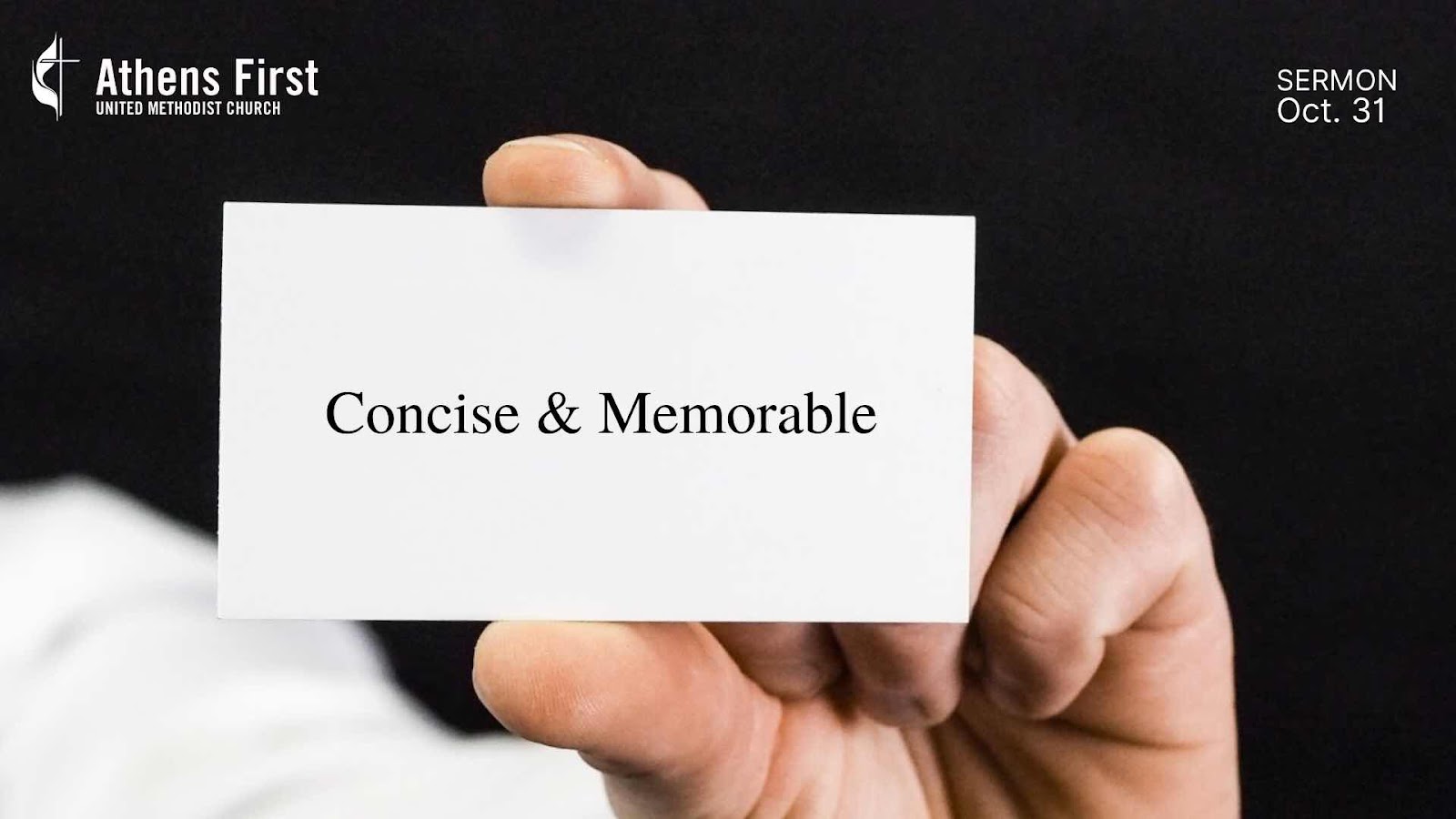
     The point of sharing these experiences is to think about how we love our neighbors and live out our faith each and every day. Maybe this is why Jesus gave us a small business card size summary of all the commandments we find in the Bible.

    Life happens so quickly as we encounter people from moment to moment in our daily lives. We might not be able to recite all of the commandments or even know they exist.

     What if we could just remember this little summary of all of them? Just remember to love the Lord your God with all your heart, soul, mind and strength and your neighbor as yourself.

     Jesus says if we can obey this commandment, we are not that far from the kingdom of God. 


Concise & Memorable

Sermon Discussion Questions
Deuteronomy 6:1-9 & Mark 12:28-34
October 31, 2021

Consultants encourage businesses and organizations to have a concise and memorable summary of their main purpose. For example, Tesla’s mission is “to accelerate the world’s transition to sustainable energy.”

Why do you think it can be helpful for a business or organization to have a concise and memorable mission statement?

The purpose of our church is “to make disciples of Jesus Christ for the transformation of our community and world by helping each person to have a loving faith, a learning faith, and a living faith.”

When you think of our mission statement, what stands out for you the most?

Of all of the 613 commandments in the Old Testament, Jesus said that the greatest commandment of all of these is “to love the Lord your God with all your heart, soul, mind, and strength and your neighbor as yourself.” This has become known as “The Great Commandment.” Jesus actually combined two commandments together but still not bad since there are a total of 613 commandments!

Why do you think that of all the commandments he could have said was the most important that he combined these two commandments as the most important to remember?

Keith Wasserman who started Good Works in Athens is known for focusing on this “Great Commandment.” It helps him to not be in ministry “to” the poor but “with” the poor. 

What is the difference between ministering “to” people vs. “with” people? Why is it more Christlike to be in ministry “with” people?

If you were to write a concise and memorable mission statement for your life, what would it be? “The purpose of my life or my mission is…”

Sunday, October 31, 2021

Online Worship (October 31) Athens First UMC


Welcome to our 
October 31
online worship service!
Athens First UMC
2 S. College St., Athens, OH 45701

[Live-Stream Begins @ 10:25 AM]

Monday, October 25, 2021

Sermon (October 24) by Rev. Robert McDowell


     A church, known for their high expectations when hiring a pastor, was interviewing for a new pastor. They had interviewed several well qualified candidates, but were still not satisfied in their search.

     During one of their interviews, they asked a very promising candidate, “So, tell us what your preaching is like.”

     And the candidate said that she takes sermon preparation very seriously and how her well crafted and Holy Spirit led sermons had helped her previous congregations to grow in their faith.

     The interview team, still not convinced if this was the right person, then asked the candidate, “But what about your pastoral care and visitation ministry?” 

     The candidate proceeded to tell them that this was another area of her ministry which she had been known to make a priority and had received positive feedback from her previous churches. She said that she had even helped organize a lay visitation team so that the whole church was involved in checking on the members.

     The interview team, not satisfied with her answer next asked the candidate about her administrative skills.

     The candidate, without any hesitation, shared how she was known for completing church reports in a timely fashion and was always prompt in returning phone calls and responding to messages.

     After answering all of these interview questions in a way that most churches would find very impressive, the candidate decided to try one last attempt to convince this committee that she was an excellent pastor. She invited the interview team to go outside the church and down to a pond that was nearby. They all made their way down to the water.

     The interview team, now standing there by the pond asked what she was going to do. She said to them, “Just watch. I think you’re going to be amazed at what I can do.”

     She then did the unthinkable. She proceeded to actually walk on the water like Jesus did. She walked to the one side of the pond and then back to where the interview team was standing.

     Thinking that this would convince them to hire her as their new pastor, she asked them, “So, what do you think?”

     With arms folded, one of the committee members said, “Do you mean to tell us that you don’t even know how to swim?”

     This fun little story reminds us that finding the perfect pastor is a futile search. We pastors have our strengths and our weaknesses. Sometimes you will hear us preach eloquent and inspiring sermons. Other times they are barely adequate, but God can use those sermons as well.

     Sometimes we make brilliant decisions, and other times, not so brilliant. Sometimes we know just the right words to share with someone who is going through a difficult time in their life, and other times, we stumble in trying to offer the right words.

     Which brings me to our Hebrews scripture reading for today. The Book of Hebrews is actually a letter that emphasizes how Jesus is our perfect high priest. Through his life, death, and resurrection, Jesus was able to be the perfect, final, and effective sacrifice for the sins that keep us from being who God has called us to be. 

     This letter is saying that priests come and go. Pastors come and go. But Jesus is the only high priest who lives forever. And this leads the author of Hebrews to say in our scripture reading for today, “Consequently, he is able for all time to save those who approach God through him, since he always lives to make intercession for them.”

     And just to emphasize his point, the writer of Hebrews says, “Unlike the other high priests, he has no need to offer sacrifices day after day, first for his own sins, and then for those of the people; this he did once for all when he offered himself.”

     Priests come and go, but Jesus lives forever.

     Several years ago, I served as an associate pastor of a large church in northwest Ohio. This church had a hallway that was dedicated to all the pastors who had served the church over their very long history dating back to the early 1800s. They had portraits of each pastor on the wall of that hallway with their names and dates that they had served. 

     One of those pastors was Norman Vincent Peale’s father. Another pastor was Clyde Pinnell who was also the pastor here back in the late 1960s and early 70s. 

     It was an impressive display of the many pastors who had served that church over its long history. I always found it interesting that it wasn’t until around the 1950s, that pastors began to smile when their picture was taken. One pastor from the early 1900s looked so grumpy and stern in his portrait, that I wondered who would want him to be their pastor. 

     It’s not that the author of Hebrews is downplaying the role of priests. They served an important purpose in making sacrifices for the sins of the people. This sacrificial system was how the people received atonement for their sins. And this process required a high priest who was the only person allowed to enter into the holy of holies in the Temple to make this sacrifice once a year on behalf of the people.

     These high priests served a very important role, but Jesus has become the only high priest we will ever need because of his life, death, and resurrection. By dying on the cross and raising to new life, our sins are forgiven and we can receive the gift of salvation. This is why Jesus is the only perfect High Priest. He did for us what no other high priest could ever do by offering himself as the perfect sacrifice by dying on the cross for our sins. 

     It’s like the math equation that I have seen that says, “One cross plus three nails equals forgiven.” “One cross plus three nails equals forgiven.” This is what Jesus, our perfect High Priest has done for us.

     John Newton who wrote the hymn, “Amazing Grace,” was a captain of a slave ship during the 1700s. He accepted Christ and ended up renouncing the slave trade and became an abolitionist, preacher, and hymn writer.

     The first verse of that hymn says, “Amazing grace, how sweet the sound that saved a wretch like me!” The word, “wretch” is such a strong word but it describes John Newton’s fallenness, his sinfulness, and his brokenness. 

     John Newton once said, “Although my memory is fading, I remember two things very clearly, I am a great sinner, but I have a great Savior!”

     The author of Hebrews is right. Jesus, our High Priest is “holy, blameless, undefiled, separated from sinners, and exalted above the heavens.” He is a great Savior. He is a perfect Savior.

    Dan Kiger who was pastor here several years ago is a good friend of mine. We often say that we are the recipients of pastors who have served ahead of us. As Dan says it so well, “We stand on the shoulders of those who have gone before us.”

     I think this is why I love to visit our church’s archives room as often as I do. It reminds me of pastors who have served this church over the span of several decades. 

     I think of Rev. James Quinn who in 1800 rode a horse into Athens to help start a new Methodist congregation. 

     I think of Rev. Slutz who sacrificed so much to help raise funds for the new 1908 church building, only to pass away just before it’s completion.  

     I think of Rev. John Versteeg who in 1955 preached a very moving sermon to the congregation in Memorial Auditorium the day after a fire had destroyed our previous church building. That sermon was the first step in the healing process that would lead to the construction of this building which would be completed three years later.

     These pastors didn’t walk on water. They weren’t perfect. They had their strengths and their  weaknesses. But God used them at very critical times in our church’s history. 

     I was talking to a church member who was telling me a story about a pastor who had served as her pastor several years ago. And this person couldn’t remember the name of the pastor so she kept referring to him as, “Pastor What’s His Name.” We laughed together as she just couldn’t remember the pastor’s name.

     It is hard to remember so many names of pastors that come and go. Quinn, Pinnell, Wagner, Kiger…

     But the name that the Book of Hebrews will never let us forget is the one and only perfect high priest, the one who is holy, blameless, undefiled, and exalted in the heavens. This is the only name you really need to remember. 

     A perfect Savior. The name that is above all names, now and forever more. Jesus.


The Perfect Pastor

Sermon Discussion Questions
Hebrews 7:23-28
October 24, 2021

Sometimes our expectations of pastors can be unrealistic. We want pastors that are great preachers, skillful administrators, wise counselors, available for a conversation at any moment, and great at visitations and pastoral care, but we also know there is no such thing as a “perfect pastor.”

What are some qualities that you like to see in a pastor? Name a Pastor from your past who has left a lasting positive impression on your life.

In our Hebrews scripture reading, the author says that unlike the High Priests who have come and gone, Jesus is “holy, blameless, undefiled, separated from sinners, and exalted above the heavens.”  Jesus He did for us what no other high priest could ever do by offering himself as the perfect sacrifice by dying on the cross for our sins. Verse 28 of our Hebrews reading concludes by saying, “For the law appoints as high priests those who are subject to weakness, but the word of the oath, which came later than the law, appoints a Son who has been made perfect forever.”

How does this description of who Jesus is (a perfect High Priest) make a difference in your life? What makes Jesus unique to you?

Pastor Robert shared a couple of names of pastors who have served at Athens First UMC. Two of those names were Rev. James Quinn who founded our church back in 1800! Another pastor he mentioned was Rev. Slutz who led a campaign for the construction of the 1908 church building. Unfortunately, Rev. Slutz died just before it’s completion. These are just a couple examples of pastors who have faithfully served this congregation. 

Why is it important to know our church’s history? In addition to former pastors, share the name of a church member(s) who was (is?) an important part of your faith journey. 

John Newton lived during the 18th century and was the captain of a slave ship. He experienced a conversion and became an abolitionist, preacher, and hymn writer. He wrote the lyrics for the hymn, “Amazing Grace” which includes the line, “Amazing grace, how sweet the sound, that saved a wretch like me.”  Although John Newton saw himself as a wretched sinner, he is also known for this powerful quote later in his life, “Although my memory is fading, I remember two things very clearly. I am a great sinner but I have a great Savior.”

What helps you to remember that Jesus, our perfect High Priest is our great Savior who is more than able to forgive and redeem us from our sins? Remember this line that Pastor Robert shared in the sermon to help us remember this…

1 Cross + 3 Nails = 4 Given