
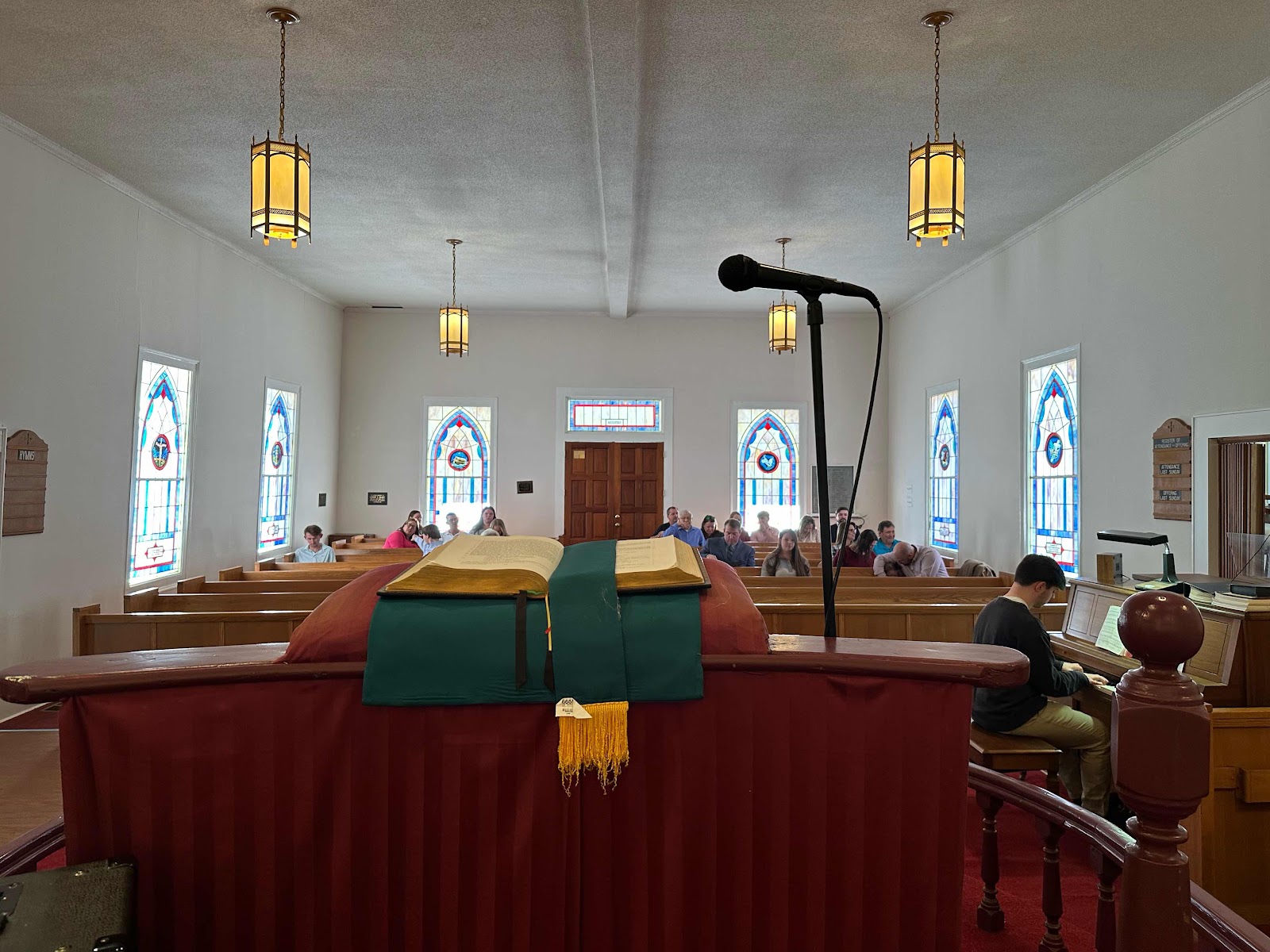
Today is the last part of a 6-week sermon series on instructions Paul is giving to Timothy, who was a young pastor serving a church in the region of Ephesus. Actually, Timothy had spent a lot of time with Paul during his missionary journey and now Paul is giving Timothy some helpful information in what it means to be a pastoral leader of a church.
For the first Sunday of our Dear Timothy series, the pastoral advice was for Timothy to set a culture where God’s overflowing love and grace welcomes all people. For the second Sunday, the pastoral advice was to emphasize the importance of prayer which includes praying for our needs, the needs of others, and offering prayers of thanksgiving. Paul wants Timothy to have a praying church.
For the 3rd Sunday, Paul’s spiritual advice to Timothy was for him to continue to pursue a godly life, a life that Paul describes as filled with faith, love, endurance, and gentleness. Paul also refers to pursing a life in which we take hold of the life that really is life.
Those first three Sundays were based on our appointed readings from Paul’s 1st letter to Timothy. For the past couple of weeks, we have been looking at Paul’s 2nd letter to Timothy.
Paul’s 1st pastoral tip in this 2nd letter was for Timothy to rekindle the gift of God that was already in him thanks to his mother, his grandmother, and through Paul himself when he commissioned him to be a pastor.
And last Sunday, Paul’s instructions to Timothy was to always remember Jesus. We get this in chapter 2, verse 8 where Paul writes, “Remember Jesus Christ, raised from the dead, a descendent of David.”
Paul is telling Timothy this, but he is also instructing him to do the same with the church he is pastoring. “Remind them of this,” Paul says in verse 14.
For this 6th and final week of our Dear Timothy series, Paul’s instruction to Timothy is, “Proclaim the Message.” Proclaim the message.
Now, of all of the pastoral instructions Paul has been offering Timothy, this one might be the one that Timothy has been waiting to hear the most. I mean, what preacher doesn’t want to hear someone say to them, “proclaim the message!”
There’s a reason that pastors are also referred to as preachers. We love to preach. And specifically, we love to preach the good news of Jesus Christ in the most creative, thoughtful, and engaging way that we possibly can.
Maybe you have heard this old joke where a young boy told the pastor, “When I grow up, I’m going to give you some money.” The pastor said, “Thank you, but why would you do that?” And the little boy said, “Because my dad says you’re one of the poorest preachers we’ve ever had.”
In all my years of pastoral ministry, I have yet to preach the perfect sermon, but I sure do love the challenge! The rule of thumb in preaching is that the pastor should spend 15 to 20 hours per week in preparing sermons. And you might wonder why that much time is needed to prepare a sermon but there’s a lot that goes into it.
First, you pray for God to open your mind and heart to what God is wanting to say through you in the upcoming sermon. Then you read the appointed scriptures several times to become familiar with them, catching anything that stands out in those readings.
Then you think about the context of that scripture like who wrote it, to whom it was first written, when was it first shared, what comes before and after that scripture passage, and how does it connect with the the rest of the Bible.
All of this work takes time because we don’t want to assume that we already understand the meaning of that scripture passage. Often times we discover something new about that text that we never saw before and that new understanding can take us down an entirely different path than what we were expecting.
And after this first part of the sermon process, you start thinking about what God is wanting to say to to us through that scripture. And that’s the really challenging part. The bible was written 2 to 3 thousand years ago and over a period of several centuries to people who lived in a very different culture and historical time period than we do. How does this ancient book speak to us today?
I believe the reason that the Apostle Paul is encouraging Timothy to proclaim the message is because he knows it’s not an easy task but it’s one that as he writes, can both challenge and encourage us to be the people God has called us to be. “Convince, rebuke, and encourage,” Paul tells Timothy.
I think most preachers know that it’s probably not a good idea to do a lot of rebuking in the first sermon they preach at their new church. Preachers need to be aware of when it’s appropriate to rebuke and when encouragement is the order for the day.
As I’ve said to people, you can’t preach about cute puppies and butterflies every single Sunday. Sometimes, the preacher will step on some toes that challenge long-held beliefs and assumptions.
I remember soon after 9/11, I preached a sermon about the difference between Muslim terrorists who hate America and Muslims in general who deeply love God and respect people who have different faiths and beliefs. Yeah, there were some people who didn’t really like that sermon since a lot of our congregation had connections with a nearby Air Force base and they were on high alert.
There were churches in that same community who were fanning the flames of anti-Muslim rhetoric in their sermons, and I just felt that God wanted to speak a different truth through me that Sunday.
There was another time when someone came to see me because they were upset with something I said in a sermon and I said,
“You know, I’m not asking you to agree with everything I say in my sermons. Maybe I could have said something in a more helpful way but here’s the wonderful thing about sermons. You’ll get a new one the next Sunday, and a new one after that. My assurance to you is that given enough time, this preacher will eventually share a word or two that will fall deep within your soul, and you will leave here saying, ‘I think God spoke to me today.’”
Several years ago, I heard a sermon where Christian author and speaker, Tony Campolo gave a sermon at Annual Conference one year. Tony stepped on a lot of toes that day by calling out people who spend more on themselves than they do on the poor, people who own luxury cars but give very little in charitable giving, teachers who look out for their own interests at the expense of the children they are teaching. He also said something about lawyers, but I can’t remember what he said about them. I heard lots of ouches during worship that day.
And to be fair to Tony, his sermon also included some stories that reflected his own struggles in living out his faith, so he was stepping on his own toes as well.
After that worship service, I asked two people what they thought of Tony’s sermon. The one person said that we need to hear more sermons like that because Jesus calls us to a radically different way of living, and we have become too comfortable in what it means to be followers of Jesus.
The other person looked at me with a scowl, and he said, “Well if you want my opinion, I hope he catches an early flight back to Philadelphia where he came from.”
Ah, the joy of preaching! Paul says to Timothy, “proclaim the message.”
One of my favorite preachers is Fred Craddock. During my seminary years, we used his textbook on preaching. He was in Dayton, Ohio one year and I was able to meet him, and I asked him to name a couple of his favorite preachers. Without even pausing, he said, “the best preachers I’ve heard are those who know their congregations extremely well.”
When preachers know their congregations and when congregations have learned to trust their preacher, Sunday mornings become an opportunity to convince, rebuke, and encourage as Paul writes to Timothy.
At the end of his book on preaching, Fred Craddock offers this thought on preachers who proclaim the message week in and week out. And it sounds like something Paul would say to Timothy as well. In writing about preaching with passion, Craddock writes, and this is a lengthy quote that I’m about to read…
He writes, “All of this is not a call for fiery styles of preaching or a return to the ways of frantic evangelists. It is simply to say that there is a passion appropriate to the significance and urgency of the gospel, and there is no valid reason to conceal that passion. Restraint, yes; but to allow reaction to caricatured and exaggerated passion to determine our method is to permit the very thing to be avoided to be the primary shaper of preaching in our time. There is no thought here of manufacturing passion so that by a kind of imitative magic our listeners may catch it. There is no blindness here to the fact that one sometimes enters the pulpit with no heart a flutter, no pulse racing, no burning in the bones. But passion, even then, need not be absent. The fact is, the act of preaching is itself integral to our fuller embrace of the very message we speak. It is in teaching that we learn, and it is in telling the Good News that we hear and accept it ever anew.”
He continues, “All of us know that it is in being kind that we become kind, and in behaving as a Christians that we become Christian. Is it unreasonable to believe, then, that it is in listening to our own sermons that we become more passionately convinced? If this is our conviction, then reexperiencing the message as we deliver it cannot fail to be a time of speaking from passion to passion.”
And then Fred Craddock continues this thought and concludes his book on preaching with this insightful thought. “And who can conceive of any greater motivation for preaching our very best than this: there is at least one person in the sanctuary listening, one person who, because of this sermon, may have a clearer vision, a brighter hope, a deeper faith, a fuller love.
That person is the preacher.”
Dear Timothy, proclaim the message!


No comments:
Post a Comment