A United Methodist Pastor's Theological Reflections

"But thanks be to God, who gives us the victory (nikos) through our Lord Jesus Christ." - I Corinthians 15:57


Sunday, March 15, 2020

March 15 Sunday Online Worship - Athens First UMC


Welcome to our March 15 online worship @ Athens First UMC!
2 S. College St., Athens, OH 45701


Greeting From Pastor Robert


Call to Worship
L: We are grateful for these days of Lent, a time to think about the life of Jesus and the men and women who followed him.
P: We bring our doubts, our struggles, our yearnings for new life.
L: We come to give thanks to God who offers all of us a deeper relationship with Jesus Christ. Let us join our hearts in worship.

Hymn                                 Jesus Calls Us


Welcome & Passing the Peace
[Blu shares God’s peace with us by reminding us that spring is just around the corner. May the peace of Christ be with each of us during these anxious times as we await the hope and promise of resurrection and new life.]


Prayer of Confession & Words of Assurance
L: God of mercy, hear the prayers of your people. For every time we have attributed your miracles in our lives to our hands alone,
​P: Forgive us, we pray.
L: For every time we promised to trust you but turned to our own way,
​P: Grant us mercy, O God.
L: For the many opportunities to share our faith that we have ignored,
​P: Show us what it means to love in your name, O Lord.
​L: For all that keeps us from loving you and our neighbors,
​All:​Tear down the barriers. Forgive our sins and show us what needs changing. Remake us into disciples of compassion and courage. Amen.
L: In the name of Jesus Christ, you are forgiven.
P: In the name of Jesus Christ, you are forgiven.
All: Thanks be to God!

Old Testament LessonPsalm 63:1-8
O God, you are my God, I seek you,
    my soul thirsts for you;
my flesh faints for you,
    as in a dry and weary land where there is no water.
So I have looked upon you in the sanctuary,
    beholding your power and glory.
Because your steadfast love is better than life,
    my lips will praise you.
So I will bless you as long as I live;
    I will lift up my hands and call on your name.
My soul is satisfied as with a rich feast,
    and my mouth praises you with joyful lips
when I think of you on my bed,
    and meditate on you in the watches of the night;
for you have been my help,
    and in the shadow of your wings I sing for joy.
My soul clings to you;
    your right hand upholds me.
Gospel Lesson - John 6:1-14

After this Jesus went to the other side of the Sea of Galilee, also called the Sea of Tiberias. A large crowd kept following him, because they saw the signs that he was doing for the sick. Jesus went up the mountain and sat down there with his disciples. Now the Passover, the festival of the Jews, was near. When he looked up and saw a large crowd coming toward him, Jesus said to Philip, “Where are we to buy bread for these people to eat?” He said this to test him, for he himself knew what he was going to do. Philip answered him, “Six months’ wages would not buy enough bread for each of them to get a little.” One of his disciples, Andrew, Simon Peter’s brother, said to him, “There is a boy here who has five barley loaves and two fish. But what are they among so many people?” 10 Jesus said, “Make the people sit down.” Now there was a great deal of grass in the place; so they sat down, about five thousand in all. 11 Then Jesus took the loaves, and when he had given thanks, he distributed them to those who were seated; so also the fish, as much as they wanted. 12 When they were satisfied, he told his disciples, “Gather up the fragments left over, so that nothing may be lost.” 13 So they gathered them up, and from the fragments of the five barley loaves, left by those who had eaten, they filled twelve baskets. 14 When the people saw the sign that he had done, they began to say, “This is indeed the prophet who is to come into the world.”

L: This is the Word of God for the people of God.
P: Thanks be to God!

Special Music                  I Got Me Flowers           R. Vaughan Williams


Sermon        The Twelve Disciples of Jesus: Andrew & Phillip                    
                                                                     Rev. Robert McDowell


     A friend of mine was telling me how she had been thinking about names for baby boys lately because her daughter was expecting her first child. She said that she was surprised to find that the names of seven of the disciples are still in the top 100 for most popular male baby names in the US.
     The name  “James” leads the way at  #19.  One of our disciples for today  “Andrew” comes in at #40.  And “Philip” is in the top 300 names at the place of #295.  The influence of  the disciples is still seen in the way we name our children. How else have the disciples Andrew and Philip changed our world?  How can their lives change us?
     Most of the stories about Andrew and Philip are found in the Gospel of John. They were fishermen from Bethsaida, a fishing village on the northern shore of the Sea of Galilee.  They stand out in the group of disciples because they both had Greek names, not Hebrew ones.
     At some point in his life, Andrew had left his home and had traveled down to the Judean wilderness and had become a follower of John the Baptist. Through John's introduction, Andrew  has encountered Jesus.  Andrew spends a day with Jesus and decides that he will follow him- he is the first disciple to make that decision.
     The next thing that Andrew does is to go and find his brother, another fisherman who we will know as Peter.  Andrew tells him the exciting news:  “We have found the Messiah.”
     Philip also has traveled to the region where John the Baptist is preaching. Jesus notices Philip and invites him to come and learn and be his disciple.  Philip in turn encourages his friend Nathaniel who we discovered a few weeks ago probably also went by the name, “Bartholomew,” to “come and see” all that Jesus is doing.
     Both Andrew and Philip were actively seeking God; they had left their daily routine of fishing in order for their faith to grow. Jesus recognized their spiritual longing and included them on his team.
     Descriptive words for these two disciples are “seeking and sharing.” Andrew told his brother about Jesus and Philip told his friend.
     Two disciples now have become four disciples. What they had received they also wanted to share. 
     Pope Benedict wrote a book about the disciples a few years ago.  In it he says this about Philip: “This apostle encourages us to become closely acquainted with Jesus.” 
     We can't pass on our exact faith experience to someone else, but we can encourage them to get to know and to love our friend Jesus.  We can plant the seed and we can open the door.
     Philip and Andrew continued to introduce people to Jesus.  In the Gospel story for today, Jesus was facing the dilemma of feeding many hungry people. A large crowd had gathered to hear his teaching and now it was late in the day. People had become hungry and needed to be fed. 
     It was Andrew who brought the boy with his lunch of fish and bread to Jesus. He helped make a connection between the child and Jesus. Andrew was not sure where that action would lead; after all there were thousands of people to feed, and the boy's lunch was small. Andrew enabled the boy to give of himself.                                                                                                                                                                       
     On another occasion, there were Greeks who wanted to meet Jesus. The crowd was large but Philip and Andrew made a way for this to happen. They introduced these outsiders to Jesus. 
     Even though Andrew and Philip introduced others to Jesus, they themselves did not have all the answers.  They questioned and grappled with their faith. We do not have to have all the answers in order to help someone else become closer to God.
     When Jesus asked Philip how they were they going to feed so many,  Philip thought the answer was way beyond their resources. When Andrew looked at the boy's small lunch, he didn't see how that could possibly be adequate.  Like Andrew and Philip, we want to walk by faith and yet our doubts naturally arise. Will our resources be adequate? We offer up what we have and we trust that God will work through our efforts.


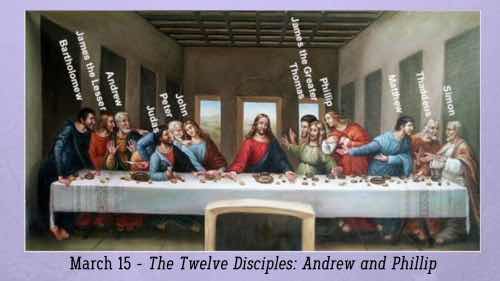
     In Leonardo da Vinci's painting, you will find Andrew on the left side of Jesus seated near to his brother Peter.  Andrew has his hands with palms out as if he is pushing away Jesus words that someone at that very table will betray him.  On the opposite side we have Philip who is in the threesome with James and Thomas. 
     Philip's hands are clutched tightly at his chest as if he is saying “Not me, Lord, not me.”Andrew and Philip have known Jesus for the longest time of all the disciples and the painting shows their dismay vividly. 
     The book of Acts gives us the impression that the disciples shared the Gospel with others, but we don't get many details about who went where except for Peter and Paul. Through the centuries, stories were told to fill in the gaps of the apostles' adventures.
     For Andrew and Philip, there are many extra-Biblical stories and traditions about them, especially within Orthodox churches.  They are portrayed as people with great passion to fulfill their mission: to let others know about Jesus Christ.
     Andrew and Philip did not travel together in these stories but took separate routes.  Andrew is said to have gone on various missionary trips  within the Black Sea area that included Russia, Bulgaria, Romania with his life ending in Greece.  Philip is portrayed as going to Turkey and dying there.     
     There are legends of them bravely speaking out against wrong and fighting against cannibals and snakes and horrendous storms at sea.  They are both said to have died by the hands of rulers who were upset that their wives had become Christian through the preaching of Andrew and of Philip.                      
     Andrew is said to have died on an X shaped cross which is known today as St. Andrew's cross which is the visual on the flag of Scotland. How did Andrew who was a first century Galilean fisherman ever become related to Scotland?  For those of you familiar with golf courses, no, he wasn't a pro golfer....
     There are a variety of stories of how some of his bones were taken to Scotland  from Greece and how these relics brought victory in a Scottish battle. Through this, Andrew became  the patron saint of Scotland.
     Some traditions say that Philip was also martyred for his faith by being hung upside down on a cross. The emphasis in both these legends is that Andrew and Philip both chose to die in a different manner than Jesus himself. 
     The disciple Philip was in the international news within the last ten years with this headline: “Philip's Grave Discovered.” At excavations in Turkey, at the traditional place of his death, archaeologist  believed that they had uncovered the remains of the ancient church built over his burial place. Isn't it amazing  that the interest in his life continues 2,000 years later!
     Ukraine is in the midst of internal strife and dominates our news stories today. The Ukraine is a land with a long history of Christian  faith and their traditions link them to the apostle Andrew. There are claims that he first brought them the Gospel on one of his journeys in the Black Sea area.
     Seeking and sharing, questioning and striving for more faith, obeying Jesus' instruction to go and tell: this is how Andrew and Philip followed Jesus. In the Scriptures, these disciples  are remembered by just a few stories. 
    What stands out in your life?  If your years of faith had to be described by one story, what would it be?
     One legend of Andrew is that he had such eyes of compassion that he saw something of Jesus in everyone.  Once he thought the captain of the ship was Christ himself and that is why they sped across the waters, and arrived safely at their destination. Another time Andrew thought the peddler on the docks was Jesus and so he treated him with great kindness.
     In my own life, there are stories that I would not want to be remembered by. And I have not been chased by lions, or shipwrecked at sea, or have preached to thousands.  But I hope that along the way I have shared some love of Christ, and because of that, someone has wanted to know more about him.  What story would you want to be remembered by?
     There is a prayer that honors what Andrew and Philip did.  It reads “O God, give us grace to follow Jesus without delay and to bring those near to us into his kingdom.”
     May that prayer be seen in each of our lives.
Sermon Discussion Questions
Both Andrew and Phillip were disciples who were willing to seek and share their faith with others.
In what ways have you shared your faith with others? In what ways are you willing to seek a deeper faith?
Who are the people in your life who have been like Andrew and Phillip and introduced you to Jesus?
Say this simple prayer which is a traditional prayer in honor of the disciples, Andrew and Phillip: 
O God, give us grace to follow Jesus without delay and to bring those near to us into his kingdom. Amen.”
Hymn                            Lord, I Want to Be a Christian


Pastoral Prayer & The Lord’s Prayer
O Lord, we want to be Christians in our hearts. We want to be more like Andrew and Phillip who took the time to invite others to encounter your healing and saving presence.

As we think about Andrew and Phillip, we are mindful of the overwhelming news of significant health concerns facing our world. We especially pray for those who are most vulnerable to the corona virus that is spreading rapidly in our communities. We are reminded of how interconnected the world is with how easily viruses can be spread from person to person.

But Lord, we are also reminded that you are the one to whom we can turn during times of uncertainty and fear. You are the one who took just fives loaves and two fish and fed the multitude, thanks in part to a young boy who was brought to you by Andrew. You are the one who encountered people from the crowd who were brought to you by the disciple, Phillip. O Lord, may we be like Andrew and Phillip who invited others to encounter your healing and saving presence.

Sometimes our discipleship involves very simple things like doing extra cleaning in our church to provide a healthy church environment, making Easter goodie bags for our home-bound members, checking on the well-being of a neighbor, feeding the hungry, and participating in an online Sunday worship service. In all these ways, we are your disciples. We are inviting others to encounter your healing and saving presence.

In these anxious times, we especially pray for world health experts and community leaders in determining the best courses of action for helping to stop the spread of this virus. Help each of us to be attentive not just to our own needs but to the needs and fears of others. Draw our attention to “The Last Supper” painting and how you remained calm even during a very anxious and fearful time.

And at this time, I invite each one of us to extend our hands in front of us with our palms facing upward like Jesus is depicted in the painting, and silently offer to him any fears and anxieties that we may be carrying in this moment. As you name those concerns, allow them to be lifted to our gracious and loving Heavenly Father who is more than able to fill our hearts with peace.

And with our palms still being extended, I invite us to pray the prayer that he invites us to say together…. 

Our Father, who art in heaven, hallowed be thy name. They kingdom come. Thy will be done on earth as it is in heaven. Give us this day our daily bread and forgive us our trespasses as we forgive those who trespassed against us. And lead us not into temptation but deliver us from evil. For thine is the kingdom, the power, and the glory forever. Amen.

Church News

1. Thank you for joining us for our online worship! Athens First UMC is joining a thousand churches in our West Ohio Conference at the urging of our Bishop Gregory Palmer in canceling in person worship services March 15 and 22 to help stop the spread of the coronavirus. Join us again next Sunday, March 22 for another online worship service on this Nikos blog as we continue our “Twelve Disciples of Jesus” season of Lent series. We hope to resume our 9 am & 10:30 am worship schedule on Sunday, March 29. We will keep you updated through this website as well as through our church’s social media (Facebook/Twitter/Instagram.)

2. We are encouraging one another to refrain from shaking hands and hugging as well as keeping an acceptable distance to help in stopping the spread of the virus. We have also decided to use a new Holy Communion method that will include the use of sealed wafer and juice cups. Thank you for helping us to have a healthy church environment.

3. In consultation with the Athens Count Health Department, we will be able to offer Monday Lunch on March 16 but will need to suspend it at least through the beginning of April due to the health concerns of both our volunteers and those we would be serving.

4. We have also canceled several upcoming church events these next several weeks as well as our Growing Tree Pre-school which was scheduled to open again this week. The preschool will remain closed the next three weeks in line with Athens City Schools. 

5. As far as other smaller scale church meetings such as small groups and other events, we are leaving these decisions up to the discretion of the event leaders. We do strongly urge groups who do continue to meet to refrain from shaking hands and to keep extra distance from each other to help curtail the spread of the virus. The Athens County Department of Health has informed us that groups of more than ten people discontinue meeting in person together. Please let our church office know if your group will not be meeting during this time.

6. For any prayer needs during this time, we are encouraging people to rely on our email prayer chain. Those requests can be sent to Vicki Butcher, one of our prayer coordinators, butcherv@ohio.edu

7. Our church office hours will be limited the next two weeks due to scheduling conflicts, but we have plans to check voice messages and emails on a daily basis. The church building will remain open, Monday through Thursday during this time even though our Sunday services are canceled due to coronavirus concerns. 

8. One of our church members, Bernie Cooley passed away on March 12. At this time, there are no details regarding a funeral service. We lift up the Cooley family in our thoughts and prayers.

9. Join us each Sunday for our online services and stay updated through our church’s email Connections newsletter and social media pages.

10. Let us offer our gifts to our gracious God.

Offering Our Gifts
[We are grateful for the continuation of your financial gifts to support the ministries of Athens First UMC, especially during these couple of weeks when we are not meeting in person for worship. Checks may be sent to the church and we also offer an online giving option on our church website. The link for setting up online giving is https://osvonlinegiving.com/2927.]

Closing Hymn            Go Make of All Disciples


Benediction

Join us back here next Sunday (March 22) for our online worship!

[For the 1st two sermons of our “Twelve Disciples of Jesus” sermon series click here for March 1 and here for March 8.]

Monday, March 9, 2020

Sunday Pastoral Prayer (March 8/Lent) Athens First UMC


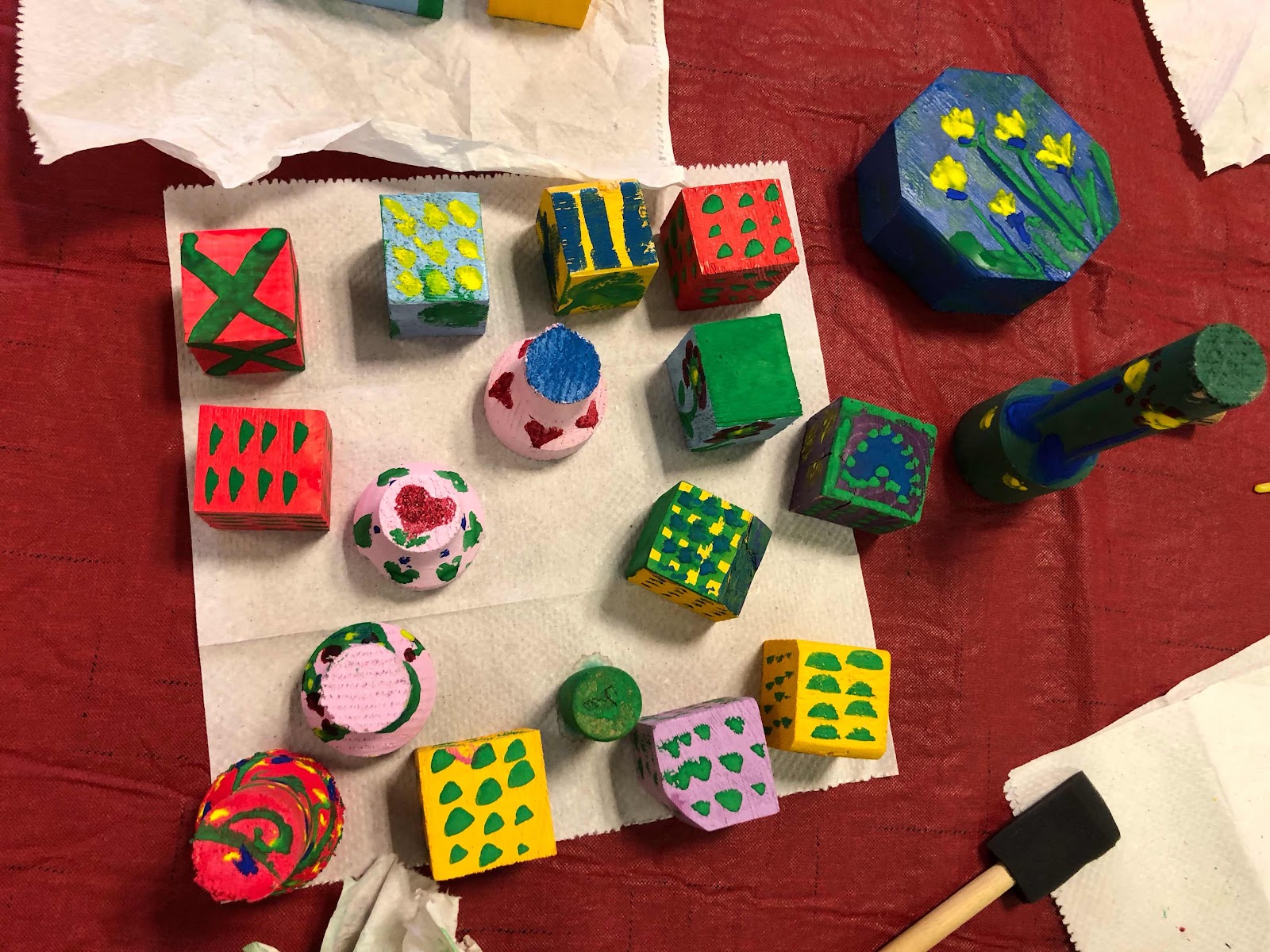
[The picture above are some of the blocks that our church members painted for Passion Works during our Athens First Saturday gathering this weekend. In addition to this project, we also made blankets for the community, arranged and delivered flowers to local hospital patients, and led a worship service for the residents at Lindley Inn Assisted Living. For the Sunday sermon on the 2nd Sunday of our “Twelve Disciples of Jesus” Lent series, click here.]


Lord Jesus, how can you be so calm when everything around you is falling apart? Soon, you will be betrayed, denied, arrested, flogged, and crucified and yet you are at peace as you prepare for what is to come.


During this season of Lent, teach us what it means to trust in our gracious Heavenly Father the way that you trusted him around that Last Supper table. Teach us to be forgiving the way that you are forgiving. Teach us to be open to the Holy Spirit, the way that you were open to the leading of the Spirit in your ministry. Teach us to be calm during these anxious times.


Lord Jesus, just as you kept your focus on your mission and purpose, remind us of the mission you have given to each one of us; to be a church that welcomes all, to share our faith with others, to do all the good we can to all the people we can, to be more willing to listen than to speak, to support those who were in the path of the recent tornados down south, to use the gifts you have given us to bless others, and to nurture our own souls as we move onto perfection in this life. 


O Lord, help us to grow in what it means to be a disciple-making church. Bless our teachers, our small group facilitators, our prayer coordinators, our Leadership Board members, our hospitality volunteers, our singers, our musicians, our staff members, our Growing Tree Preschool teachers, our Monday Lunch volunteers, our altar guild and liturgical arts helpers, and all of our ministries that help people to grow in being your disciple. 


And Lord, help us to not be too envious of those who are away from church today enjoying Spring Break. We are happy for them. Help us to not be too envious.


But seriously, Lord thank you for giving us these times on the calendar like Spring Break and like the season of Lent that push us out of our normal routine so that we can look at our lives and our faith from a fresh perspective.


And thank you for the routine of rituals like praying the Lord’s Prayer which we now join in praying together…


“Our Father, who art in heaven…”

Sunday, March 8, 2020

Sermon (March 8) by Rev. Robert McDowell


     We continue our Lenten series on the twelve disciples by focusing on James the Lesser and Thaddeus.  We’re using “The Last Supper” painting by Leonardo da Vinci to highlight each disciple.

     Last Sunday, I shared some of the key features of this famous painting. The reason Leonardo da Vinci painted this scene from the Bible was to help a religious order of monks to meditate on this scene whenever they would gather for a meal in the refectory. In a similar way, we also have the opportunity to meditate on this scene of Jesus with his disciples during the Last Supper.

     A friend of mine who’s an artist pointed out another key feature of this painting that I think we will find very meaningful. To help us appreciate this feature, we’re going to look at another picture of The Last Supper painting that has lines that point to Jesus.


     My artist friend says that these lines help us to see how Leonardo da Vinci was using a 1 point perspective. This was used during the Renaissance period which is the time period for this painting. Leonardo da Vinci wants our eyes to be drawn toward Christ as the focal point. 

     This was da Vinci’s creative way of reminding us that even though we may turn away or deny Christ, we can still be drawn back to him as the center of our lives. The message is that there is always hope and the opportunity to begin anew in our faith which is one of the reasons why the church observes the Season of Lent.

     These several weeks leading up to Easter are an important time for us to refocus our lives on Jesus Christ and to be one of Jesus’ disciples, regardless of how we may have strayed from him in the past.  I’m grateful for these artistic insights.

     Let’s begin this morning by looking at the disciple, James the Lesser. In the painting, he is the 2nd disciple from the left. He’s next to Bartholomew also known as Nathaniel who was one of the disciples we focused on last Sunday.

     If you remember, the disciples are reacting to when Jesus told them that one of that would betray him.  Notice how James the Lesser, the 2nd disciple from the left is reacting to Jesus’ words. 

     He is reaching toward Peter and you’ll notice that Peter is leaning toward Jesus. Peter doesn’t seem to be aware that James the Lesser is touching his shoulder. What do you think James the Lesser is thinking about as he tries to get Peter’s attention? This painting invites us to reflect on his reaction.

     So what do we know about James the Lesser? Well, it’s a little complicated. The New Testament refers to at least two people who were known as James, probably three, and maybe even eight.

     If you’re keeping score, here are the eight references of the name, James in the New Testament. 

     There’s a reference to James the Greater who was also one of the twelve disciples. Because he appears in the same list as James the Lesser, we know that there are at least two people known as James. 

     We also have James, the brother of the Lord, the brother of Jesus. We have a James who wrote the Epistle of James. There’s James, Son of Cleopas. There’s a James the Nazarene. We also have James, a kinsmen of Jude who was also known as Thaddeus who is the second of the two disciples we are focusing on today.

     And last but not least, we also have James who was the brother of the writer of the “Epistle of Jude” which is the name of a very short book found in our New Testament. This all leads to an important question. Are any of these other James references the same person as the disciple, James the Lesser? If so, that would give us a lot of information about this disciple.

     During biblical times, James was a very common name, so there very well could have been many followers of Jesus with this name.

     Most scholars believe that James, the brother of Jesus was the one who wrote the “Epistle of James” because he was the key leader of the church in Jerusalem. He also was known for his ministry with Christians who were from a Jewish background which is the focus of the epistle that bears his name.

     There’s some speculation that James the Lesser who is also known as the Son of Alphaeus might have been the disciple Matthew’s brother since Matthew was also known as the son of Alpheus.  We can only speculate.

     Other scholars wonder if James the Lesser and Thaddeus, our other disciple for today might have been brothers. Both Acts and Luke refer to Thaddeus as the son of James. You might be wondering how this would make them brothers but in the Greek language, the word for “son” and the word for “brother” were often used interchangeably. 

     How many of you are still with me? I think this is a good time to have a pop quiz!  This will be worth half of your grade for the spring semester. 

     The truth is that we don’t have a whole lot of information about James the Lesser. Maybe he had an inferiority complex with a name like that, especially with another disciple who was known as James the Greater. 

      Outside of the bible, church tradition tells us that when James the Lesser was 96 years old, he was thrown off the top of the Temple in Jerusalem because of his faith in Jesus Christ. In a way, this reminds me of the story of when Jesus was in the wilderness and the devil tempted Jesus to jump from the Temple and have his angels save him. Of course, Jesus refused.

     As the story goes, they threw James the Lesser off the Temple. He somehow managed to get up. He staggered around. He then begged God to forgive them for what they had done. This angered the people and so they clubbed him to death and sawed him into pieces. This is why the traditional symbol for James the Lesser is a saw.

     I wonder if this story was told about him because of a reputation for being a very forgiving person in his ministry. This is an important thought for us especially in this season of Lent leading up to Holy Week and Good Friday. As Jesus was hanging on the cross, he looked down upon the people who were taunting him and said, “Father, forgive them for they know not what they do.”

     Last week, Penny and I watched a documentary on a tragic story that happened in Mansfield, Ohio back in 1990. A husband was convicted of murdering his wife. A key witness for the prosecution was their eleven year old son who was in his bedroom at the time and heard what was happening. 

     The documentary that we watched focused a lot on how this young boy who is now around 40 years old has been traumatized by those memories. Collier has gone on to have a successful career. He actually ended up going here to Ohio University. For these past 30 years, he has been writing to his father to get him to admit that he murdered his mother, something which he continues to deny even though he has a life sentence.

     Collier recently went to Marion Correctional Institute to try one last time to hear his father come clean with what had happened. But he still denies it. 

     After that meeting at the prison, Collier met with his therapist and expressed how he isn’t able to forgive what his father has done. And the therapist said something really, really interesting about forgiveness. He told Collier that forgiveness doesn’t necessarily mean reconciliation. It means that point when we can let go. Let go of what you can’t change.

     When I heard that, it gave me this new understanding of forgiveness which is on one level, doing what you can do to seek reconciliation, but when the other party is not willing to make the effort, forgiveness might mean simply letting go. The therapist, then encouraged Collier that the way to let go is to allow yourself to grieve. 

     Lent is a time for us to seek forgiveness and be forgiving, but to also let go of the hurt and the pain. The stories surrounding James the Lesser invites us to be forgiving regardless of how others may or may not respond. Forgiveness might mean allowing ourselves to grieve and to let go of the pain.

     Let’s move on to the disciple, Thaddeus. Thaddeus has three nicknames. He is known as Jude, Judas, and the King James Version uses the name, Labbaeus.

     In “The Last Supper” painting, Thaddeus is the 2nd disciple from the right as you are facing the painting. You’ll notice that Thaddeus is looking at Simon the Zealot who we focused on last Sunday. If you remember, Simon the Zealot could very well have been someone the other disciples turned to during difficult times. Simon is known as the “go to” disciple.

     Now, why did Thaddeus have several nicknames? Since one of his names was Judas, many bible scholars think that it was to distinguish him from Judas Iscariot, the disciple who had betrayed Jesus. The word, “Thad” literally means, “chest.” Maybe Thaddeus was chosen as his new name because of his ability to bench press 400 lbs. We don’t know. Just speculating.

     His nickname, Labbaeus literally means “heart.” For all we know, he might have been a very passionate person in the way he lived out his faith.

     Unlike James the Lesser, we do have a story about Thaddeus in one of the gospels.  It’s the gospel reading that we heard earlier in the service.  Interestingly enough, this story is set in the context of the Last Supper. 

     After this tense scene when Jesus tells them that one of them will betray him and Judas Iscariot leaves the scene, he begins to prepare them for his crucifixion and when he would be leaving them. Of course, the disciples do not understand what Jesus is trying to tell them because it doesn’t make any sense to them. 

     Their expectation was for Jesus to continue leading them, not end up dying on a cross. We have the benefit of hindsight, but they were trying to figure out what Jesus was trying to tell them. 

     In our Gospel reading from John chapter 14, Jesus tells the disciples, “They who have my commandments and keep them are those who love me; and those who love me will be loved by my Father, and I will love them and reveal myself to them.”

     This prompts Thaddeus to ask Jesus a question and notice that it says, “Judas” and in parenthesis, it says, “not Iscariot.” Again, this is why Thaddeus was given a different name to distinguish him from Judas Iscariot. 

     Thaddeus asks Jesus, “Lord, how is it that you will reveal yourself to us, and not to the world?”  He’s trying to grasp where Jesus is going with all of this.  And Jesus goes on to reassure them that even after he is gone, the Father will send them the Holy Spirit who will continue to teach them everything and remind them of all that he has told them.

     Jesus kept his promise because on the fiftieth day after the empty tomb, the Holy Spirit came upon the disciples and this is what empowered the disciples to continue what Jesus had started. They boldly proclaimed the good news of Easter and they were able to do many signs and wonders and point people to the Risen Christ. 

     The question that Thaddeus asked Jesus following the Last Supper wasn’t fully answered until that day when the Holy Spirit came upon the disciples.  This is why the traditional symbol for the disciple, Thaddeus is a flame around his head. The flame is a symbol of the Holy Spirit.

     Jesus wanted Thaddeus to know that he would always be with them through the presence of the Holy Spirit.  I’m glad that Thaddeus asked Jesus what he meant because it gave Jesus the opportunity to reassure the disciples that he would continue to be with them even after his death.

     An elderly church member was telling me how difficult it’s been since her husband’s death several years ago. She said that when he passed away, she felt all alone.  Everything changed when he died.

     She said that her husband would always drive them places and now she was in the driver’s seat. She said that every time she got in their car to go somewhere, she had a little conversation with God. She would say, “Well, Lord, it’s just you and me now. I know you are with me. Guide and direct me in all that I do.”

     Isn’t that incredible? It was her way of reminding herself that she wasn’t alone. The Holy Spirit has been guiding her every step of the way. I’m wondering if this is something we each might do during this Season of Lent. Make it a point each day to have a little conversation with God. Remember that God is always with you, even if you are feeling alone and wondering what the future holds.

     That’s really all we know about the disciple, Thaddeus. Most bible scholars do not think that he is the same person who wrote the short letter of Jude that we find in the New Testament. Even though one of his nicknames was Jude, that letter was probably written by another person named Jude.

     Beyond the bible, church tradition tells us that Thaddeus ended up serving as a missionary in Syria and Armenia.  And it’s worth noting that the famous St. Jude Hospital which provides treatment and research for children with cancer is named after Jude or Thaddeus the disciple. Thaddeus is known as a disciple who did a lot of good for people.

      As we come to a close on these two disciples for today, there are a couple of questions for us to reflect on this week.

     Like the disciple James the Lesser, are you forgiving toward those who have wronged you? 

     And like the disciple Thaddeus, will you remember that you are never alone because you have the Holy Spirit at work in your life?

     Next Sunday, we will focus on two more disciples, Andrew and Phillip.


The Twelve Disciples: James the Lesser & Thaddeus
Sermon Discussion Questions
John 14:18-24
March 8, 2020

We are in the 2nd week of an 8-week season of Lent series on the twelve disciples of Jesus. We are using the famous 15th century painting, “The Last Supper” by Leonardo Da Vinci as a helpful guide for us. It was painted for use in the dining hall of a monastery where the monks who were not permitted to talk would be able to meditate on this very important scene from Holy Week when Jesus was having a Passover meal with his twelve disciples. Look at this version of the painting that includes lines to help us see how Da Vinci wants us to notice how everything points toward Christ. This is known by artists as the “1 Point Perspective.”


In what ways can you spend more time focusing on Christ during this season of Lent? Share some of these specific ways.

James the Lesser is the 2nd disciple from the left in the painting. He is next to the disciple, Bartholomew/Nathaniel who we focused on last week. In the painting, the disciples are reacting to Jesus’ words that one of them would betray him. Notice that James the Lesser is trying to get Peter’s attention who is looking at Jesus. There are eight references of the name “James” in the New Testament which makes it difficult to sort out who each one is. James was a very popular name during biblical times. One of the other twelve disciples is known as James the Greater. Outside of the Bible, church tradition tells us that James the Lesser was thrown off the top of the Temple for his faith. He survived the fall and immediately prayed to God to forgive the people for what they had done, but they clubbed him to death. He was then sawn into pieces which is why the symbol for James the Lesser is a saw. The story about how James the Lesser was forgiving toward the people who had tried to kill him reminds us of when Jesus was hanging on the cross and said to his tormentors, “Father, forgive them.”

What helps you to be forgiving toward people who have hurt you? How can we be witnesses of God’s forgiving love in how we respond to others?

In the sermon, Pastor Robert shared the story of a therapist who told one of his patients who was seeking reconciliation with his father, that forgiveness doesn’t always mean reconciliation. His father was unwilling to repair the relationship even though the adult son gave him every opportunity to do so. The therapist told the son that sometimes forgiveness is about letting go of past hurts, accepting the reality of a broken relationship, and allowing ourselves to grieve the loss of the relationship.

What do you think of this perspective of forgiveness? Do you agree that forgiveness doesn’t necessarily mean reconciliation?

Thaddeus is the other disciple we are focusing on this week. In the painting, Thaddeus is the 2nd disciple from the right. He is looking toward Simon the Zealot who we focused on last week. Thaddeus was also known as Jude, Judas, and Labbaeus. In our Gospel reading this week, Thaddeus asks Jesus, “Lord, how is it that you will reveal yourself to us, and not to the world?” Jesus reassures him and the disciples that after he leaves them, the Holy Spirit will come and will remind them of everything he taught them. This is why the symbol for the disciple, Thaddeus is a flame around his head. The flame is a symbol of the Holy Spirit.

What does it mean for you to know that Jesus is present in our lives through the Holy Spirit? How does the Holy Spirit empower, encourage, and equip you to live out your faith?

Tradition tells us that Thaddeus ended up serving as a missionary in Syria and Armenia. The famous St. Jude Hospital which provides treatment and research for children with cancer is named after this disciple’s nickname which is Jude. Thaddeus is therefore known as a disciple who has one a lot of good for people. 

What are some specific ways that you can do good for someone else this week?

Monday, March 2, 2020

Sunday Pastoral Prayer (March 1/Lent) Athens First UMC


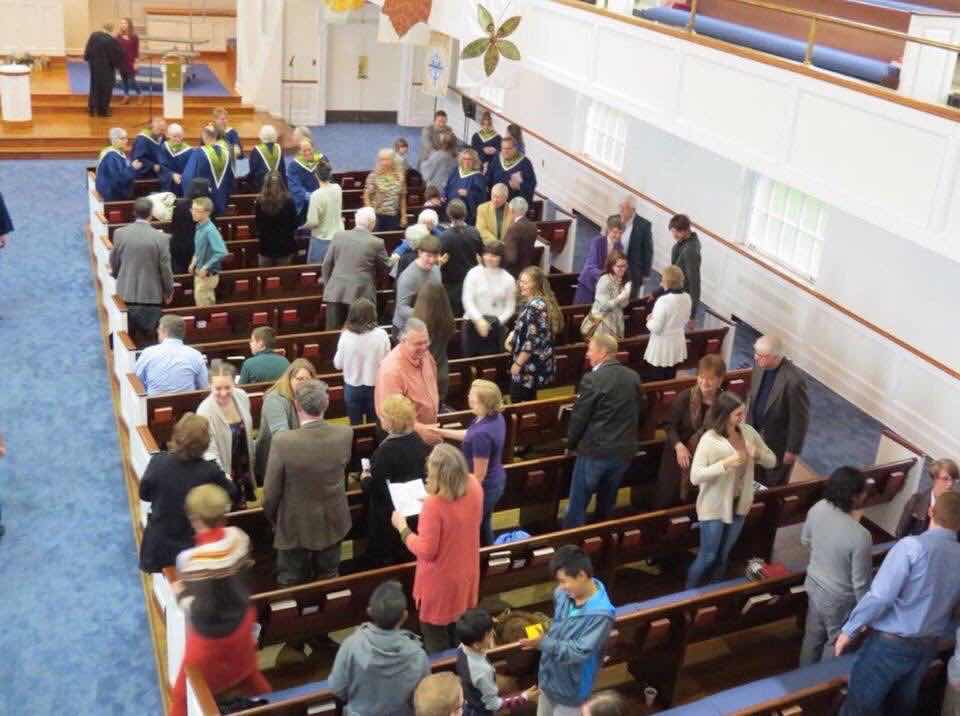
[The greeting time in our worship services is liturgically known as “the passing of the peace.” Our Christian faith has always been a communal faith where we remind ourselves that we are brothers and sisters in Christ. The photo above is one of our Sunday worship services where we welcomed each other with the peace of Christ. Due to the flu season and the uncertainty over the coronavirus, this week for worship, we replaced hand shaking with patting our heart as we greeted one another. It will take time getting used to this new method, but think of it as giving up the sharing of germs for Lent. For the sermon which began our 8-week series on “The Twelve Disciples of Jesus,” click here.]


Lord Jesus, thank you for choosing twelve ordinary people to become your disciples. During these next several weeks, help us to learn from them so that we can be your followers, too. 


Give us a zeal for our faith like Simon the Zealot had. And give us an open mind to know you more deeply like Bartholomew had when he first met you. 


And Lord, as I think about it, those two qualities don’t seem like they can coexist; having zeal and an open mind. And so, we pray that our zeal for you doesn’t turn into tunnel vision where we falsely believe that we have the corner of the truth, but we also pray that having an open mind doesn’t lead us to having a luke-warm faith. Lord, you said that following you wouldn’t be easy.


Give us a zealous faith from the time that we wake up in the morning to the time that we call it a day. Help us to make every moment count. Give us an open mind where we listen to others in the way that we would like others to listen to us. 


Lord, my deepest prayer during this season of Lent is for each one of us to grow as your disciples in what it means to have a loving faith, a learning faith, and a living faith. We know this will mean dying to some things that will allow for new life to happen. May a greater zeal and open mind in our faith be an important part of our season of Lent journey with you and with each other.


In this world that is filled with so much fear, worry, and anxiety over a divisive political culture, a spreading global virus, and things we can’t control, remind us to pray the prayer you taught your disciples and now remind us to say together…


“Our Father, who art in heaven…”

Sunday, March 1, 2020

Sermon (March 1) by Rev. Robert McDowell


    As we begin the Season of Lent, we also begin a new sermon series on who were the twelve disciples of Jesus. I like the timing of this because it gives us an opportunity to journey with the disciples as they followed Jesus to the cross and to the empty tomb.

     You might notice that for six of the eight Sundays, we’re going to need to pair up some of the disciples so that we can cover them all. We’re actually going to look at thirteen disciples since Matthias was the one who replaced Judas Iscariot who betrayed Jesus and ended up taking his own life.

     There are four listings of the names of the disciples in the New Testament and these are found in Matthew, Mark, and Luke and the Book of Acts. In all of these lists, the disciples are paired up, but the pairings are not always the same among the four lists. And so, for this sermon series, I have decided to pair up the disciples by the places where they are seated in the famous Last Supper painting by Leonard da Vinci. 

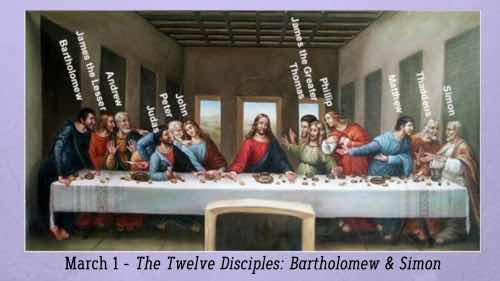
     Let’s take a look at the painting of the Last Supper which includes the names of the disciples. For the most part, we’ll be pairing up the disciples by starting from the outside of the table and working our way toward the middle.

     Before we begin focusing on the disciples, here are some interesting facts about this incredible painting of “The Last Supper.” It took three years for Leonardo da Vinci to complete this painting so it was a monumental task for him. He started it in 1495 and completed it in 1498. 

     He painted it at the request of one of his wealthiest clients who was the Duke of Milan. The Duke wanted this painting to be placed in the refectory or what we would call the dining hall of a local Dominican Church. He wanted the monks who worshipped there to be able to meditate on this Last Supper scene while they ate their meals.

     Now, these monks ate their meals in silence, so can you imagine how powerful this must have been for them as they reflected on this scene whenever they gathered together for a meal. This ended up being a very large painting. It’s 15 by 29 feet so it takes up a lot of space.

     When Leonardo da Vinci painted this, he wanted to experiment with his own version of a fresco painting by using a certain kind of paint that ended up not working very well. In fact, the paint that he used for this painting began peeling off just a few months after he completed it. Only 20% of the original paint has survived this painting which means that most of this painting needed to be restored.

     Like the monks who had the opportunity to reflect on this meal when Jesus was gathered with the disciples for the Last Supper, we too can use this painting during this Season of Lent to reflect on each of these disciples. It will help us grow in what it means for us to be one of Jesus’ disciples.

     I have one more feature of this painting that is very important to highlight as we begin this series and it’s one that I hope we will always keep in mind over these next several weeks. In his own creative way, notice that there is what appears to be an empty spot at the one end of the table next to the disciple, Simon. 

     By including this empty seat, Leonardo da Vinci is inviting you and me to take a seat at the table with Jesus and his disciples. This empty space is to remind us to not be passive spectators during this Lenten journey. Jesus calls us to be at the table with him.

     With this background information in mind, let’s begin looking at our very first disciple in the Last Supper painting, the disciple Bartholomew. Looking at the painting of the Last Supper, Bartholomew is on the far left end of the table. 

     When Leonard da Vinci painted this picture, he wanted to humanize each of the disciples by showing their individual expressions. They are reacting to Jesus who has just told them that one of them will betray him. 

     Each disciple reacts in a unique way, but notice how Jesus is reacting. Unlike the disciples, Jesus remains calm. Notice that Jesus has the palms of his hands facing upward as a symbol of his trust in God.

     This is also symbolizing how Jesus is calmly accepting his mission in the face of adversity. Even though he will be betrayed, the disciples will deny him, he will be arrested, and then will soon be crucified on a cross, Jesus remains calm and resolute. 

     In contrast to Jesus being calm and in control, carefully observe how the disciple Bartholomew is reacting. Notice that he is standing with his arms leaning on the table, almost in a defiant attitude. He looks to be responding to Jesus by saying, “Who would do such a thing!?”

     This is how I see da Vinci depicting Bartholomew in this painting. Maybe you see it a little differently. That’s the beautiful thing about art. It’s meant to help us use our imagination.

     So, who was the disciple Bartholomew and what do we know about him besides what we see in this painting? 

     John, the Gospel writer never refers to the name, Bartholomew in his entire gospel. If you remember, John is the only gospel writer who does not include a list of the twelve disciples like we find in the other three gospels. 

     The thinking here is that it would be strange if John would totally leave out one of the twelve disciples. You would think that he would have at least mentioned Bartholomew’s name, but he never does.  

     If you look at the four lists of the disciples including the one in the Book of Acts, we find that the disciple Phillip is paired with Bartholomew three out of the four times. Even though John doesn’t mention the name Bartholomew, he does offer us the story about Phillip and a man named, Nathaniel. 

     Since the disciple, Phillip is connected with both Bartholomew and Nathaniel, it stands to reason that this could very well be the same person. Are you still with me? This can be a little confusing and what I’m offering is only an educated guess. But I believe that Bartholomew and Nathaniel are two names for the same disciple.

     In our Gospel reading this morning, Phillip finds his friend, Nathaniel also known as Bartholomew and tells him that he has found Jesus of Nazareth, the one who Moses and the prophets had promised would come.

     This is one of the more humorous stories we find in the bible because when Phillip tells his friend about Jesus, instead of offering a statement of faith, Nathaniel or Bartholomew offers a sarcastic comment, “Can anything good come out of Nazareth?”

     And I love how Phillip responds to Nathaniel’s skepticism. He simply tells him, “Come and see.”  Those are three of the best words that we can share with others about our faith.  Sometimes, we think that we have to be bible scholars before we can begin to tell people about our faith.  All we really need to do is offer this simple invitation, “Come and see.”

     The humor in the story continues when Jesus sees Nathaniel or Bartholomew coming toward him. And you have to wonder if Jesus could already sense Nathaniel’s skepticism and sarcasm because he takes the initiative and offers his own little fun jab at Nathaniel. He greets Nathaniel by saying, “Now, here’s an Israelite who can do no wrong.”

     Nathaniel, who was probably surprised by Jesus’ quick wit, asks Jesus how he knew him. And when Jesus said that he had already noticed him under the fig tree before Phillip had called him, that’s all Nathaniel needed to realize that Jesus was who Phillip said he was.

    And this leads Nathaniel to say to Jesus, “You are the Son of God, the King of Israel.”

     I love this little exchange between Jesus and Nathaniel because it reminds us that Jesus meets us right where we are. “If you can make fun of my backwoods town of Nazareth, then I can talk about how you are the first person who has never sinned.”

     In that brief conversation, Nathaniel had met his match and Jesus won him over. This just goes to show how Jesus always meets us where we are. If you’re mature in your faith, Jesus will meet you at the level of your maturity. If you’re skeptical and doubting, Jesus will meet you at the level of your doubts. If you’re questioning your faith, Jesus will meet you at the level of your questions. Jesus always meets us where we are.

     We’ve all been in those social situations where you arrive at an event and you’re a little nervous because you don’t know anyone there.  But what a relief when somebody who is gracious in spirit comes up to you, offers an introduction, and includes you with the rest of the group. 

     This is what Jesus did when he met Nathaniel or Bartholomew. He put him at ease with some humor that he wasn’t expecting. But notice that Jesus doesn’t stop there. Immediately after Nathaniel refers to Jesus as the Son of God, Jesus tells him, “Do you believe in who I am just because I said that I saw you under that fig tree? Spend some time with me and you will see so much more, Nathaniel. You will see the heavens opened and the angels of God ascending and descending upon the Son of Man.”

     It’s like Jesus is telling Nathaniel, “You haven’t seen anything yet.”

     The only other time that the disciple, Nathaniel is mentioned in the scriptures is the time when Jesus appeared to the disciples for the second time after his resurrection by the Sea of Galilee. And I can’t help but wonder that when Nathaniel saw Jesus, now resurrected from the dead, that he was remembering these words of Jesus during their first encounter.

     “You will see greater things than these, Nathaniel.” I would think that rising from the dead would qualify as one of those greater things that Jesus had in mind.

     And so, when I think of Nathaniel or Bartholomew and what it means to be a disciple of Jesus Christ, I think of how important it is to have an open mind to who Jesus is. It means letting go of any preconceived notions of Jesus that would place limitations on what Jesus can do in and through us.

     The Roman historian, Eusebius of Caesarea from the 3rd and 4th centuries recorded that Nathaniel or Bartholomew ended up going to India to preach the good news of Jesus Christ. He also claims that he went to Armenia and it was there where he was killed for his faith. He was skinned alive and beheaded according to church tradition. This is why the emblem for Bartholomew includes three knives. 

     In Michelangelo’s famous Last Judgment painting, Bartholomew is shown holding his own skin. The face on the skin is generally considered to be a self-portrait of the painter, Michelangelo.

     And by the way, as we shall see as we go through this series, according to church tradition, of the twelve disciples, only one of them did not die a violent death for his faith and that was the disciple John who will be our focus on Easter Sunday. The only other exception was Judas Iscariot who took his own life after he betrayed Jesus. 

     So that’s really all we know about the disciple Bartholomew or Nathaniel which ever name you prefer. 

     Let’s briefly talk about the disciple, Simon. On the far right side of the painting, your right, you can see Simon. 

     It’s interesting that the two disciples to his right are looking his way as Jesus offers the words, “One of you will betray me.” Why are these two disciples looking at Simon?

     It’s probably Leonardo da Vinci’s way of showing that the disciple, Simon was seen as a leader, as someone the other disciples could turn to during difficult times. Simon had two nicknames. He was known as Simon the Zealot and Simon the Cananean. 

     The reason there are these two nicknames for Simon was because the word “Cananean” is an Aramaic word that literally means “to be zealous.” Those two words, “Cananean” and “zealot” mean the same thing. 

     These nicknames also help to distinguish the disciple Simon from the other disciple who went by the same name. We know the other Simon as Simon Peter, probably the most well known of all the disciples and who will be our focus on another Sunday.

     If Simon was anything that his nicknames indicates, he probably was somebody who was very zealous for his faith. He would have been very passionate about the scriptures and his commitment in being a disciple of Jesus. I think that Leonardo da Vinci is paying a very nice compliment to Simon in this painting by having the disciples turn to him for support when Jesus shared those very troubling words that one of them would betray him.

     When I think of Simon the Zealot, I think of John Wesley, the 18th century founder of Methodism. He too was known to be very zealous in his faith. Many people who didn’t appreciate Wesley’s zeal, labeled him an “enthusiast” which in 18 century England was a very derogatory word to use of someone.

     To be an “enthusiast” meant that you were somebody who acted impulsively and irrationally without using logic and linear thinking. What some people didn’t realize was that John Wesley emphasized the use of reason as well. He believed that both the head and the heart were important in living out one’s faith in Jesus Christ.

     The scriptures don’t have a lot more to tell us about who Simon the Zealot was. Church tradition teaches us that Simon, along with another disciple we will look at later, Jude, traveled together to Persia to share the good news of Jesus Christ. While they were in Persia, they were killed for their faith. Some sources say that Simon was sawed in half and other sources say that he was beheaded.

     Jesus told the disciples to expect opposition to their message. I’m sure they were well aware of this since Jesus himself ended up dying on a cross for the sins of the world. Sometimes, our walk with Christ involves suffering and pain, but God promises to always be with us.

     The symbol for Simon is a boat hook and fish because he traveled by sea in order to be a fisherman of people and share his faith with as many people as he could.

     As we conclude this first Sunday in our focus on these first two disciples, Bartholomew and Simon the Zealot, here’s what I would like us to focus on this week. The first question is, like Bartholomew, am I willing to set aside my preconceived notions of who Jesus is and follow him?

     And the second question is this: Like Simon the Zealot, am I zealous in my relationship with Jesus Christ? Am I zealous in my worship of God, in my obedience to Christ, and in the sharing of my faith with others?

     Next Sunday, we’ll focus on two more disciples, James the Lesser and Thaddeus.


The Twelve Disciples: Bartholomew & Simon the Zealot
Sermon Discussion Questions
John 1:43-51
March 1, 2020

During the season of Lent and through the week after Easter Sunday, we will be focusing on the twelve disciples of Jesus and seeing what they can teach us about being followers of Jesus. To help us do this, we will be using the famous 15th century painting of “The Last Supper” by Leonardo Da Vinci as our guide for each of the disciples. Here are some interesting points about this painting that might be helpful to us along the way.

1) Da Vinci painted this from 1495 to 1498 at the request of one of his wealthy clients who was the Duke of Milan. It was for the dining hall (refectory) of a local Dominican Church so that the monks who ate in silence would be able to meditate on the spiritual meaning of the Last Supper during each meal.
2) It’s a very large painting, 14 x 25 feet! Unfortunately, the particular kind of paint that Da Vinci used began peeling off only a few months after it was completed. Only 20% of the original paint remains.
3) The painting will be helpful to us during this study because of Da Vinci’s creative way of depicting each disciple’s reactions to Jesus’ words, “One of you will betray me.” Notice that there appears to be an an empty space at the end of the table near the disciple Simon. This is Da Vinci’s way of inviting us to take a seat at the table and be participants and not merely observers.
4) While the disciples in the painting offer a variety of troubled reactions to what Jesus tells them, notice that Jesus remains calm with the palms of his hands facing upward toward God.

This week, we focus on the disciples, Bartholomew (Nathaniel) and Simon the Zealot. There are four scripture passages that list the twelve disciples. Whenever the scriptures list the disciples, Bartholomew is paired with Phillip. Strangely, Bartholomew never appears outside of these lists. Since Phillip is the one who invited Nathaniel to meet Jesus, it is believed that Bartholomew and Nathaniel are the same person. Nathaniel can’t believe that the Messiah would come from an unknown town in Nazareth which leads to a spirited conversation between the two. Church tradition (post-bible) tells us that Nathaniel ended up going to India to preach the good news of Jesus and was skinned alive and beheaded. It’s because of this that the symbol for Nathaniel is three knives. Notice in the painting that Da Vinci depicts Bartholomew (Nathaniel) standing with his arms leaning on the table in a defiant attitude. One of the things that we learn from Bartholomew is that it is important to set aside our preconceived notions of who we think Jesus is so that we can see him more clearly.

What helps you to have an open mind about who Jesus is?

Simon the Zealot (not the same as Simon Peter) is the other disciple for this week. He is on the far right side of the painting. The disciples near him are turning to him for answers to why Jesus would say that one of them would betray him. This suggests that the other disciples turned to Simon for support during confusing times such as this. Because he was given the extra name of “Zealot,” some have speculated that this is because he was very zealous in his faith. Perhaps he was even a political revolutionary who was looking for a Messiah to overthrow the Romans and lead Israel to independence. Church tradition tells us that Simon the Zealot joined Jude in traveling to Persia to share the good news of Jesus and they were killed for their faith. It is said that Simon was either sawed in half or beheaded. He is symbolized by a boat hook and fish reminding us that he traveled by sea in order to be a fisher of people for the gospel.

Since Simon was known for his zealous faith, what helps you to be zealous and fervent in your relationship and commitment to Jesus Christ?

Conclude your time with this prayer of reflection:

Lord Jesus, on this first week in the season of Lent, we confess that that we have not always been your faithful disciples. We have heard your call to follow you, but we have often played it safe instead. Help us to become more like Bartholomew and Simon who served you with zeal and with an open mind. Thank you for your grace which accepts us for who we are and transforms us into the disciples you want us to be. Amen.