Welcome to our
January 16
online worship service!
Athens First UMC
2 S. College St., Athens, OH 45701
[Live-Stream Begins @ 10:25 AM]

(Nee'-kos) Biblical Greek Word for "Victory"
Whenever we think of baptism, we most likely think of water. Thank you, Captain Obvious! It’s kind of hard to have a baptism without water.
This reminds me of the joke about local church leaders who got together to do their part to conserve water in their community during a severe drought. The Baptists decided to only baptize by sprinkling. The Methodists agreed to baptize by just using wet-wipes. The Episcopalians announced they would issue rain checks. And the Catholics began to pray for the wine to turn back into water.
That’s your religious humor for the day.
In our Gospel reading for today, John the Baptist told the crowd, “I baptize you with water; but one who is more powerful than I is coming; I am not worthy to untie the thong of his sandals. He will baptize you with the Holy Spirit.”
So which is it. Water or Spirit? And the answer is, “yes.”
There’s a book that is required for new pastors to read on the meaning of Holy Baptism. The title is appropriately called, “By Water and the Spirit.” This book lays out a theological understanding of the meaning of baptism.
One of the key understandings of baptism is related to the title of that book. Baptism involves water and Spirit. It involves water because water is a symbol of being cleansed.
Water also reminds us of so many stories in the Bible like the water that was present when God created the world, the story of the flood and how God saved Noah and his family through the building of an ark, the story of when God freed the Hebrews who were slaves in Egypt by parting the Red Sea, God then provided them with water from a rock as they traveled for forty years in the wilderness, and then they crossed the Jordan River and into the Promised Land. Like the parting of the Red Sea, it was by crossing through the water of the Jordan River that led them to freedom and a new life as God’s people.
In the New Testament, the Apostle Paul talks about when someone is immersed in water, it reminds us of the life, death, and resurrection of Jesus. We are submerged into the water symbolizing when Jesus’ died on the cross and our need to die to ourselves, but then we come out of the water symbolizing Jesus’ being raised from the dead and the new life we now have through the Risen Christ.
And so, water is a really big deal in the Bible and when we think of baptism, we have all of these biblical stories and references in how water leads to freedom, cleansing, and new life.
Just as water is an important part of the meaning of baptism, the Spirit is equally important.
In almost every reference to someone being baptized in the New Testament, it also refers to the presence of the Holy Spirit.
When Jesus was baptized with water, we are told that the Holy Spirit descended upon him like a dove. Water and Spirit. The scriptures emphasize how they both are essential in our understanding of baptism. They are inseparable.
We often only think of water when we think of baptism, but the Holy Spirit is equally important.
Luke’s Gospel in known for how it is very descriptive of the role of the Holy Spirit in baptism. The Greek word for Spirit that is used here is pneuma. So, when we couple water with spirit in referring to baptism, we can just as easily say that baptism is about water and wind. And just like water is an important part of the creation story in the Book of Genesis, so is wind.
The first verse of Genesis says, “In the beginning, God created the heavens and the earth. The earth was timeout form and void, and darkness was over the face of the deep. And the Spirit or wind of God was hovering over the face of the waters.”
Water and wind. Water and spirit.
Luke who is describing baptism by coupling water and wind or spirit does so in such a very descriptive way by using the analogy of how a farmer separates grain from the stalk during harvest time. The last part of that process is winnowing in which the grain is thrown into the air by hand or by a shovel and the wind is what removes the inedible covering over the grain.
By using this analogy, Luke is describing the role of the Holy Spirit or the wind in removing all that would keep us from being who God has called us to be. Baptism is a sign of how we are to allow God’s Spirit to blow away the sin and brokenness in our lives. The Spirit is what enables us to bear fruit for God and to live in such a way that we reflect God’s goodness and love.
Luke is wanting us to know that the water and spirit of baptism is a powerful sign of God’s desire to cleanse us from our sins and become more like Jesus in all that we do and say. This cleansing dimension of baptism is also why we always have a prayer of confession and words of assurance during our worship services. Our baptism leads us to be cleansed by water and to allow the sin of our lives to be blown away by the Spirit.
Speaking of baptism, I drove up to a car wash one day. It was the kind of car wash where a couple of the workers first scrub down your vehicle and then it takes your car through the rest of the car wash. Car washes always remind me of baptism. I love the look of my car after it gets baptized, especially after a week of snowy and salty roads. And like baptism, it douses us with water throughout the car wash and when you get to the end, that super powerful air blower shakes the car to get rid of the excessive water. There you have it, water and wind!
I love how on the first sunny day after the roads have been cleared from all the snow and slush, you will often see a long, long line of cars waiting to go through the car wash. Everybody wants to get their cars baptized at the same time!
So I drove up to this car wash to put in my credit card and I laughed because of a sign they had next to the entrance. The sign read, “No vehicles with excessive mud allowed in the car wash!”
That’s where my analogy of a car wash and baptism breaks down. When we come to be baptized or to renew our baptism, there is no sign by the baptismal font that says, “No persons with excessive sin allowed to be baptized!”
Luke’s description of baptism reminds us that there is no excessive mud that is too great for God’s cleansing water and Spirit to clean in our lives. We all come as we are. Broken, sinful, vulnerable, empty but open to what God wants to do in and through us.
Baptism is not only about drawing us into a personal relationship with God through Jesus Christ. Baptism is also about being cleansed by God’s water and spirit. Both are needed to free us from our sins so that we can be the people who God has called us to be. When we go through God’s car wash, we are made new again.
Water and Spirit. Water and Spirit.
For the past few years, we have been including our West Ohio Conference “Light the Way” campaign as part of our special Christmas offering. To date, our church has given approximately $6,000 toward “Light the Way” which supports the creation of new church starts in our conference. One of those new churches is in Dayton, Ohio called New City Church.
I shared this story with you two years ago during a worship service and it seems fitting to share this again on this Baptism of the Lord Sunday. Patrick Shannon ended up being baptized in this new church start and he shared his testimony during our West Ohio Conference session up in Lakeside, Ohio in June of 2019.
It’s a powerful testimony of how Patrick’s life has been transformed through his relationship with Jesus Christ. Listen to this four minute video and how Patrick describes when he was recently baptized in that church.
I love how Patrick described his baptism by saying that “It was like all the muck and mire and nastiness was rinsed off and laid at the bottom of that pool.”
Wow! When we approach the baptismal font to be baptized or to renew our baptism, there is nothing that God can’t cleanse from our lives and make new again.
In our Gospel reading, John the Baptist says, “I baptize you with water; but one who is more powerful than I is coming… He will baptize you with the Holy Spirit and with fire!”
Water and Spirit. What a powerful combination!
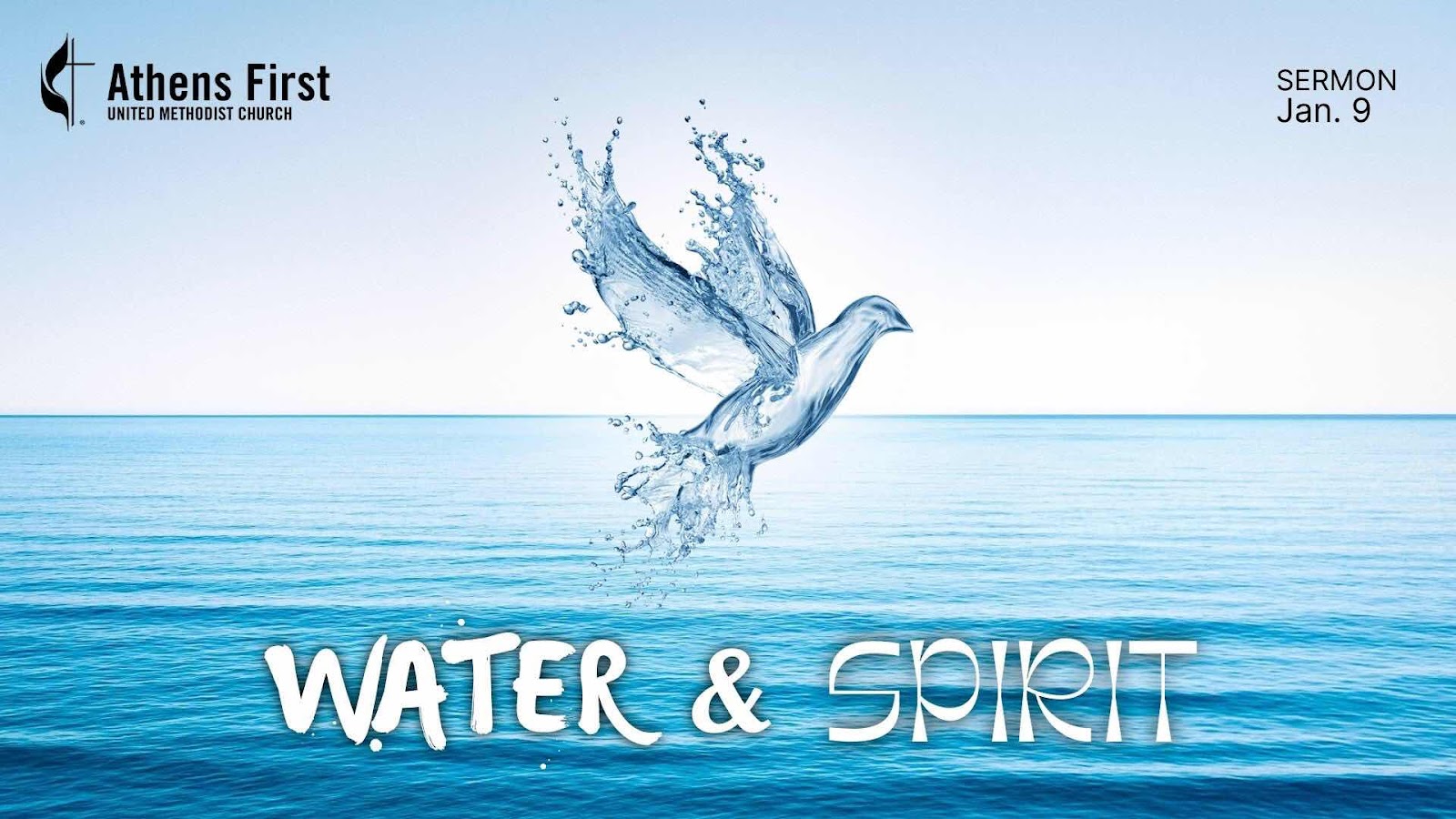
Water & Spirit
Spirit of the living God, descend upon us this day in a mighty way. Let your wind blow away pain, suffering, and evil. Let it blow away apathy, indifference, and ignorance. Let it blow away selfishness, insensitivity, and envy. Let it blow away hatred, bigotry, and prejudice. Let it blow away unkind thoughts, words, and actions. Spirit of the living God, let your wind blow upon us and make us new again. Amen.
According to the church calendar, this Thursday will be the last day that it is liturgically correct to greet each other with the words, “Merry Christmas.” January 6 marks the 12th day of Christmas which is also known as Epiphany, the day that we celebrate when the Wise Men visited the Christ Child and offered him gifts.
For some of us, we might be experiencing some of those post-holiday blues. It’s hard to believe that Christmas is coming to an end.
Well, it depends on who you ask.
Matthew and Luke are the only two gospels that include the Christmas story. They describe the events that surround Jesus’ birth. For example, they tell us about who was the ruler when Jesus was born. They also describe the people who were there at the time of the birth; people like the shepherds, the angels, and of course, Mary and Joseph.
So if we would ask Luke when Christmas is over, he might refer to the day after Jesus’ birth. If we would ask Matthew, he would probably say, not until the Wise Men visited the Christ Child which we observe on January 6th.
Mark doesn’t even include a Christmas story so all we have left is John’s Gospel. When would John say that Christmas is officially over? I think John would say that Christmas is never over. It’s something to be celebrated every single day of the year.
No, it’s not because John is a fan of the Hallmark Channel. It’s because he sees the story of Jesus coming into the world in theological terms. For John, Jesus, who he refers to as “The Word” has been with us since the beginning of creation and will continue to be with us for all time.
Listen again to John’s theological take on the coming of Jesus into the world. “In the beginning was the Word (Jesus) and the Word was with God and the Word was God. He was in the beginning with God. All things came into being through him and without him not one thing came into being.”
Now, I’m sure John had no problem with Matthew and Luke describing the Christmas story the way they did. Perhaps John felt that there was nothing left to add to their telling of how Jesus was born. And so, John does what John does best. He wants us to explore the theological meaning of who Jesus is.
Yes, Jesus was born in a manger during a particular time in history, but Jesus also transcends history in a theological way. John connects Jesus to the creation story from the Book of Genesis, the first book of the Bible. Jesus and God are interconnected as the same entity. Jesus is both within our space and time and also beyond our space and time.
So for John, how can we ever confine the celebration of Christmas to just twelve days beginning on December 25? It really should be celebrated year round. Since there is no time in which Christ did not exist, Christmas can be celebrated throughout the year.
In a church I served, we celebrated Christmas in July. We thought of this idea because July 25th fell on a Sunday that year.
Our church even had a float that promoted our Christmas in July event in the city’s annual July 4th parade. Here’s is a picture that we took before the parade.

I felt bad for our Santa Clause because he had to wear his beard and heavy Santa outfit for two hours in 90 degree heat that day. We had to put ice packs his Santa pants to keep him cool.
Radio stations across the country found out about our Christmas in July focus and people were calling our church office asking about it. A former high school classmate who I hadn’t spoken to since High School lives in the state of Washington and he told me that he heard my name mentioned on the radio and wanted to make sure if it was the Robert McDowell he knew in High School.
A family in the church decided to have a family Christmas dinner on July 25thafter church. People in the congregation were sending Christmas cards to each other during the month of July. For our July 25 worship service, we had all of our Christmas decorations up including our Christmas tree in the front of the sanctuary. And during the service, we sang Christmas carols and I preached about the good news of Jesus’ birth.
But really, the best part of having Christmas in July wasn’t the float in the parade or the Christmas carols we sang during worship. The best part was that we used this fun idea to raise money for missions. During that July 25th worship service, Santa made a special appearance during worship. Here’s a picture of him.
During our offering time, he went up to the Christmas tree in the sanctuary, pulled out a large gift wrapped box, opened it, and inside was a check of $10,000 that our congregation had raised for that special missions offering.
By celebrating Christmas in July, not only did we have fun as a congregation, but we were also able to share the good news of Christ’s birth through that special missions offering.
I think that John would be pleased that we celebrated Christmas in July. “In the beginning was the Word, and the Word was with God, and the Word was God. He was in the beginning with God.”
Maybe we should celebrate Christmas year round.
Will Wold, a United Methodist pastor tells the story of Jerry who was a member of one of the churches he served. Jerry was a gentle and loving man and was one of those people who never knew a stranger. Jerry had a heart to get to know people and love them.
During Will’s first Sunday at the church where Jerry was a member which happened to be in the month of September, Jerry greeted him for the first time after the worship service that day. Jerry introduced himself and his wife, and when he left, Jerry said to his new pastor, “Merry Christmas!”
Will thought to himself, “but it’s September, why is Jerry wishing him Merry Christmas?”
The following week, he saw Jerry sitting in the front office volunteering and the first thing out of Jerry’s mouth was, “Merry Christmas, Pastor Will!”
Will was again confused why Jerry greeted a second time by saying, “Merry Christmas” since it was only the month of September. So he asked Jerry why he greets him with “Merry Christmas.”
Jerry than leaned back in his chair and with his hands on the back of his head and looking very relaxed he said, “I had a pastor once who told me that when Christ came to earth it’s too important to celebrate just one time during the year. It should be celebrated every day even in the month of September.”
From that point on, whenever Jerry greeted Will with a “Merry Christmas,” Will returned the favor with the same greeting.
Will goes on to say that four years later, ironically, on Christmas Eve, he got a dreadful phone call that Jerry had died of a heart attack. His heart sank when he received the news and all he could think about in that moment were all the times that Jerry had wished him a Merry Christmas.
During the funeral for Jerry, Will began the service by greeting the congregation with the words, “Merry Christmas!” It was a very fitting funeral service for this church member who was known to celebrate Christmas throughout the year.
Our Christian faith is an everyday journey in which we are called to share the good news of Jesus Christ. You know, come to think of it, Easter is meant to be celebrated year round as well. I love the verse from the Easter hymn, “Easter People Raise Your Voices” which contains the verse, “Every day to us is Easter, with its resurrection song.”
Martin Luther, the great 16th century reformer who ignited the Protestant Reformation once said, “Live as if Christ died yesterday, rose this morning, and is coming back tomorrow.”
I’m glad that the Wise Men were delayed in arriving to Bethlehem to see the Christ Child. Most bible scholars say that they probably didn’t arrive until months after Jesus’ birth. The Wise Men remind us that it’s never too late to celebrate the coming of Jesus into the world.
Whether it’s December 25, January 6, July 25, or some other day, John gives us permission to celebrate the good news of the coming of Christ into the world.
Oh, by the way, I forgot to mention another fun thing that happened that year when we celebrated Christmas in July. After the worship service that day, a church member gave me a Christmas gift. When I got home, I unwrapped it. And guess what it was?
Fruitcake!
Merry Christmas!
Merry Christmas!