Today’s Focus:
Happy Belated Valentine’s Day!


(Nee'-kos) Biblical Greek Word for "Victory"

Our Old Testament reading this morning from the Book of Deuteronomy invites us to think about what we are going to do when we finally achieve a goal or arrive at a destination.
Here in this story, the Israelites who have been wandering in the wilderness for almost 40 years now, are nearing the end of that long journey. They will soon be entering into the Promised Land. Along the way, they have experienced God’s guiding hand and they have been given the Ten Commandments along with many other laws that they are to follow as God’s people.
Moses, their leader is preparing them for when they will finally reach their destination. It’s one thing to prepare for a test, or practice for an upcoming game, or get ready to start a new job, but it’s another thing to actually live into that new reality when you finally arrive. This is why Moses in this scripture reading today, offers these important words of wisdom for when the Israelites actually do enter the Promised Land.
So Moses tells them that when they finally arrive, that they are to take the next steps in being God’s people in their new homeland. It’s one thing to prepare to be God’s people while traveling through the wilderness. It’s another thing to continue to be God’s people once they get settled.
I hear that this is often what happens to people when they retire, so I’m being told! My brother who has served as a Music Minister in our home church for the past 30 years, retired this past October. In the weeks leading up to his official retirement, my brother was intentional in calling it, not a retirement, but a renewal.
Retirement or Renewal?
He called it a renewal because for him, the word “retirement” sounded too much like an ending to a large part of his life. Instead of seeing it as an ending, he viewed that transition in his life as more of a beginning of something new. For him, it was the beginning of a renewal in his life by exploring new ways of living, reordering his days, and picking up some new ministry opportunities beyond his long and established role as a Church Music Director.
I like that. Renewal sounds so much better than retirement. My brother shared this with me as words of wisdom to consider as I prepare for my own retirement. Even if I continue to serve as a pastor of a church in retirement, there are new holy rhythms and opportunities to be explored. There are new steps of faith to take.
Moses was taking a similar approach in offering words of wisdom to the people as they were drawing closer to the Promised Land. I like that Moses didn’t simply give them a true or false final exam on all the commandments that were taught them over that 40 year time in the wilderness. For Moses, the people of God didn’t need more information. They now needed to know what their next steps might look like once they arrived.
So he says to them, that if they continue to love the Lord and walk in God’s ways, that they would become numerous and they will be blessed in the land that they are about to possess. Moses was in effect telling them, “Don’t think of it as a retirement from being wilderness travelers. Think of it as a renewal where you will be able to experience new blessings in being God’s people. Your walk with the Lord isn’t ending. It’s just beginning!”
And the good news is that they get to decide if they will see it as a retirement or as a renewal. Which will it be?
If they just want to retire and just be content that they don’t have to walk through a wilderness anymore, then they will miss out on the new blessings and the renewal that God has in store for them. Do you want to retire or be renewed, is basically what Moses is presenting to the people.
In one of the churches I served, the people had this wonderful vision of expanding their church facility to include a large multi-purpose room as well as renovate other parts of the church building. That dream would require a lot of work for them which included getting a building plan, a cost analysis, a vote of the congregation, a fundraising strategy, and then the actual construction and renovations that would be required.
In a way, those years of preparation reminded me of when the Israelites were traveling through the wilderness to the Promised Land. No, it didn’t take that church 40 years but it did take them a couple of years before everything was finally completed.
They were so happy to finally make it to the Promised Land! The newly constructed church building looked incredible. A new multi-purpose room, a newly expanded front entrance in the older part of the church, a newly remodeled education wing, a very spacious meeting room, and new staff offices.
Less than a year after the construction was completed, a tornado hit that church building, destroying half of that new multi-purpose room, leveling the entire new education wing, and damaging several of the older parts of the building including the sanctuary. The tornado hit the church during a choir rehearsal but thankfully, nobody was seriously injured.
In less than one year in the Promised Land, this congregation was faced with going back into the wilderness by having to worship at the high school on Sunday mornings and having Sunday School classes at the community senior citizen center. The Trustees needed to go back to the drawing board and go through this whole building process all over again.
As you would expect, this caused a lot of stress for the people of that church. The once positive spirit in that congregation slowly became more and more negative. People began arguing over every little detail about the new building program from what the color of carpet in the various rooms should be to possible staff changes including the current pastor who was serving at the time.
It was in this situation, that I was sent by the Bishop to serve as pastor of this church! Even though I went there with a lot of hope and energy to help that congregation make it back to the Promised Land, I quickly realized that it would take a lot longer than I had imagined.
As this 2nd construction phase was getting closer to completion, I felt a little bit like Moses who was trying to help God’s people begin to picture themselves living in the Promised Land. I tried my best to have us think more about the new ministries and programs we could start rather than just upon the sense of the tremendous loss that they had experienced from this major setback.
It took some time, more time than I had imagined, but we were eventually able to start a new ministry called “Common Cup” which was the name for a mid-week dinner at the church that included bible studies and classes for all ages. It was called “Common Cup” because we started partnering with 16 small United Methodist churches within a 15 mile radius of our church.
Pastors and lay people from each of these churches helped lead the classes and it was beneficial for the smaller churches since they often lack the resources and space needed for weekly church programs. And one of the reasons this new mid-week ministry worked so well was because our church had a massive parking lot!
Those Wednesday gatherings for Common Cup felt like we had finally arrived to the Promised Land because we were now entering the next steps of being the church following a long time of wandering and traveling through the wilderness of construction and stress. Sometimes, we need to start thinking about what are next steps will be once we arrive rather than just how to survive in the wilderness.
Since announcing my retirement a couple of months ago, I mean my renewal, I’ve been praying about the next steps that God is leading us here at Athens First in the months ahead.
The good news of our faith is that God is always leading and guiding us into a new future. God is always inviting us to think about the next steps for us once we arrive in the Promised Land. The church is never done dreaming, never done hoping, and never done visioning.
Actually, we are never fully in the Promised Land and we never fully leave the wilderness. Both are part of our journey of faith. The 40 years in the wilderness was how the people were formed and shaped to become God’s people. Those 40 years were how the people learned to trust God along the way.
We are always being shaped and formed into God’s image. In less than two weeks, we will observe Ash Wednesday, the beginning of the 40 day season of Lent. Those 40 days are to remind us of the 40 years in the wilderness.
But we also know that at the end of those 40 days, we will celebrate the joy of Easter and the good news of Jesus’ resurrection. Easter is a Promised Land moment where we celebrate Jesus’ victory over sin and death.
And every Easter, we are always faced with the question, “How will the good news of Easter and Jesus’ victory over the grave change and transform my life? What will be my next steps moving forward?”
A Lutheran pastor friend of mine told me one day how a Lutheran pastor knows if he or she preached a good sermon. He said that it it’s not about how creative the opening of the sermon was or how good the illustrations in the sermon are. He said that Lutheran pastors are taught that you know it was a good sermon if the sermon helps people to answer the question, “so what?”
I love that! I think Moses might have been Lutheran because he was asking the Israelites the same question. “So what are you going to do now? What are the next steps you’re going to take once you make it into the Promised Land? Are you going to chose life and love and obey God?”
As we stand ready to enter into the new renewal that God has in mind for us, we are left with this very important question, “What will our next steps be?”
Next Steps
Whenever I read something from I or II Corinthians, I’m always glad that God never sent me to a church like that. Let’s just say, that the Church of Corinth had a lot of issues!
I’ve been blessed to serve many wonderful churches over my 35 years as a pastor, but not all pastors have been as blessed. Some have been called to serve in some very cantankerous congregations.
When I first became a pastor several years ago, an older and very experienced pastor in our conference told me this fun little story that happened during Annual Conference which is where clergy and laity gather for several days in early June.
In the old days, it was at one of these annual meetings when the bishop would announce the names of the pastors who would be moving to new churches later that month. Now, they let you know ahead of time if you will be moving but that wasn’t the case then.
As this old story goes, a pastor who had been sent to some of the worst churches in the conference and who was currently serving at another very difficult church felt like he had nothing to lose. And so he decided to go to one of the microphones and really let the Bishop have it in front of everyone at that conference. He criticized the Bishop up and down during his long rant.
After his speech, he sat down feeling really proud of himself for getting his frustrations off his chest, but that’s when he suddenly realized that he had forgotten that there was still an opening at a church that was known as the worst of the worst church in the conference.
And that’s when the people around him could hear him say, “O crap. I forgot. The Little Hope Church is still open!”
Little Hope Church and the Church of Corinth were both very difficult churches to serve. Only the bravest pastors would want to serve at either of them.
It’s ironic that one of the most beautiful chapters in the entire bible comes from I Corinthians. Chapter 13 in that letter has become known as the love chapter. The Apostle Paul beautifully describes what love is and what love isn’t in those verses which is why it often gets read at many weddings.
But actually, the love chapter has nothing to do with marriage or weddings, at least not directly. Paul wrote that chapter because he was calling out the members of that church in Corinth for their very selfish and egotistical attitudes toward one another. They had been bragging about who had the most impressive spiritual gifts in the church and they looked down on those who they determined had less important gifts to offer.
See what I mean about this church? Tough, tough church to serve. And so Paul writes this love chapter to tell them that they can have all the spiritual gifts in the world, but if they don’t have love they are just a noisy gong or clanging cymbal. And Paul ends that chapter by telling them, “But faith, hope, and love abide, but the greatest of these is love.”
The Church of Corinth was missing the whole point of the Christian faith. We don’t find our strength in power. We find our strength in how we love and serve one another.
And this is what Paul is conveying to them in our I Corinthians, chapter 2 scripture reading for today. Listen again to Paul’s words to them:
“When I came to you, brothers and sisters, I did not come proclaiming the mystery of God to you in lofty words or wisdom. For I decided to know nothing among you except Jesus Christ and him crucified. And I came to you in weakness and in fear and in much trembling.”
Here in the early part of his letter, Paul is setting the tone, that our strength is found in our weakness and not in whether or not we have what some might consider to be “the more glamorous spiritual gifts.” There are no glamorous gifts, just spiritual gifts, that when all put together can make for a vibrant and growing church, faithfully living out its vision and mission.
A couple of months ago, I watched a documentary about Bill Wilson, the founder of Alcoholics Anonymous. He started AA in Akron, Ohio and it quickly spread throughout the country.
The reason that AA has been so effective over these many decades is because people who are struggling with alcohol abuse can help each other by attending meetings on a regular basis. Our church provides space for 6 AA groups to meet each week in our building.
During that documentary, it talked all about the challenges that Bill Wilson faced in helping AA and the 12 steps program reach as many people as possible. During the era of racial segregation, one of the AA groups refused to allow people of color to join their group. Some other AA leaders who heard about this, asked Bill Wilson how to handle this situation.
Bill Wilson responded by saying that what they needed to do was to emphasize that what makes AA effective and special isn’t because they are better people, but because they are only made better by sharing their weaknesses with each other. We are made strong through our weakness. In other words, there is no room for egos or discriminating against anyone who wants to find healing and wholeness.
This reminds me of what the Apostle Paul is saying in our I Corinthians reading, “For I decided to know nothing among you except Jesus Christ and him crucified. And I came to you in weakness and in fear and in much trembling.”
We live during a time, like during the time that Paul wrote this letter to the Church of Corinth where we think that it’s through our strengths that we can find our greatest fulfillment in life, but really it’s the opposite. As Paul writes, it’s through our weaknesses, our vulnerabilities, our frailties, and our brokenness that we are our most real and authentic selves.
But we also know that when we try to hide who we really are or deny that we are broken and hurt people, that sets us up for all kinds of unhealthy and unrealistic expectations. Focusing on our strength only can lead us to cover up what is really going on inside us and that can often lead to depression, loneliness, feelings of self-hate, and sometimes even lead someone to hurt themselves.
At the heart of the Christian faith is the recognition that it’s through our weaknesses that we not only find healing in our lives, but we can also be a source of healing and hope for others.
Recently, I was introduced to this incredible painting that was drawn in 1903 by the Finnish painter, Hugo Simberg. Here’s the painting:
The title of the paining is “The Wounded Angel.” As we give ourselves a little time to look at this painting, we can see that it is a very melancholic depiction of this wounded angel being carried on a stretcher by these two young, healthy, but very somber boys.
The angel has a bandaged forehead and a bloodied wing. The context of when this painting was done is very important because the boys are carrying this wounded angel to what was then, the Blind Girls’ School and the Home for Cripples.
This painting is so powerful to me because we’re not used to seeing wounded angels. Angels are meant to be the ones who are strong and who save and help us, but this angel is in need of someone to help her.
It’s interesting to me that a version of this painting hangs in a prominent church there in Finland suggesting that there are spiritual connections for us to make as people of faith.
There are so many things that can be said about this painting, but I want you to especially notice that the angel is clutching what is called snowdrops in one of her hands. Snowdrop flowers are a symbol of healing and rebirth. Even though this angel is wounded, these snowdrop flowers are a symbol of hope.
And then notice in this artist’s subtle way the flowers that are blooming along that pathway. Those flowers are also a symbol of hope that healing is on the way.
I wonder if this artist is painting a picture to help us to see that it’s really in our brokenness and wounds, that we can be agents of healing, not only for ourselves but for others. We all have injured wings and our share of bandages, but it’s through our pain that we can be a source of healing for others.
Henri Nouwen, a Catholic Priest and author of several books on spirituality wrote a book called, The Wounded Healer. It’s a book that reminds us that we can’t really help to bring healing to others unless we are willing to also see our own brokenness and need for healing.
Or as someone has said, it’s through the cracks of our lives, that the light can enter, and it’s through those same cracks that the light can then shine out upon others.
The Apostle Paul who was writing these letters to the Church in Corinth wanted them to know that it’s not through our impressive spiritual resumes that the light shines through, but it’s through our vulnerabilities and our weaknesses that God’s love and light can be a blessing to others.
I think this is what Jesus means in our Gospel reading for today when he says that we are the light of the world. We shine the brightest when we allow God’s light to shine through the brokenness in our lives.
And this is one of the reasons why we celebrate the Sacrament of Holy Communion because it reminds us that it was through Jesus’ self-emptying and willingness to die on a cross, that led to an empty tomb where resurrection and new life were made possible and can bring healing to our wounds. Broken, weak, and wounded as we are, this holy meal reminds us to keep holding onto those snowdrop flowers because it is through our weaknesses, that the light of God’s healing love can shine through us.
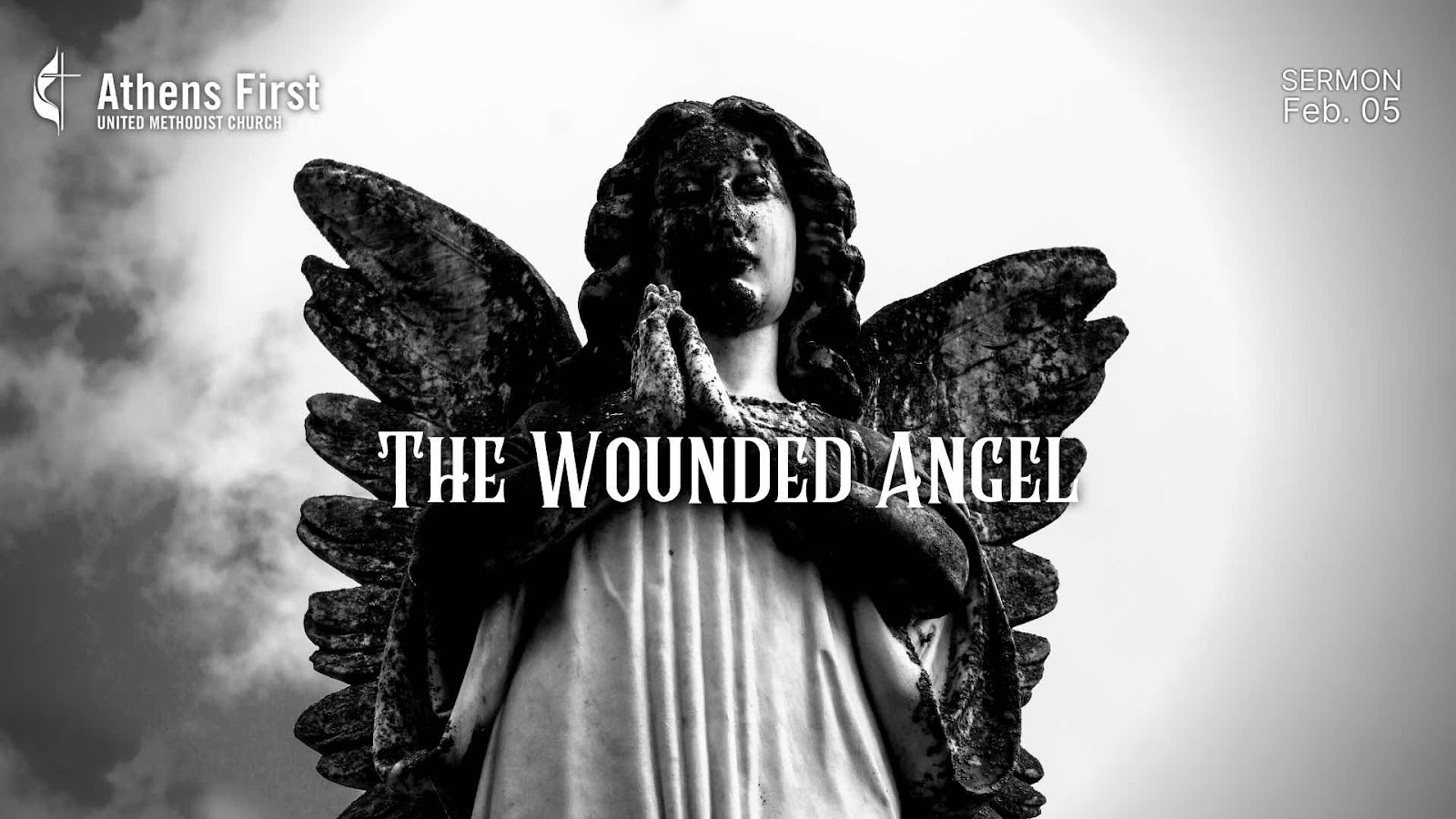
The Wounded Angel
Alcoholics Anonymous (AA) has been successful over the past several decades because they believe that it is through the sharing of our weaknesses that we can find healing and wholeness. The strength of each AA group is found through the honest sharing of their brokenness and by encouraging each other to find healing and wholeness.
What are some other examples of people who need healing through others who need healing as well?
Henri Nouwen, a Christian author wrote a book entitled, “The Wounded Healer” which is based on this important concept that it’s through our brokenness and our weakness that we can help each other find healing. Someone else once said, “it is through the cracks of our lives, that the light can enter and it is through those same cracks that the light can then shine out upon others.” In our Gospel reading, Jesus says that we are the light of the world.
Do you think that allowing the light to shine through the cracks of our lives is what Jesus means when he says that we are the light of the world? Why or why not?
Pastor Robert shared the 1903 painting, “The Wounded Angel” by the Finnish painter, Hugo Simberg. When you look at this painting, you will notice that two very determined by somber boys and carrying a wounded angel on a stretcher. The angel has a bandaged forehead and a bloodied wing. The context of when this painting was done is very important because the boys are carrying this wounded angel to what was then, the Blind Girls’ School and the Home for Cripples. Notice that the wounded angel is carrying snowdrop flowers which are symbolic of healing and rebirth. Also notice that there are snowdrop flowers blooming along the path.
What does this painting convey for you? How does this painting relate to Paul’s words in our I Corinthians passage? “And I came to you in weakness and in fear and in much trembling.”
Close with this prayer from Sunday’s worship service:
Gracious God, how quickly we forget that our strength is found in your sacrificial love for the world. Forgive our preoccupation in relying on wealth, status, and prestige as the measures of success. Remind us to always keep our focus on Jesus, the one who came not to be served but to serve. Help us to keep our eyes focused, not upon the status symbols of the world, but upon the cross in which Jesus offered himself for the sake of the world. It is in your cross and your sacrificial love, that we find our greatest strength! Amen.