Welcome to our
(Jan. 3/Epiphany Sunday)
online worship service!
Athens First UMC
2 S. College St., Athens, OH 45701
[Live-Stream Begins @ 10:20 am]

(Nee'-kos) Biblical Greek Word for "Victory"
During a Christmas Eve service several years ago, the senior pastor began his Christmas sermon in a most interesting way. After retelling the details of the Christmas story, he then paused and asked the congregation if they had noticed any mistakes in what he had just shared with them.
He then retold the same story, this time; inviting the congregation to shout out if they heard anything that wasn’t true to the biblical Christmas story. Detail by detail, he told the story again.
Joseph and Mary traveled to Bethlehem on a donkey because of the Roman census. While they were in Bethlehem, Mary gave birth to her firstborn son and wrapped him in bands of cloth and laid him in a manger.
Angels appeared to some shepherds who were out in the fields and they announced that a savior had been born. The shepherds went to Bethlehem, found Mary and Joseph and the baby Jesus, telling them that the angels had shared this good news with them.
And after going through this story again, detail by detail, this senior pastor, asked, “Do you mean that you didn’t catch the mistake in this story?”
I remember wondering to myself which detail he purposely got wrong, but nothing was jumping out at me.
And then he said, “Everything was true except for one thing. The gospel writers never mention that Mary and Joseph rode on a donkey.”
The point that this senior pastor was making was that many of us hear the Christmas story so many times, that we don’t really pay attention to the details.
He finished his sermon and we sang a Christmas carol. It was then my turn to offer the children’s sermon. I remember spending the whole week leading up to Christmas Eve, trying to think of a creative children’s sermon to use for that night. Penny suggested a really good idea that the children might like.
For the children’s sermon, I ended up bringing a large gift-wrapped box with a big bow on it and I told the children that God wanted to give them a Christmas present. I said, “Let’s open it up and see what Christmas present God wants to give us.”
I lifted the large lid of this beautifully gift wrapped box and pulled out something which also was wrapped. After I unwrapped it, I said, “Look, it’s Joseph. Let’s stand him up right here.” And then I pulled out another item that was gift wrapped. This time it was Mary. And I said, “Let’s put Mary next to Joseph.”
“But wait, there are more presents in the gift box. What do we have here?” I unwrapped a shepherd and placed him right behind Mary and Joseph there on the altar steps.
Now keep in mind that I was randomly taking the nativity display figures out of the box. I didn’t know which figurine was going to appear next.
And boy did I have the attention of these children. They couldn’t wait to see if Jesus would be the next one. With great anticipation, I pulled out the next figurine and unwrapped it, showed it to the children, and said, “Uh-oh. We have a problem. It’s the donkey. He needs to go back in the box!” The congregation about lost it. They were laughing so hard.
After a few more figurines, I finally pulled out the baby Jesus in a manger and placed it in front of Mary and Joseph.
But I still had three more wrapped pieces that were still in the box. And they ended up being the wise men and I said to the boys and girls, “These are the wise men and technically they didn’t arrive until after Christmas, so they need to go back into the box with the donkey!”
So that’s how my children’s sermon went on that Christmas Eve. Not as I had expected!
So let’s get the details straight. There’s no mention of a donkey and there’s no mention of wise men being present when Jesus was born in Matthew and Luke’s telling of the Christmas story. But at least we get a birth story.
So what’s up with the Gospel of John? Forget about the donkey and the wise men because John doesn’t even include Mary and Joseph. And there’s no mention of angels and shepherds. What kind of Christmas reading is this on a Christmas Eve? If I would offer a children’s sermon tonight, according to the Gospel of John, I wouldn’t even be able to use the crèche scene at all.
Well, actually there is a birth story in John’s opening verses. We just have to dig a little bit to find it, but it is there.
True, John doesn’t have in mind the birth of Jesus specifically. Instead he wants to tell us about the birth of the world. Or should I say the rebirth of the world.
Listen to how he begins his Gospel, “In the beginning was the Word, and the Word was with God, and the Word was God. All things came into being through him, and without him not one thing came into being. What has come into being in him was life, and the life was the light of all people. The light shines in the darkness and the darkness did not overcome it.”
The first three words from John’s Gospel are the same three words from the Book of Genesis. “In the beginning.” And then John refers to light in describing Jesus. “The light shines in the darkness and the darkness did not overcome it.”
Again, John’s reference to light reminds us of the creation story when for the first day of creation God creates light and separates the light from the darkness. The birth of the world.
John clearly wants us to make the connection. Jesus, who he introduces as the light of the world is the embodiment of the creator God who was the one who created light in the first place.
Just by speaking a word, God creates the world. We are told for each day of creation, “And God said...” Notice that the Gospel writer John refers to Jesus as the Word. Jesus is the word which God speaks and brings about creation and new life. “And the Word became flesh and lived among us,” John tells us.
When the world was born, everything was the way God designed it to be. A place filled with beauty, harmony, peace, and justice. A place where there was no sin or death. But then the Book of Genesis tells us that sin entered the world when we disobeyed God in the Garden of Eden.
And because of this, our world lives with the reality of sin, brokenness, and death. And ever since, the world which was born through God’s spoken word has been waiting to be reborn as it was meant to be.
Yes, even with the Gospel of John, we do get a birth story, just not the one we were thinking we were going to hear on this holy night.
A while back, I ran across a Larry King Live video clip of an interview he had with the singer and actress, Naomi Judd. She asked Larry, "What will be the first question you will want to ask God?" And true to style and with his typical wit, Larry said that his question to God would be, "Do you have a son?"
Now, if that’s what Christmas is all about – life and light from God through Jesus Christ – it kind of makes you want to celebrate Christmas more than just once a year doesn’t it? Maybe even throughout the year and not just this Christmas season.
Jesus is the light of the world. What good news for those who are waiting for rebirth and newness of life!
Christians didn’t celebrate Christmas as a holiday until the 4th century. Since the Roman Empire celebrated the winter solstice on December 25 which was a celebration of the birth of the sun, the church decided to transform this pagan holiday of light into a celebration of the birth of Jesus Christ, who they believed to be the true light of the world.
How fitting that during this darkest time of the year, that we celebrate the coming of the light of the world, Jesus Christ.
But it’s not so much about Jesus’ birthday. It’s a story about OUR new birth.
On this holy night, we are invited to receive the light and the life of Jesus and be born again.

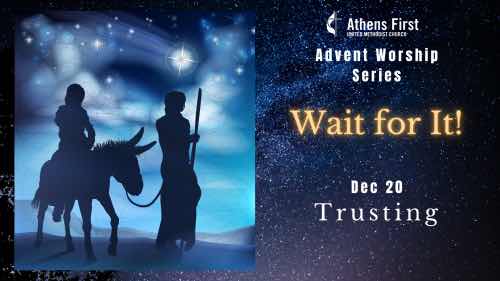
During these four weeks of Advent we have been thinking a lot about what we can do while we’re waiting for the celebration of Christmas. The appointed scriptures for these past four Sundays have encouraged us to be involved in a time of not passive, but active waiting through confessing, hoping, and rejoicing.
As we prepare for Christmas, we recognize that we are broken people who have fallen short of who God has called us to be. On the first Sunday of Advent, we heard the words of the prophet Isaiah who said the we are all unclean. When we confess our brokenness to God, we open ourselves and make room for God’s forgiving love to bring healing and wholeness in our lives. Advent is a season of confessing.
For week two in Advent, the scriptures pointed us to be a people of hope. Our scripture from II Peter reminded us to keep hope by waiting for new heavens and a new earth. This is our ultimate hope that one day God will make all things new.
Last week, the the Apostle Paul called upon us to rejoice always. Even before the arrival of Christmas, we are called to rejoice in anticipation of what God is about to do.
Advent, this season of active waiting is inviting us to confess, to hope, to rejoice, and for this fourth week, we are called to trust. Trust that God will be found faithful. Trust that this season of confessing, hoping, and rejoicing is leading us into a deeper awareness of how God is present and at work in our day to day lives.
Our Gospel reading for today features two women, Elizabeth and Mary who offer us wonderful examples of what it means to trust God during this time of waiting.
Elizabeth and Mary are cousins and both were told by the angel Gabriel that God was going to use them in a very unique and special way.
Elizabeth, even in her advanced years would become pregnant and give birth to John the Baptist who would end up preparing the way for people to encounter Jesus, the Savior of the world. And Mary, a virgin would become pregnant through the power of the Holy Spirit and give birth to Jesus.
I know. That’s a lot for us to take in. I think that’s another reason why we need this season of Advent is to give us time to process this incredible story about these two remarkable women of faith.
Let’s start with Elizabeth. She is beyond child bearing years and yet with her husband, Zechariah she will become pregnant and give birth to John the Baptist, who will serve as the one who will point people to Jesus.
Elizabeth’s story might sound familiar. It sounds a lot like the story of Abraham and Sarah from the Old Testament. Remember them? They too were advanced in years and an angel visited them and told them that Sarah would become pregnant. And the great thing about that story is that we are told that Sarah laughed when she first heard this news. Sarah ended up giving birth to Isaac which is a Hebrew name that means, “laughter.”
Imagine with me for a moment what must have been going through Elizabeth’s mind when she was told that she would become pregnant and be an important part of the Christmas story. We are told earlier in the first chapter that after Elizabeth conceived she was in seclusion for five months. I wonder what was going through her mind during that long time of waiting.
Luke does tell us a little of what she was thinking during that time because he tells us that Elizabeth knew that the Lord had looked favorably upon her. Even though she must have still wondered how all of this would play out, she knew to place her trust in the Lord.
And then we turn to Mary, our Gospel reading for today. She too received a visit from the angel, Gabriel that she would become pregnant and give birth to Jesus, the one who would become the savior of the world. Mary responds with, “How can this be?”
Mary and Elizabeth needed to trust that what was told to them would be fulfilled. I’m sure that during their pregnancies, they had all kinds of unanswered questions going through their minds. In other words, during that long time of waiting, they needed to to trust that God would fulfill the promise that was made to them.
Trusting is such an important part of our faith. Trusting is what we do when we place our faith in God but still have questions along the way. The season of Advent is a season that calls for us to trust. And really, even beyond these four weeks of Advent, trusting is at the heart of who we are as a people of faith.
Like Mary and Elizabeth, God also has calls each one of us to participate in the building of God’s kingdom here on earth. Through our baptism, God has called each one of us to be ministers of God’s saving love for the world. I love how our United Methodist Book of Discipline states this.
It says that our theological task, “requires the participation of all who are in our Church, lay and ordained, because the mission of the Church is to be carried out by everyone who is called to discipleship. To be persons of faith is to hunger to understand the truth given to us in Jesus Christ.Theological inquiry is by no means a casual undertaking. It requires sustained disciplines of study, reflection, and prayer.”
In other words, living out God’s calling in our lives isn’t just handed to us on a silver platter. It’s something that involves trusting and participating with God through the spiritual disciplines of our faith. Sometimes, that process of trusting can take us to places that we would never have chosen on our own.
During my sophomore year in college, I was really struggling with my purpose in life. I had no clear direction and I wasn’t sure if I was in the right major.
So one day, when I was feeling really low, I just decided to get on my knees and pray. And I told God that nothing I was doing was helping me to figure out what to do with my life. I also told God that I was sorry for not making him more of a priority in my life.
And then I went for broke. I told God that whatever he wanted me to do, I would do it. I also told God how sorry I was for not turning to him sooner and how from that point on, I would follow his leading.
It was in that very moment, that I felt God’s love in such a powerful way. And I felt this huge weight being lifted from my shoulders. I knew that I wasn’t alone.
And then I could hear God telling me to do three things. The first thing was to allow him to be first in my life through daily prayer, scripture reading and worship.
The second thing was to make my college studies a priority. You see what happens when you pray to God? God messes with our priorities.
Up to that point, my college grades were pretty low. I was feeling so overwhelmed with what direction my life should go, that I wasn’t focused on my current classes. That was the first thing God told me to do. Study and get good grades. So, I decided to set aside two hours every day keeping up with my studies.
And the third thing God told me to do was to start a bible study with people my age. And I did. We had ten to twelve meeting every week learning about the Bible, spending time in prayer, and serving in the community. At the time, I was thinking that I was helping other people my age who were feeling lost in life, but looking back on it, I think that this was God’s way of helping me to stay encouraged.
So God gave me these three things to do. Make God more of a priority in my life. Work on my grades. And start a bible study group.
Even though I felt a sense of peace and purpose in my life, I still didn’t know exactly where God was leading me. I didn’t end up feeling a calling to become a pastor until over a year later. All God wanted me to do after that prayer was to trust him. To put him first. To work on my grades. And to start that bible study.
I’ve discovered that this is how God works in our lives. God calls us to follow him even though we don’t exactly know what that future may look like or how long it will take. I learned through that early experience in my life that as we confess to God where we have not made him first in our lives, as we renew our hope that God is leading us into a better future, as we rejoice because of the peace God is offering to us, and as we trust that God will guide us every step of the way, that it is worth the wait. It is worth the wait.
A friend of mine recently announced that she was making a job change. She said that the decision to change jobs was not an easy one because it meant that she would need to let go of what was familiar to her and step out in faith.
She sent this photo which really says it all as we think about the importance of trusting in God’s promises. This note says, “God, I have no idea where you are taking me, but I trust you.”
Maybe this is a note that we can carry with us at all times not just in Advent but in any season of our life where we are invited to trust in the new future God has in mind for us.
When I began this Advent series four weeks ago, I shared the story of how I was able to take a picture of this beautiful sunset during vacation a couple of years ago.
I almost gave up on taking it. But it was like this voice kept telling me, “Wait for it. Wait for it.” I’m glad I did or I would have missed this incredible display of God’s beauty.
Confessing our brokenness and shortcomings, hoping because we look forward to that time when God will make all things new, rejoicing because God offers us peace along the way, and trusting because we know that God will continue to be faithful. This is what makes the waiting worth it.
And like Mary, may we join in saying with her, “Here am I.”