Today’s Focus:
Reflections On
Jesus’ Resurrection from the
Perspective of the Disciples


(Nee'-kos) Biblical Greek Word for "Victory"

Get ready, because this is going to be the most incredible sermon you have ever heard on the topic of humility. Do you see what I did there. Most incredible sermon on humility?
When the preacher starts bragging about a sermon on humility, that’s when you know that it’s not going to be a very good sermon. So let me just go ahead and offer my usual description of my sermons. Friends, it’s going to at least be an above average sermon. Let’s hope and pray. But that’s OK, because it’s on humility. It’s just going to be a solid, halfway decent sermon if I do say so myself.
I say all of this because humility is such a difficult concept, isn’t it? How do you know when you are being a humble person? Certainly not when you start bragging to your friends that you are humble, right?
This is what makes today’s wilderness challenge maybe the most challenging of them all. Just when you think you arrived at humility perfection, that is probably an indication that there’s a lot more work to be done!
This reminds me of the best advice I have ever received. "Don’t try to be witty, charming, creative or intellectual. Just be yourself."
What a great piece advice! Just be yourself.
And of course, just being yourself is remembering that we have been created in the image of God. This is related to the first wilderness challenge back on the first Sunday in Lent, our identity and who we are.
Like Jesus, we reminded ourselves that God loves us and calls us his beloved. We belong to God. We have been claimed and redeemed by God.
Then on the second week, we focused on the wilderness challenge of our trust. Like Jesus, we are called to trust that God’s covenant will be fulfilled through us. God has called us and invites us to respond to that calling by trusting.
During the third week in Lent, the wilderness challenge was related to our passion. Jesus had a passion for offering his redeeming love for the world. We too are called to be passionate in our mission of making disciples of Jesus Christ for the transformation of our community and world. Having that kind of mission and purpose in life is what gives us energy and motivation in living out our faith.
Then for the fourth week in Lent, we looked at the wilderness challenge of our healing. Sometimes, we don’t realize how broken we are in mind, body, and spirit. By keeping our focus on the cross where Jesus offered his life for our sake, we too can receive the abundant life that God intends for each one of us. God can make us whole again.
Last week, we faced the wilderness challenge of our focus. In a culture where we are constantly interrupted with alerts and text messages and the busyness of life, the challenge of finding time to spend with Jesus can be difficult. We talked about the importance of being more intentional in scheduling time with Jesus.
Our wilderness challenge for today and this week is a very appropriate one because humility is not something that is valued in a world that espouses power, prestige, and privilege. What can we learn about this challenge of humility on this Palm Sunday and the events of Holy Week?
Notice how Jesus uses the symbol of a lowly donkey to show what kind of King he is. Instead of riding into Jerusalem on a horse which is what you would expect of a king, he rides on a donkey instead. What kind of king does that?
I am surprised that the crowd of people was still willing to wave their palm branches and proclaim him as king as he rode by them. Maybe they were initially taken in by this act of humility on Jesus’ part. They were used to displays of brute force and power but this was a very different way to triumphantly enter a city.
I have to wonder if the crowd thought that this just might be Jesus’ way of creating some expectancy among the crowd by entering the way he did. Maybe they saw Jesus’ action as showing self-confidence that he only needs a donkey to take on the mighty Romans. Once he gets into the city, he’ll get down to business and then we’ll see him unleash the war tactics that successful kings use.
Who knows exactly what the crowd was thinking when Jesus entered Jerusalem by riding on a donkey, but they sure didn’t think that he would stay on that donkey. That’s not how you win any battles.
We know this because it was only five days later that this same crowd that was shouting “Hosanna!” on Palm Sunday, would now be shouting, “Crucify him!” when Jesus was standing before Pontus Pilate.
This king who entered into the city on a lowly donkey was now embarrassing them by being mocked by the Romans soldiers. We can say that the crowd was fickle because that’s what crowds do when they don’t understand the wilderness challenge of humility.
But before we criticize the crowd too much, here’s the thing. We are all somewhere in that crowd. We might be waving our palm branches and welcoming Jesus as King today, but where will be on Good Friday when it becomes clear that Jesus is not meeting our expectations of who a king should be?
The events of Holy Week still have a shock value. What King would ride on a donkey for his grand entrance? What King would become a servant and wash the feet of his disciples? What king would tell one of his disciples to put away their sword when they were being threatened? And what King would be mocked and hung on a cross to die? We, who know the end of the story might forget what it was like to be part of that crowd. We are all somewhere in that crowd facing the wilderness challenge of our humility.
Jared Byas who has a weekly podcast about the Bible, tells the story of how difficult this challenge can be. He says how he grew up with the assumption that there is only one correct way of interpreting the Bible and of course, he had the only correct interpretation. Any time somebody challenged him, he worked hard at proving them wrong.
He shares the story of getting into a conversation with his mother about whether we are predestined by God or if God has given us free will. Looking back on that experience, he says that he had read a couple of books on the topic and he believed that he was now an expert and his job was to prove that others were wrong, even if it was his own mother.
During that theological conversation which started out as a simple exchange of thoughts, at some point it became more of an argument. When his mother shared one of her thoughts on the issue at hand, Jared pointed his finger in her face and he proudly said very loudly, “Aha! See? You just contradicted yourself!”
In an instant, Jared’s mother grabbed him by his throat with one hand and his shirt with the other and slammed him into the back door. They both then looked at each other in disbelief at what had just happened. They both began to shake and tears streamed down their faces as they sat in silence.
Finally, his mom apologized as she explained that people pointing fingers at her was an emotional trigger from when she was a girl and her father would name-call the children while pointing his finger at them.
That’s when Jared came to the painful realization that having the right theology isn’t all there is to the Christian faith. Living out our faith isn’t about being right at all costs at the expense of our relationships with others. When we don’t approach each other with a humble spirit where the focus is on the person rather than the argument we are trying to win, we end up doing great damage in our relationships.
We find this same problem when trying to talk politics with others even with those who are very close to us. What begins as a conversation of ideas can abruptly turn into a win at all costs full blown argument.
Yes, Jesus had strong beliefs about God and his mission and purpose, but instead of trying to win every single argument at any cost, he was more focused on being an expression of God’s self-emptying love for the sake of the world.
That’s why we find King Jesus riding on a lowly donkey on Palm Sunday. It’s why he will wash the disciples’ feet. And it will be why he suffers and dies on a cross. And it’s why our Philippians scripture reading for today offers us these words,
“If then there is any encouragement in Christ, any consolation from love, any sharing in the Spirit, any compassion and sympathy, make my joy complete: be of the same mind, having the same love, being in full accord and of one mind. Do nothing from selfish ambition or conceit, but in humility regard others as better than yourselves. Let each of you look not to your own interests, but to the interests of others. Let the same mind be in you that was in Christ Jesus, who, though he was in the form of God, did not regard equality with God as something to be exploited, but emptied himself, taking the form of a slave, being born in human likeness. And being found in human form, he humbled himself and became obedient to the point of death—even death on a cross.”
I love the phrase, “Let the same mind be in you that was in Christ Jesus.” Good words for us to ponder as we enter into Holy Week.
Let the same mind be in you that was in Christ Jesus.
This humble King who rode into Jerusalem on a donkey is who enables us to remember our true identity, who invites us to trust God, who gives us passion and focus in living out our faith, who offers us healing, and who invites us to be his humble servants.
Wilderness Challenges - Our Humility
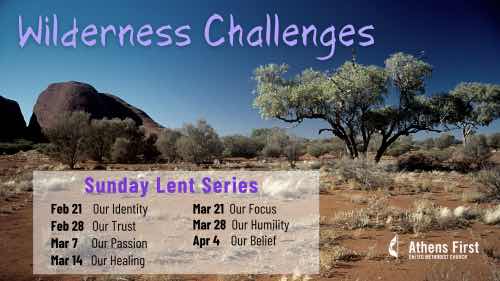

During this season of Lent, we have been spending time with Jesus in the wilderness and facing various challenges that can help us to have an even stronger faith. So far, we have faced the challenge of our identity, our trust, our passion and this week’s challenge is related to our focus.
Staying focused is not an thing easy thing to do in our day to day living. When was the last time you had a conversation with someone without somebody’s phone sending either a text message or some news alert? Our family loves to send group text messages so it’s not uncommon for me to receive 15 to 20 text messages in a span of less than ten minutes.
Usually, I like receiving these texts except when I’m trying to record a sermon or lead a bible study or set up for a golf shot. Ding-ding-ding-ding-ding-ding-ding-ding, duhding . These messages are sent at a furious pace.
Sometimes, I have to politely say to please remove me from the group text thread. Most of the time, these are fun to receive but they can also be very distracting when you’re trying to focus.
One of the reasons that we are invited to spend these forty days in the wilderness is so that we can give more focus to our faith and our relationship with God. Maybe this is why Jesus was sent into the wilderness to prepare for his ministry rather than to the hustle and bustle of the city of Jerusalem.
Cell phones are useless in the wilderness. And there’s no Netflix. But there’s lots of hiking. Lots of gazing at the stars. And a lot of time to… well to just think and pray.
Our Gospel reading today offers us a wonderful request that was made by some Greek speaking people who wanted to meet Jesus. They went to one of Jesus’ disciples and said, “Sir, we would see Jesus.”
This one short request has made it’s way into several pulpits. You’ll fine it engraved on a plate attached to the pulpit to remind the preacher who is about to speak that his or her main focus as a preacher should always be to help people meet Jesus. That’s it. That’s the purpose of preaching.
“Sir, we would see Jesus.”
I want to offer some important ways that can help us keep our focus on spending time with Jesus in a world that bombards us with of lots of ding-ding sounds.
How can we stay focused on Jesus?
Bishop Bruce Ough was the bishop of our West Ohio Conference prior to Bishop Palmer who is our current Bishop. When Bishop Ough first came to our conference, he encouraged the pastors and laity to actually schedule times to meet with Jesus. Yes, that’s right. Schedule times with Jesus.
He uses a plan that he encouraged us to use as well. He calls it the 1-1-1 Plan. It’s pretty simple. He schedules time with Jesus by spending one hour each day in prayer and scripture reading. He also spends one weekend a month with Jesus. And then he spends one week a year with Jesus.
This 1-1-1 Plan helps him to keep his focus on Jesus. It’s an intentional way of blocking out the distractions so that he can keep his focus on God.
My plan is a little different. I do spend each day and specifically each morning with Jesus through prayer and the reading of scripture.
I don’t schedule a weekend each month like Bishop Ough, but on a weekly basis, my Mondays are my sabbath day where I spend the day in prayer and preparing my sermon. Mondays are my “Jesus and me” days. You’ve heard of the best selling book from several years ago, “Tuesdays with Morrie?” Well, if I wrote a book, it would be “Mondays with Jesus.”
That’s why you don’t see me a lot on Mondays unless there is a particular event that falls on a Monday. I need all of Monday to develop a sermon. Mondays are what helps me to focus on how I have experienced the presence of God in my life because often it’s those holy moments that make it into my sermon.
I have been doing this same practice of Monday sermon work for years. When I can’t do it for some reason, I feel like I missed my appointment with Jesus.
It’s not the day of the week that’s important. The important thing is to find that day where you can be especially focused on your relationship with God. That’s the thinking behind having a weekly Sabbath. What day each week can you set aside to intentionally meet with Jesus and keep your focus on him? Maybe for you, it’s a Sunday or another day.
And the last part of the plan for me is to spend a week away each year with Jesus. I’ve been doing this for the past ten years although I missed it last summer due to COVID-19 traveling concerns.
A pastor friend of mine and I spend time at his summer lake house to reflect on sermons for the next year. We share in the Sacrament of Holy Communion, read scripture, pray, and do a lot of sermon planning. We also pick a fun place to visit within an hour radius which is usually a historic site. These day visits often lead to future sermon illustrations.
These are just a couple of different plans that can be used to help us schedule time with Jesus. You might think of a different variation of the plan that is more suited to your unique schedule and needs.
In describing the importance in having his 1-1-1 Plan, Bishop Ough tells the story of just after he was elected to be a Bishop. He and his wife Char were driving home to Cedar Rapids, Iowa where he was serving as pastor at the time, and during that long drive, Char said, “So, what are we going to do to keep you alive and to keep our marriage alive now that you will be a Bishop?”
And that’s when they thought of the idea of spending one weekend a month together as a couple. That has worked well for them all these years.
“Sir, we would see Jesus.”
In the Anglican and Episcopal denominations, they have a wonderful appointment system with Jesus called, “The Liturgy of the Hours.” It’s based on Psalm 119 where the Psalmist says, “Seven times a day I praise you.”
The Liturgy of the Hours offers specific hours during the day and night to pause and spend time with Jesus. These include 6 am, 9 am, noon, 3 pm, 6 pm, 9 pm, and midnight. Our own United Methodist Hymnal offers two brief services that can be used in a group setting or individually for the morning and another one in the evening.
One of my favorite prayers is a prayer that was written for the morning service. Here it is:
“New every morning is your love, great God of light, and all day long you are working for good in the world. Stir up I us desire to to serve you, to live peacefully with our neighbors, and to devote each day to your Son, our Savior, Jesus Christ the Lord. Amen.”
For the evening Vespers service, this prayer is often used.
“O gracious Light, pure brightness of the everliving Father in heaven, O Jesus Christ, holy and blessed! Now as we come to the setting of the sun, and our eyes behold the vesper light, we sing your praises, O God: Father, Son and Holy Spirit.You are worthy at all times to be praised by happy voices, O Son of God, O Giver of life, and to be glorified through all the worlds. Amen.”
The idea is that we have a scheduled time to be with Jesus each day and these daily services and prayers can help us do just that. These times also help to remind us that other people around the world are praying these common prayers as well.
Now, this might not be practical to use a scheduled time like this each day, but what’s important is that we find a way where we intentionally spend time with Jesus.
In what ways can we join those Greek speaking people from our Gospel reading today who said, “Sir, we would see Jesus.”
During my first pastoral appointment, I served as an associate pastor at a large church up in northwest Ohio. I had the privilege of serving with a Senior Pastor who was an incredible role model for me in how he provided loving and caring pastoral leadership in the church. I wish more new pastors who are just beginning the ministry could work with seasoned pastors like I was able to have early in my pastoral ministry.
Probably the most memorable thing that he would say to me again and again and again was, “Robert, just stay focused on Jesus.” “Just stay focused on Jesus.” He told me this so many times that I can hear him telling me this now. “Robert, stay focused on Jesus.”
Even after he retired back in the 1990s, we would meet once a month for breakfast or lunch. And he would remind me again, “Robert, just stay focused on Jesus.” Even when I moved here to be pastor, he called me on the phone and before the call ended he said, “Robert, just stay focused on Jesus.”
Later that same year, I received the news that he passed away. I was thinking of him as I was working on this sermon because his birthday anniversary was just a couple of weeks ago. I realized that it’s now been five years that I haven’t heard his voice, but I will never forget those words he would say to me. “Robert, just stay focused on Jesus.”
Our wilderness challenge this week is to find ways to stay focused in our faith. And may this challenge lead us to say, “Sir, we would see Jesus.”
Wilderness Challenges - Our Focus